
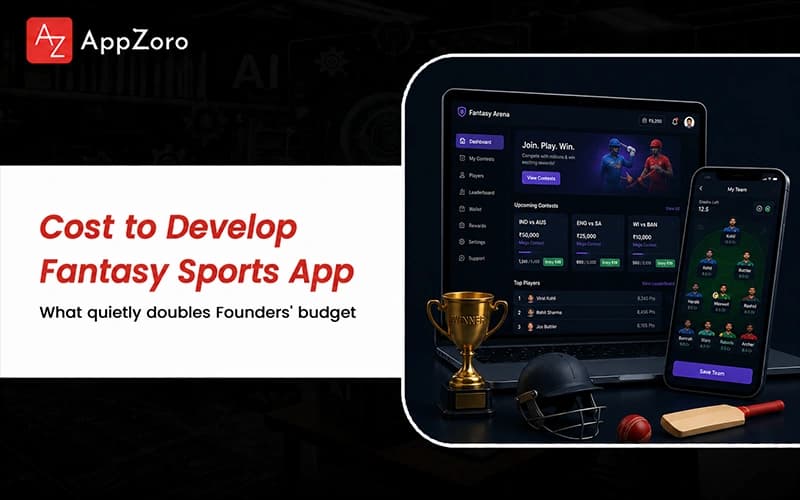
Quick Answer: The cost to develop fantasy sports app projects in 2026 typically runs from around $40,000 for a single-sport MVP to well past $300,000. To manage these expenses while ensuring a high-quality launch, most founders partner with a specialized mobile app development company USA that understands the real drivers like live data feeds, KYC compliance, and real-money play. Most founders also miss that the true first-year cost lands 40 to 60 percent above the original build quote once maintenance is counted.
A founder once showed me a tidy $45,000 quote for a fantasy cricket app and asked why anyone would pay much more. The honest answer was uncomfortable, because the live data feed alone would cost more than the entire build in his first year. This gap between the initial quote and the final reality is why a comprehensive mobile app development cost breakdown is so critical for first-time founders who need to understand the true financial commitment required for success.
Fantasy sports looks simple from the outside, just pick a team, watch the scores and win money, however the engine underneath is anything but. It blends real-time data, real money and brutal traffic spikes into one product and each of those three quietly carries a price tag most quotes leave out.
So where does the money go in the cost to develop fantasy sports app projects and why is that first quote almost never real? Well, the spend hides in a few specific places that only show up once you start building, so following a standardized mobile app development process is the best way to uncover these line items before the project gets underway. Let's break down the individual spend categories that determine the total investment for a production-grade fantasy platform.
What Really Drives the Cost to Develop Fantasy Sports App Projects
If you have searched for the cost to develop fantasy sports app projects and seen wildly different numbers, that spread is honestly fair. The price swings from forty thousand dollars to several hundred thousand because a handful of expensive ingredients are hidden beneath the surface and not every quote includes them.
A serious build has to pay for a few things long before launch day, resulting in costs that surprise almost every first-timer:
A live sports data feed from a provider like Sportradar or Stats Perform, running $1,000 to $10,000 a month, depending on sport and depth.
A real-money layer of wallets, payments, withdrawals and fraud checks, which has to be airtight because actual money flows through it every day.
Infrastructure that survives match-day spikes, since a platform that is fine on a Tuesday can collapse the moment a big game kicks off on Sunday.
The Sports Data Feed Is the Hidden Bill
The single biggest cost most founders never see coming is the live data feed, which can pass fifty thousand dollars a year before anyone signs up. This recurring expense underscores the importance of knowing how to choose the right sports app development company with existing partnerships or integration expertise to help navigate the pricing models of providers like Sportradar. That recurring fee is not a one-time build cost, so it keeps arriving every month.
Real-Money Play Multiplies Everything
The moment your app touches real money, the cost to develop fantasy sports app projects climbs sharply, because payments and withdrawals have to be airtight. On top of that sit KYC and geofencing requirements, which often demand rigorous mobile application security testing strategies to protect user wallets and ensure the platform survives a formal compliance audit without major findings. None of this is optional in a cash product, which is why a free app and a real-money app are almost different projects.
Fantasy Sports App Development Cost, Tier by Tier
So what does the fantasy sports app development cost look like once you put real numbers against it? Well, it helps to think in tiers, because a lean MVP and a Dream11-style platform are genuinely different animals with very different price tags. Here is roughly how those numbers tend to break down across the common build tiers in 2026:
Build Tier | Rough Cost | Timeline | What You Get |
Single-sport MVP | $40,000–$60,000 | 2–3 months | Core teams, scoring, leaderboard |
Full single-sport | $90,000–$150,000 | 4–6 months | Real money, payments, admin panel |
Multi-sport platform | $150,000–$300,000+ | 6–9 months | Many sports, deep data, scale |
Dream11-style build | $300,000+ | 9+ months | Full features, heavy compliance |
Those ranges cover the build itself however, they rarely include the data feed, the compliance work or the first year of running costs. When planning your budget, you must also factor in how long it takes to develop mobile apps at this level of complexity, as a 9-month timeline implies significantly higher burn rates for engineering and project management than a simple prototype. That is the line most quotes quietly skip and it is also the line that decides solvency.
Why the Cheapest Quote Usually Costs the Most
A forty-thousand-dollar quote can look like a bargain right up until the data feed, the compliance work and the scaling bills all arrive uninvited. The cheapest vendors win the deal by quietly leaving those lines out, then charge for each one later as a change request nobody ever budgeted for. Paying a little more upfront for a team that scopes the data and compliance honestly almost always works out cheaper across the first year.
What Changes the Cost to Develop a Fantasy Sports App the Most
Beyond the core build, a few specific choices swing the cost to develop a fantasy sports app more than anything else on the list. For founders specifically focused on how to develop an app and make money, the choice between entry-fee-based contests and subscription models will fundamentally shift the backend requirements for wallet management and transaction frequency. These are the factors that move the budget hardest once the basic feature list is settled.
These are the factors that move the budget hardest once the basic feature list is settled, resulting in big swings either way:
The launch region, since real-money compliance in the United States is handled state by state and that legal patchwork alone can add tens of thousands.
The number of sports, because every extra sport means another data feed, another set of rules and another slice of recurring monthly cost.
The platforms you ship on, as building for both iOS and Android costs more than one, though most fantasy audiences expect to find you on both.
Region and Compliance Quietly Set the Price
Where you launch changes the cost to develop a fantasy sports app more than almost any feature, because real-money gaming is regulated very differently around the world. The United States makes up roughly seventy percent of the market, yet its rules are decided state by state, which turns compliance into a slow and genuinely expensive exercise. Skipping that work to save money is how apps get pulled from stores, so it is rarely a corner worth cutting.
Scale Is a Cost You Pay Later
Fantasy traffic is not steady, it arrives in violent waves the moment a popular match begins and hundreds of thousands of users open the app at once. Building infrastructure that handles those spikes is expensive, but it allows you to capture the long-term mobile app development benefits of user trust and retention during the season's highest-traffic events. Teams that design for that match-day surge early avoid the far larger cost of rebuilding under fire after a very public failure.
How to Control the Cost to Develop Fantasy Sports Mobile App
So how do you keep the cost to develop fantasy sports mobile app projects sensible without shipping something that falls apart at scale? Well, the answer is rarely about cutting features and almost always about sequencing them so the expensive parts arrive only when they earn their place. A few disciplined choices keep the cost to develop a fantasy sport app under control without gutting the product, resulting in a build that can grow:
Launch a single-sport MVP first, prove that real users will play and pay and only then spend on more sports and deeper data.
Start with one strong region rather than chasing global compliance on day one, since each new market adds its own legal and licensing bill.
Treat the data feed as a deliberate decision, choosing the depth you truly need rather than the premium multi-sport package by reflex.
Start With an MVP That Can Scale Later
The smartest way to control the cost to develop a fantasy sport app is to launch lean but on foundations that will not need ripping out later. Many teams find that adopting agile methodology allows them to launch a single-sport MVP that proves demand without the risk of over-engineering features that users might not actually value. Building it on architecture that can grow means the next stage adds features rather than forcing a painful and expensive rebuild when you scale.
Budget for the True First-Year Number
The mistake that hurts most is treating the build quote as the whole cost, when the real first-year figure runs forty to sixty percent higher. Once you add the data feed, the compliance work, the cloud bills and the maintenance, the gap between the quote and the real cost to develop fantasy sports app projects becomes painfully clear. Founders who plan for that full number raise enough runway, while the rest stall months after a launch they cannot afford.
If you have a quote for a fantasy sports app on your desk and it feels too clean to be true, it is worth a second opinion on the data feed, the compliance and the real cost to develop fantasy sports app projects. Our senior team reviews these proposals most weeks and would far rather flag the missing lines now than after the budget runs out mid-season.
Final Thoughts
The cost to develop fantasy sports app projects in 2026 is no longer a mystery but it is also rarely the tidy number a first quote suggests. The build is only one slice, which is why learning how to choose a mobile app development company that is honest about data fees and compliance is what actually decides whether the app survives its first season. If a fantasy sports quote feels suspiciously low, ask someone who has shipped through a real season where the data gets expensive.
The founders who succeed are not the ones who simply found the cheapest vendor and the smallest invoice. They scoped the data and compliance honestly, launched lean in one region, planned for the real first-year number and built infrastructure that could survive a match-day surge.
If a fantasy sports quote feels suspiciously low, ask someone who has shipped one of these apps through a real season where the data and compliance get expensive. The right partner walks you through every hidden line without flinching, because they have already watched these budgets blow up before.
Leave a Comment