
Remember installing a calorie counter on the first of January, logging breakfast with full enthusiasm, and quietly giving up by Thursday because finding your grandma’s homemade pasta in the database was taking longer than eating it? You are definitely not alone in that, and the research is saying the same thing.A pooled analysis of two earlier weight-loss studies, reported by Live Science, tracked who was still logging at least half of their daily calories six months in, and smartphone users were holding on the best at roughly 62 percent of the time in the final week, while PDAs and paper diaries were falling well behind that. So adherence was slipping in each and every format, and the phone was simply slipping the slowest.Annoyances like these don’t just frustrate the users/customers; they also decide whether the product is living or dying, and this is where plenty of diet and nutrition app development projects are losing money, since the idea is sounding easy while the decisions underneath it, like food data, privacy and accuracy, really aren’t. If your product is leaning closer to training than food, AppZoro’s fitness app development guide is showing the wider build picture first.So what should the planning be covering before a single screen is getting designed? Well, a clear user, a small first release, food data you can defend, and an honest view of what the app can and cannot say about somebody’s health, so let’s take a look at each of those.
What Is Diet and Nutrition App Development?
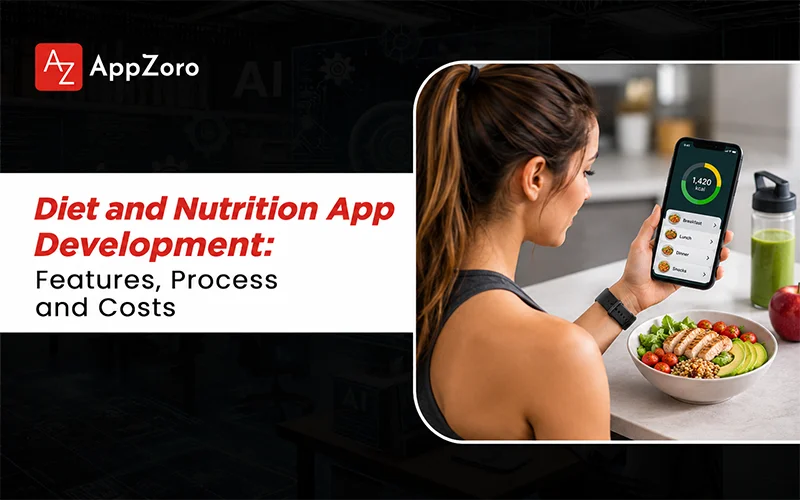
Put simply, it’s the work of building software that lets people record what they eat, see how it adds up against a goal, and get a nudge on what to eat next. A general fitness tracker is mostly reading sensors, whereas here food is the main data, so the product ends up managing food records, portion sizes and preferences that users type in themselves, and this one difference is changing almost every technical decision that follows. The people asking for these apps are a mixed group too, from startups and gyms to wellness brands and healthcare/wellness businesses, and a good number of them are placing meal logging inside a bigger product, which is where this guide to building a wellness app helps with the wider planning. But what should the app actually include? Let’s break it down.
Essential Features of a Diet and Nutrition App
At the heart of any diet tracker app development project sits a small loop, where someone logs a meal, sees the result and comes back tomorrow, and every other feature exists to keep that loop turning. This is how the main features line up against what people need, and the last column is where the quiet product decisions are hiding: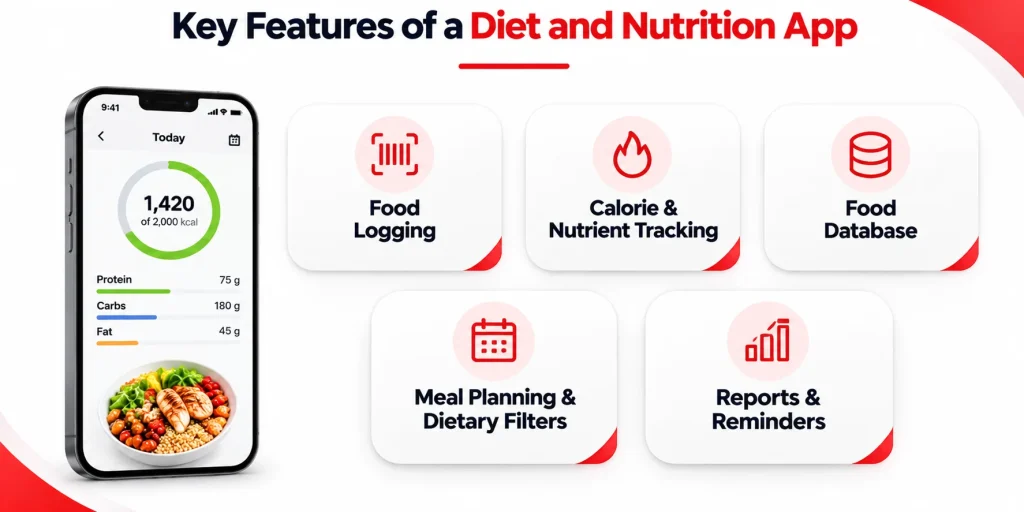
| Feature | User Need | Product Consideration |
| Food logging (search, barcode, manual) | Record a meal in a few taps | Entry speed decides whether people keep going |
| Calorie and nutrient tracking | See intake against a goal | Choose which nutrients to show and how to flag shaky values |
| Food database | Trust that numbers match the food | Public, licensed and user-added data differ in coverage, accuracy and cost |
| Meal planning and dietary filters | Know what to eat, and avoid what they can’t | Needs allergen filters, portion logic and recipe upkeep |
| Reports and reminders | Spot trends and stay consistent | Show trends, not only daily totals |
Wearable sync, AI photo logging and dietitian dashboards aren’t in that table on purpose. They’re optional, and each one brings integration, privacy and testing work that a first release rarely needs, which is why the core loop should be settled first.
How to Develop a Diet and Nutrition Tracking App
Diet and nutrition tracking app development tends to go smoothly when the stages follow the user’s problem and the food data, instead of a generic software checklist, and in practice that means:
- Defining who is logging and why, because a casual user, an athlete and a patient following a clinician’s plan need very different guardrails.
- Deciding where the food data comes from.
- Keeping the number of taps per meal as low as possible.
- Testing with real meals, including regional dishes, packaged items and foods the database simply doesn’t have.
- Setting up consent, privacy controls and a maintenance plan before launch, not after.
The second point deserves the most attention. USDA’s FoodData Central is a free place to start, and its API guide states that the data is public domain under CC0 1.0 and is reached with a free data.gov API key (USDA, accessed October 22, 2026). It’s a US source though, so teams serving other regions will need local composition data as well, and licensed databases may trade a recurring fee for wider coverage. With the data question sorted, let’s look at where AI fits in.
AI, Personalization, and Meal Planning: What Should You Build?
Plenty of founders/entrepreneurs want to begin with personalization, and the sensible first step is usually rules rather than AI, meaning preference filters, allergen exclusions, portion targets and recipes that a nutrition professional has already reviewed. That route is easier to test and explain, and it suits teams who type “create your own meal plan app” into a search bar because all they want is a planner that works without a long build.And that is not all, because AI features like photo logging can cut down typing but their accuracy has to be measured, not assumed. Research presented at NUTRITION 2026 and reported by Nutritional Outlook on July 30, 2026 tested four photo-based apps against 102 meals prepared in a metabolic kitchen and found calories and fat were consistently underestimated, with the headline putting the calorie shortfall at about a third. It’s an unreviewed conference abstract, so treat it as an early warning rather than a benchmark, but it’s still a solid reason to check AI output against reference data and to have a qualified professional review anything medically sensitive. This also explains why a law-firm summary of FDA’s 2026 general wellness guidance matters, since it notes that products referencing diseases or prompting clinical action may fall outside the low-risk policy. For personalized plans inside a wider wellness product, AppZoro’s wellness app development services page shows how it describes that work.
What Affects the Cost of a Nutrition App?
There isn’t one verified price for a nutrition app, so the table below lists general cost drivers and no cited figures. AppZoro’s fitness app development cost breakdown is a useful look at how platforms, integrations, team structure and maintenance shape a budget, but it covers fitness products, so nutrition costs can differ once food database licensing and nutrition-specific testing come into the picture.
| Cost Factor | What Affects It | Budget Consideration |
| Scope | Logging only, or meal plans, recipes and coach tools | Fix a first-release scope before asking for quotes |
| Platforms | iOS, Android, web, native or cross-platform | One platform first can limit early spend |
| Food data | Public data, licensed databases, barcode lookup | Licensing and API fees may recur |
| Integrations | Apple Health, Health Connect, wearables | Each needs building, testing and upkeep |
| Security and testing | Consent flows, encryption, accuracy checks | Plan from day one, since retrofitting typically costs more |
| Maintenance | OS and database updates, new features | Budget for ongoing work after launch |
Diet and nutrition tracking mobile app development is also much easier to price when the first release sticks to one platform and the logging loop, because each and every extra integration or data source brings its own build, testing and upkeep. And speaking of integrations, let’s see what they can and can’t do.
Integrations, Privacy, and Data Accuracy
Connecting an app to Apple Health, Health Connect or a fitness wearable can add activity context and save some manual entry, which is why so many teams put it on the roadmap early, and the practical limits like battery life and phone-to-watch sync are covered in AppZoro’s wearable app development guide. The accuracy side matters more for nutrition, though, and a 2017 study from Stanford published in the Journal of Personalized Medicine (May 24, 2017) is a good reminder of why. It tested seven wrist-worn devices and found that none of them estimated energy expenditure with an error below 20 percent, so wearable data should add context to an app and never set calorie targets on its own, even if newer devices have improved.Food data has its own limits too. A 2020 validation study in the Journal of Medical Internet Research (October 21, 2020) compared MyFitnessPal’s database with Belgium’s Nubel database and found it accurate for energy, macronutrients, sugar and fiber but not for cholesterol and sodium. That’s one app in one country, so it isn’t the final word, but it’s a fair hint that some nutrients deserve a softer display than others, for example a range or an “estimated” label instead of a precise-looking number.Privacy needs the same honesty. The FTC’s updated Health Breach Notification Rule took effect on July 29, 2024, and law-firm summaries of it say it reaches many health apps outside HIPAA, including tools that track diet. What applies depends on where the app operates and who it serves, so consent flows, data minimization and legal review belong in the plan from the start, and none of this is a compliance guarantee. The full sources for each study and rule mentioned here are listed at the end of the article.
How to Choose the Right Features for Your Nutrition App
Start with one measurable problem, like logging a meal in under a minute or sticking to a weekly plan, and build only what supports it. Expectations should stay realistic too, since a 2022 systematic review and meta-analysis in JMIR found smartphone weight-loss apps effective between 3 and 12 months but with minimal effects in their current state. It covers adults with overweight or obesity, so it isn’t the last word for every nutrition product, yet it’s a good reason to track outcomes like completed logs per week or plan adherence, and to add features only when those numbers are moving. Teams whose nutrition feature lives inside a training product will find broader planning in the fitness app development guide.
Conclusion
So when it all comes together, diet and nutrition app development is really about a handful of decisions made in the right order, namely who the app is for, which food data gets trusted, how small a first release can be while still being useful, and how carefully health data and AI suggestions are being handled, and these choices are extremely crucial because they shape both cost and trust. If a nutrition feature is part of a gym, coaching or fitness product you’re planning, AppZoro’s fitness app development services page lists nutrition and diet apps among the products its team builds, and it’s a reasonable place to start the conversation.
Frequently Asked Questions
How is diet nutrition app development different from fitness app development?
Food data and user-entered records sit at the center of a nutrition product, while fitness products lean more on sensors and workouts, so databases and dietary filters carry much more weight.
How much does it cost to develop a diet and nutrition app?
There isn't a single verified figure, because cost follows scope, platforms, food data licensing, integrations, security and maintenance, so define a first-release scope and ask for written assumptions.
How do you build a diet and nutrition app with meal planning?
Begin with logging and dietary filters, add rules-based planning from reviewed recipes, have a qualified professional check the outputs, and bring in AI suggestions only once accuracy can be measured.
Can a nutrition app integrate with fitness trackers or wearables?
Yes, through Apple Health and Health Connect, though wearable energy estimates can be imprecise, so they work better as context than as a basis for calorie targets.
 Profile of Sam Agarwal