
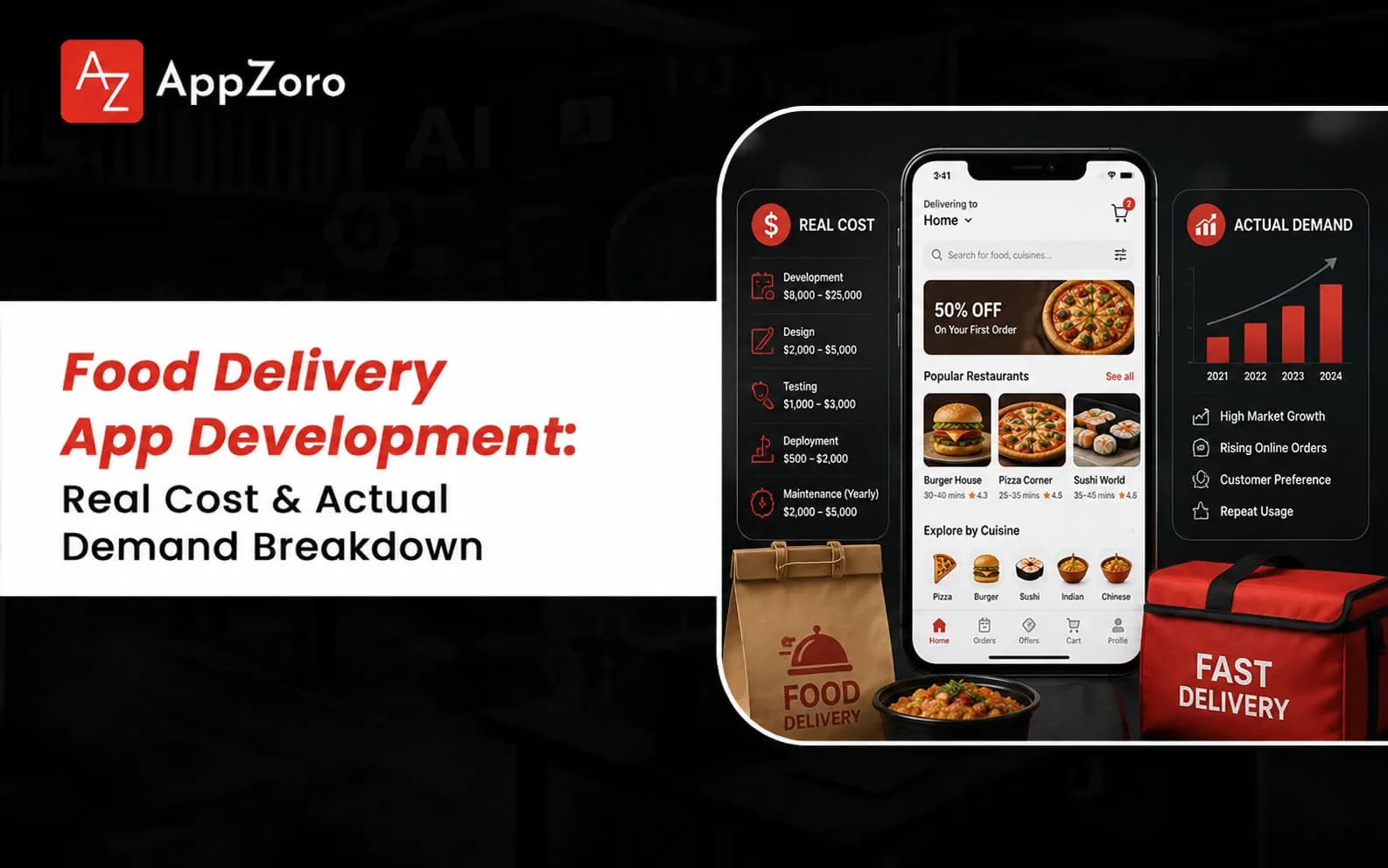
Quick Answer: Food delivery app development is the work of building mobile apps that let customers order food from restaurants and receive delivery through a coordinated platform of customer app, rider app, restaurant app, and admin dashboard. To succeed in this competitive space, most regional chains partner with a mobile app development company in the USA to ensure serious builds in 2026 combine real-time order tracking, dispatch routing, restaurant POS integration, and the payment and refund flows that survive heavy operational volume gracefully. Realistic project cost lands between $45,000 for a regional MVP and over $350,000 for a polished on-demand product.
Why do most regional restaurant chains that launched food delivery apps between 2020 and 2023 quietly shut them down within twenty-four months, while a handful of small operators in the same markets keep outcompeting the national platforms across their territory? The answer has almost nothing to do with the app itself and almost everything to do with how the operations layer was architected long before the first sprint of development started.
This is the uncomfortable truth sitting underneath every serious food delivery app development conversation in 2026, and it costs real money during procurement when nobody names it out loud. Before signing a contract, it is vital to consult a custom mobile app development guide because that single shift moves the conversation away from app features and into dispatch routing, POS integration depth, and the restaurant retention discipline that genuinely separates the winners from the abandoned launches. What follows is the version of this conversation an experienced builder would have with a restaurant chain CEO over coffee.
By the end you will know what actually decides platform survival across the first dinner rush, what realistic builds cost, and where this category quietly breaks for teams underestimating its operational depth.
What Food Delivery App Development Actually Looks Like in 2026
The conversation has matured well past the DoorDash-clone era into a more operational discussion about restaurant ops, dispatch economics, and unit margins that defend across the first year. Following a modern mobile app development process is now the baseline, as the category went through a brutal correction between 2022 and 2024 when most cash-burning growth plays collapsed, and what survived is a more disciplined version of the original playbook.
Here is what serious food delivery app development involves now:
A customer app handling restaurant browsing, menu rendering, real-time order tracking, and the payment flow that survives heavy refund volume
A rider app handling order acceptance, restaurant pickup, navigation, customer handoff, and the earnings tracking riders genuinely care about across their shift
A restaurant app handling order receipt, prep status, packing confirmation, and the POS integration that protects kitchen workflow during peak hours
An admin dashboard handling dispatch logic, restaurant onboarding, payment reconciliation, refund processing, and the merchant analytics regional chains actually need
Why the DoorDash-Clone Era Quietly Ended
The DoorDash-clone era ended quietly because the operational complexity it papered over caught up with most copy-paste builds within twelve months of launching to real paying customers. Teams shipping serious food delivery mobile app development today take dispatch routing, restaurant integration, and refund flows seriously from week one rather than bolting them on later.
What Restaurant Integration Actually Demands
Restaurant integration demands far more from the build than founders expect during initial discovery conversations with vendor teams pitching pre-built templates. Selecting the right tech stack for mobile app development is critical here, as POS integration with Toast, Square, and Clover, plus real-time order injection and modifier mapping, all take serious engineering effort across hundreds of restaurants.
The Operational Discipline Real Chains Quietly Want
The operational discipline real regional restaurant chains quietly want is the same discipline they bring to kitchen operations across decades of managing tight prep timelines. Apps respecting that operational world get adopted enthusiastically by store managers, while apps treating restaurants like rideshare drivers get quietly abandoned during the very first painful dinner rush.
How to Develop a Food Delivery App That Customers Actually Reorder From
If you are searching for how to develop a food delivery app that genuinely wins repeat customers, the honest answer is that architecture decisions made in week one matter more than almost any feature you ship later. To ensure a high-performance build, you must evaluate various mobile app development frameworks because the customer reorders when the platform delivers hot food in the right window, and that depends on operational plumbing nobody sees from outside.
The strongest teams I have watched develop food delivery app products treat the category as fundamentally an operations product wearing an app interface, rather than an app product with operations bolted on afterward. Here is what matters when you set out to develop a food delivery app from scratch:
Dispatch routing that balances rider proximity, prep time, and customer wait expectations without breaking down at peak Friday night order volume
Restaurant POS integration that injects orders cleanly into the kitchen workflow without forcing staff to manage a second device on the line
Real-time order tracking that gives the customer honest expectations across prep, pickup, and delivery phases without overpromising arrival time
Why Discovery Is the Cheapest Investment You Make
Discovery is the cheapest investment you will make across the entire build because two weeks of real category research routinely save four months of painful rework later. By identifying the long-term mobile app development benefits early, you can spend time honestly with real restaurant managers and delivery riders rather than relying on assumptions borrowed from generic rideshare playbooks.
The Four-App Structure Most Founders Underestimate
The four-app structure most founders underestimate during initial scoping is what separates serious food delivery platforms from rough MVPs that quietly fail under operational pressure within months. Customer app, rider app, restaurant app, and admin dashboard all need to coordinate cleanly through a shared backend, and the integration engineering is substantial.
Why Dispatch Logic Quietly Decides Everything
Dispatch logic quietly decides everything because every poorly routed order is either a cold meal arriving late or a rider sitting idle waiting on prep that should have been timed better. Teams who tune their dispatch algorithm ruthlessly across the first six months operate with meaningfully better margins than teams treating dispatch as something to fix later.
The Food Delivery App Development Process from Discovery to Launch
The food delivery app development process follows a structure that looks similar to other on-demand builds on the surface, but with specific phases that decide whether your platform actually survives the first dinner rush after launch arrives.
Skipping or compressing any phase tends to save weeks during the build and cost months of painful rework across the first year afterward.
A serious project runs through six defined phases across five to nine months total, depending on the scope and complexity of the restaurant integration surface area:
Discovery and category research runs three to five weeks covering competitor analysis, restaurant partnerships, dispatch requirements, and the unit economics that need to defend
Core development runs sixteen to twenty-eight weeks producing the customer app, rider app, restaurant app, and admin dashboard alongside the backend coordinating every order
POS and payment integration runs four to six weeks handling Toast, Square, Stripe, mapping services, and the menu feeds from real restaurant systems
QA, pilot rollout, and citywide launch run six to ten weeks covering real-device testing, one-neighborhood pilots, and methodical expansion catching operational edge cases
Why the Discovery Phase Rewards Discipline
The discovery phase rewards discipline because the platforms that win market share are the ones that respected each phase rather than rushing past discovery into the build. Teams investing real time in restaurant interviews and dispatch modeling ship platforms that survive the first peak season, while teams shortcutting that work burn cash during their first painful Friday rush.
The POS Integration Phase Most Teams Forget
The POS integration phase most teams forget covers the messy reality of injecting orders into Toast, Square, and Clover without forcing kitchen staff to babysit a second device on the prep line. During this stage, it is essential to implement mobile application security testing strategies to protect customer payment data and merchant credentials before moving into a pilot rollout in a live environment.
Why Pilot Rollout Quietly Decides Everything
Pilot rollout quietly decides everything because real restaurants, real delivery riders, and real customers behave in ways no QA team can predict from inside the engineering office. Running a focused four-week pilot in one neighborhood before launching citywide catches the operational edge cases that would otherwise cost months of painful trust rebuilding afterward.
Food Delivery App Development Cost: Real Numbers and Hidden Realities
Most founders ask about food delivery app development cost as if there is one clean number that applies across every project shape inside the category. The realistic answer depends heavily on complexity, making a mobile app development cost breakdown essential to distinguish between a regional MVP for one city and a polished on-demand product with serious POS integration carried inside the platform from the start.
The build cost is roughly thirty to forty percent of the real three-year spend across most projects that survive past their first operating year. The rest shows up as cloud infrastructure, mapping API fees, SMS costs, payment processor fees, and the restaurant onboarding tooling chains quietly demand as they grow.
Here is how realistic food delivery app development cost breaks down for serious builds in 2026:
A regional MVP covering customer app, rider app, and basic admin runs between $45,000 and $90,000 with limited restaurant integration and one payment processor
A full platform with all four apps, POS integration, and serious operations depth lands between $100,000 and $200,000 depending on scope
A premium on-demand food delivery app development build with dispatch tuning, POS depth, and restaurant tools lands between $200,000 and $350,000
Why Regional MVPs Cost Less Than National Builds
Regional MVPs cost less than national builds primarily because operational complexity scales sharply once you cross into multi-city operations. Starting in one city and using hybrid app development to reach both iOS and Android users from a shared codebase is meaningfully cheaper than building for national scale from day one.
Hidden Costs That Trip Up First-Time Food Delivery Builds
The hidden costs that trip up first-time food delivery builds tend to be mapping API fees at real volume, SMS costs across order updates, and the POS integration engineering nobody scoped honestly during the initial proposal. Budget realistically for these upfront rather than discovering them during your first month operating at real volume.
Year-One Maintenance Reality Senior Teams Plan For
Year one of maintenance covers bug fixes, dispatch algorithm tuning, restaurant onboarding work, payment reconciliation, and the merchant tooling regional chains quietly demand as the platform matures. Budget honestly for this from kickoff, or pay double during the year when operational learnings are most valuable.
On-Demand Versus Scheduled: What Actually Wins for Food Delivery
The on demand food delivery app development conversation often skips past whether on-demand is even the right model for the specific chain and region the platform serves. National platforms have trained customers to expect thirty-minute food delivery, but the unit economics behind that expectation only defend in dense urban markets with serious order density per square kilometre.
Most regional chains genuinely win with a hybrid model that offers scheduled pre-order alongside on-demand pickup, with each tier carrying its own pricing logic designed around operational cost:
On-demand food delivery app development wins in dense urban markets where order density supports rider utilization and customer expectations have shifted firmly toward speed
Scheduled pre-order wins for office lunch programs, family dinner planning, and weekend gatherings where customers happily pick a delivery window for better pricing
A hybrid model wins for most regional chains because it captures both customer segments without forcing operational compromises that hurt margins across the wider business
When On-Demand Genuinely Defends Its Costs
On-demand genuinely defends its costs in dense urban markets where order volume per restaurant partner supports the rider utilization needed to make unit economics work. Outside those conditions, on-demand quietly burns cash that scheduled delivery would have captured at meaningfully better margins.
Why Scheduled Pre-Order Quietly Wins in Office and Family Segments
Scheduled pre-order quietly wins in office and family segments because customers planning lunch deliveries or weekend dinners prefer locking in a window in advance and paying less for the convenience. The operational simplicity also lets regional chains run the platform with smaller dispatch teams and less complex routing engineering.
The Hybrid Model Serious Chains Increasingly Adopt
The hybrid model captures both customer segments by offering scheduled pre-order alongside on demand food delivery app development features at a premium tier customers willingly pay for. That positioning quietly protects margins while still defending market share against national platforms competing on raw convenience signals.
Custom Food Delivery App Development Versus White-Label: The Real Trade-Off
Most regional chains evaluating food delivery genuinely consider white-label platforms first because the lower upfront cost feels attractive. The realistic trade-off shows up in the operational ceiling, which is why you must choose the right mobile app development company that can build a custom solution giving you complete control over dispatch logic and restaurant integration depth.
Custom food delivery app development costs more upfront but gives you control over dispatch logic, restaurant integration depth, and the customer experience that drives reorder rates:
Custom builds give you complete control over dispatch, branding, and restaurant integration depth, which compounds quietly across years of operation in market
White-label saves thirty to fifty percent upfront but caps your operational sophistication and forces you to share customer data with the platform vendor
How to develop food delivery app products that defend market share long term increasingly means going custom because the operations layer is where this category gets won
Why Custom Wins Long Term for Regional Chains
Custom wins long term because the platform becomes a competitive asset rather than a commodity service shared with every other chain on the same vendor stack. Owning your dispatch tuning, your restaurant relationships, and your customer data outright is exactly what protects your margins against the national platforms.
Where White-Label Genuinely Still Makes Sense
White-label genuinely still makes sense for single-restaurant operators and very small regional chains where the operational sophistication of a custom build would simply not pay back across realistic order volumes. Knowing honestly which side of that threshold your business sits on is the most useful framing before signing any vendor contract.
The Hidden Cost of Starting White-Label and Migrating Later
The hidden cost of starting white-label and migrating to custom later tends to surface around the eighteen-month mark, when chains realise the operational ceiling and decide to rebuild. The migration work is genuinely substantial because the customer data, the restaurant relationships, and the operational learnings rarely transfer cleanly across to a new platform.
What Senior Teams Get Right About Online Food Delivery App Development
The strongest teams I have watched ship online food delivery app development share a small set of disciplines that compound quietly. They are winning because they successfully navigate common mobile app development challenges, treating the food delivery operations layer as the actual product being built, with the app serving as the visible interface to operations doing all the work underneath.
They are winning because they treat the food delivery operations layer as the actual product being built, with the customer-facing app serving as the visible interface to operations doing all the real work underneath:
They invest seriously in dispatch and POS integration during discovery because those decisions ripple across reorder rates and restaurant satisfaction for years
They protect dispatch algorithm performance ruthlessly because slow routing translates directly into cold food, frustrated customers, and unit economics that quietly break
They embrace pilot rollouts before going citywide because real operational learning only happens with real restaurants, real riders, and real customers placing real orders
Why Operations Workflows Earn the Investment
Operations workflows earn the investment because they decide whether the customer who placed their first order ever reorders or quietly switches to a competitor inside the same operating week. Get the dispatch logic, restaurant integration, and refund flow right, and you build a platform regional customers genuinely love using week after week.
How Restaurant Tooling Decides Long-Term Defensibility
Restaurant tooling decides long-term defensibility because the chains and independent restaurants on your platform are the operational supply your customers depend on every order. Teams treating restaurants as partners with real operational tooling retain them meaningfully better than teams treating them as commodity supply waiting to churn.
Why Pilot Rollouts Save Months of Painful Rework
Pilot rollouts save months of painful rework because operational edge cases that surface in real restaurants with real riders simply do not show up inside simulated QA runs. Running a focused four-week pilot in one neighborhood catches the issues you would otherwise discover painfully across a botched citywide launch.
If you have a vendor proposal sitting on your desk and want a second opinion on whether the dispatch architecture and POS integration is actually scoped honestly, our senior team can help you hire the best mobile app developer for your specific needs. We review these proposals for restaurant chains almost every week and are happy to flag anything quietly underscoped before you commit.
Final Thoughts
Food delivery app development in 2026 is a more disciplined category than it was three years ago, and the playbook for shipping something that defends real market share is more legible today. The teams who win treat food delivery operations as the actual product, scope dispatch and POS integration honestly into the build, and embrace pilot rollouts before pretending the platform is ready for citywide scale.
If the proposals on your desk feel impossible to compare honestly, get a third opinion from someone who has actually shipped food delivery products to regional chains at scale. The right partner walks you through the operations architecture without flinching, because they have lived inside the build cycle.
Leave a Comment