
A few years ago, the biggest question in health system boardrooms was simple: what can AI actually do for us? That question has quietly changed. Nobody is debating capability anymore. The conversation now is about consequence. Does it hold up under clinical scrutiny? Can it survive a regulatory review? Does the ROI justify the disruption?
Margin pressure is real. Hospitals are running on thin margins with labor costs up and reimbursement flat. AI investments must show measurable financial returns, not just improved satisfaction scores. Faster revenue cycle, fewer denials, reduced documentation burden — these need to show up in the CFO's quarterly review.
Regulatory scrutiny is sharpening. The FDA, ONC, and CMS have all been tightening guidance on clinical AI. Organizations that deployed tools without thinking about software-as-a-medical-device classification are scrambling to get compliant. The ones winning now built compliance into vendor selection from the start.
Physician trust is fragile. Clinicians have been burned before by tools that promised time savings and delivered checkbox fatigue instead. Generative AI in healthcare industry has to earn trust through consistent, accurate, genuinely useful performance. Marketing claims don't close that gap. Outcomes do.
Generative AI in Healthcare — A Practical Definition
Generative AI refers to systems designed to produce original content rather than simply classify or predict. In healthcare, that means AI that writes a clinical note, drafts a prior authorization letter, synthesizes patient history across fragmented records, or generates care plan recommendations. It produces something new. That is the core distinction from traditional AI.
Traditional healthcare AI has mostly been about pattern recognition. It flags sepsis risk. It identifies a suspicious nodule. It predicts readmission probability. Generative AI adds a layer of composition. It doesn't just flag, it explains. It doesn't just identify, it documents. For clinical workflows buried under administrative burden, that difference is significant.
The real power isn't that it thinks for clinicians. It's that it handles the cognitive overhead that was never clinical thinking to begin with.
Predictive AI vs Generative AI
These two categories get conflated constantly, and that confusion leads to poor vendor decisions.
Predictive AI Technologies in Healthcare takes historical data and produces a forecast. A readmission risk score. A deterioration alert. A probability of complication within 72 hours. The output is a number or a flag. The clinical team decides what to do with it.
Generative AI takes contextual input and produces content. A clinical note. A patient-facing diagnosis explanation. A structured summary of unstructured records. A suggested payer denial response. The output is language or structured data that a human reviews and acts on.
Both matter. They often work best together. But they require completely different validation approaches and different change management strategies. Treating them as interchangeable in vendor conversations is one of the most common and costly mistakes health system IT teams make.
Assistive vs Autonomous Systems
Most generative AI in healthcare today is assistive, not autonomous. The ambient scribe drafts the note. The physician reviews and signs it. The system suggests a prior authorization response. The billing specialist reviews and submits. AI does the drafting, the composition, the first pass. The human remains accountable for consequential decisions.
Fully autonomous clinical systems are rare and will remain rare. The liability structures, the regulatory environment, and the professional culture of medicine are all built around human accountability. That is not a limitation of generative AI. It is the appropriate design for a high-stakes domain.
Real Workflow Examples
The clearest way to understand generative AI use cases in healthcare is to follow it through actual workflows.
A primary care physician sees 22 patients in a day. With ambient AI active during each visit, the conversation is transcribed and structured into a complete draft note by the time the patient is leaving. The physician reviews, makes two minor edits, and signs. She finishes documentation before 6pm for the first time in two years.
These are not hypothetical. Each scenario is already running in production.
Core Capabilities Powering Modern Healthcare AI
Understanding the architecture behind generative AI in healthcare industry matters more than most people acknowledge. The difference between a system that performs in a demo and one that holds up in live clinical environments almost always comes down to design choices made under the hood.
Large Language Models for Clinical Documentation
Large language models are the engine behind most text-based healthcare AI applications. In healthcare, they translate into systems that can process clinical documentation, EHR data, and payer communications at a fluency that feels natural to clinicians.
Early LLMs deployed in clinical settings were impressive until they weren't. They would hallucinate medication names, invent diagnostic criteria, and miss nuanced clinical language in ways that ranged from embarrassing to potentially dangerous. Newer domain-adapted models, trained specifically on medical literature and clinical notes, perform substantially better. But even the best available models require human review at any point where documentation accuracy has direct patient safety implications.
In practice, LLMs are delivering consistent value in three areas: real-time transcription and structuring of clinical encounters, automated generation of discharge summaries, and structured data extraction from unstructured notes. That last one is quietly one of the highest-value applications in the market right now, because it unlocks clinical data that has been sitting inaccessible in free-text fields for decades.
Multimodal AI: Imaging, EHR, and Genomics Together
One of the more significant developments in how generative AI in healthcare industry is the emergence of genuinely multimodal systems. Earlier tools were siloed by design. An imaging AI worked on images. An NLP tool worked on notes. Combining their outputs required manual effort.
Modern multimodal architectures can ingest and reason across multiple data types simultaneously. A system supporting oncology treatment planning might process radiology imaging, pathology report text, structured EHR data, and genomic sequencing results together, producing a synthesis no single-modality tool could generate.
This is still more common in research settings and academic medical centers than in community health systems. But organizations making long-term infrastructure investments should be asking vendors directly how their platforms handle multimodal data integration. The answer tells you a lot about where their roadmap actually goes.
Retrieval-Augmented Generation for Evidence-Based Outputs
RAG has become one of the most important architectural patterns in clinical AI. Rather than relying solely on what a model learned during training, a RAG system retrieves relevant documents from a curated knowledge base at the moment it generates a response and uses that context to shape its output.
In healthcare this matters enormously. Clinical guidelines update. Drug approvals happen. New evidence changes standards of care. A model trained six months ago may already be working from outdated knowledge. RAG keeps the system current by pulling from live sources, whether updated formularies, current clinical protocols, or health system-specific policies, without requiring a full model retrain.
Health systems using RAG-based clinical decision support are seeing outputs that are more accurate, more traceable, and more consistent with institutional standards than those relying on general-purpose models alone. The auditability matters from a compliance perspective too. When a system can show exactly which documents it retrieved to support a recommendation, that is a much easier story to tell in a regulatory review.
Agentic Workflows and Orchestration
This is where healthcare AI is heading next. Agentic systems don't just respond to a single prompt. They execute multi-step workflows autonomously, using tools and data sources in sequence to accomplish a defined goal.
In a prior authorization context, an agentic system reads the clinical note, retrieves the applicable payer policy, checks formulary status, identifies supporting diagnostic codes, drafts the clinical justification, and flags high-risk cases for human review. All of this happens in sequence, automatically, in under two minutes.
This requires what is called an orchestration layer, infrastructure that coordinates multiple model calls, manages process state, handles errors, and enforces human review checkpoints at the right moments. The best healthcare AI Predictive Analytics today have this architecture at their foundation, even when it isn't visible in the demo. Asking vendors how they handle agentic workflows and what guardrails maintain human oversight is one of the most important questions you can ask in 2026.
Fine-Tuning vs Domain Adaptation in Regulated Environments
When a vendor says their model is trained on clinical data, it is worth pressing on what that actually means.
Fine-tuning involves additional training that modifies the model's underlying weights. Done well, it produces strong performance on narrow tasks like specialty-specific note generation or ICD-10 coding. The tradeoff is that fine-tuned models are expensive to update, and modifying weights in a clinical decision support context may trigger FDA software-as-a-medical-device review requirements.
Domain adaptation through RAG keeps the base model unchanged and improves outputs by ensuring access to current, curated knowledge at inference time. It is faster to update, easier to audit, and better suited to environments where clinical knowledge changes frequently.
Where Generative AI Is Actually Delivering Value in 2026
There is a lot of noise about what generative AI in the healthcare industry could eventually do. What matters more right now is where it is actually working today, in live production environments, with measurable outcomes. The honest answer is that value is concentrating in a few specific areas, and health systems that focus their investments there are seeing the clearest returns.
Clinical Workflow Automation
Documentation is where the pain is most acute, and it is where generative AI is delivering the most immediate, tangible relief.
Physicians in the United States spend an average of two hours on administrative tasks for every one hour of direct patient care. A significant portion of that is documentation. EHR entry. Charting. Note generation. Work that requires clinical knowledge to do correctly but does not require clinical judgment in the way that diagnosis or treatment planning does. That distinction matters because it is exactly the kind of work generative AI is built to absorb.
Ambient AI scribes are the most visible application right now. A clinician conducts a patient visit normally, speaking naturally, and the AI listens, transcribes, and structures the conversation into a complete clinical note in real time. By the end of the appointment, a draft SOAP note is ready for physician review. The clinician reads it, makes minor edits if needed, and signs. No dictation. No after-hours catch-up charting. No opening the EHR during the visit at the expense of eye contact with the patient.
Patient Experience and Personalization
One of the more underappreciated applications of generative AI in the healthcare industry is what it does for the patient-facing side of care delivery.
AI-driven triage and care navigation tools are changing what happens before a patient ever sees a clinician. Intelligent intake systems can gather symptom history, ask contextually relevant follow-up questions, assess urgency, and route patients to the appropriate care setting, whether that is an in-person appointment, a virtual visit, or a self-care protocol. This reduces unnecessary ED visits, shortens wait times, and gets patients to the right level of care faster.
On the engagement side, generative AI is enabling health coaching and chronic disease monitoring at a scale that was never previously possible.
Administrative and Revenue Cycle Transformation
Administrative costs account for roughly 25 percent of total hospital spending in the United States. A significant portion of that is driven by labor-intensive processes that are highly repetitive and rule-based, which makes them exactly the kind of work generative AI handles well.
Prior authorization is the most frequently cited example, and for good reason. The current process is expensive, slow, and frustrating for everyone involved. Physicians spend time they do not have gathering clinical documentation. Administrative staff spend hours on the phone with payers. Patients wait days for approvals on treatments their physician has already decided they need. Health systems using generative AI to automate PA workflows are seeing turnaround times drop from several days to under an hour in many cases, with denial rates declining as AI-generated clinical narratives are more complete and better aligned with payer criteria than manually produced documentation.
Clinical Decision Intelligence
This is where the conversation gets more nuanced, and where it is important to be precise about what generative AI is actually doing versus what it is not.
Generative AI, particularly systems built on RAG architectures, can synthesize that information and surface the most relevant evidence in a clinically useful format at the point of care. It can highlight risk factors that might otherwise be missed in a fragmented EHR. It can flag contraindications. It can present guideline-concordant care pathways for complex patients with multiple comorbidities. The clinician still makes the call. The AI ensures the clinician is making it with better information than they would have had access to otherwise.
Key Benefits of Generative AI in Healthcare — Why Organizations Are Investing Now
The business case for generative AI in healthcare has sharpened considerably in the past 18 months. Health system leaders who were waiting for proof points now have them. The benefits of generative AI in healthcare are no longer theoretical, and the organizations moving deliberately are putting meaningful distance between themselves and those still in evaluation mode.
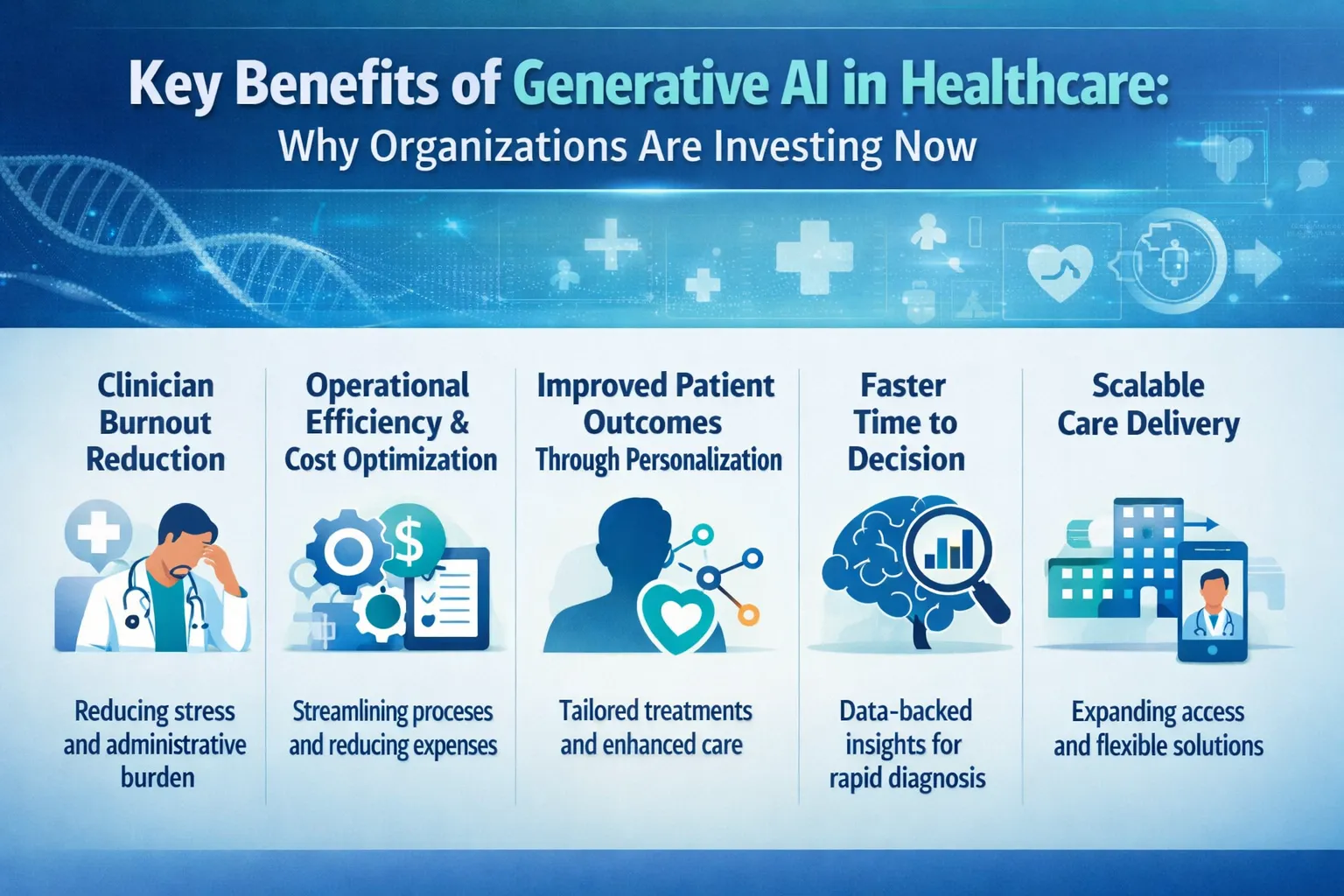
Clinician Burnout Reduction
This is the primary driver behind most generative AI investments in 2026, and it deserves to be stated plainly. Physician burnout is a patient safety issue, not just a workforce problem. Burned-out clinicians make more errors, leave the profession earlier, and deliver a measurably worse patient experience. Documentation burden is consistently cited as the leading contributor to burnout, which is exactly what ambient AI and automated note generation address directly.
Health systems that have deployed ambient scribing tools are reporting meaningful improvements in physician satisfaction scores, reductions in after-hours EHR time, and lower rates of reported burnout symptoms among participating physicians. When a surgeon can spend her evenings with her family instead of finishing charts, that is not a small quality-of-life improvement. It is a retention strategy and a patient safety investment at the same time.
Operational Efficiency and Cost Optimization
The efficiency gains from generative AI in healthcare compound across the revenue cycle, clinical operations, and administrative functions simultaneously. Prior authorization automation reduces staff labor costs. Cleaner claims reduce denial rework. Faster discharge documentation reduces length of stay. Automated patient outreach reduces unnecessary utilization. Each of these individually is a reasonable business case. Together, they represent a structural shift in what it costs to deliver care.
Health systems that have deployed generative AI across multiple operational functions are reporting efficiency gains in the range of 20 to 35 percent on targeted workflows. That is not a rounding error. At scale, those efficiencies fund additional clinical capacity, reduce reliance on contract labor, and create margin that can be reinvested in care quality.
Improved Patient Outcomes Through Personalization
Personalized care has always been the goal. Generative AI is making it operationally achievable. When every post-discharge communication is tailored to the patient's specific condition, literacy level, and care plan, adherence rates improve. When chronic disease patients receive continuous, contextually relevant coaching rather than generic educational content, their engagement with their own health management improves. The outcomes data is beginning to catch up with the intuition that personalized engagement leads to better health.
Faster Time to Decision with Data-Backed Insights
Clinical decisions made with more complete, better synthesized information are made faster and with greater confidence. Generative AI that surfaces relevant risk factors, applicable guidelines, and evidence-based care pathways at the point of care compresses the time between data and decision. In acute settings, that compression can be clinically significant. In population health management, it means care managers are spending their time on the highest-risk patients rather than on manual chart review.
Scalable Care Delivery
Perhaps the most strategically important benefit of generative AI in healthcare is what it does for capacity. The physician shortage is not going to resolve quickly. Demand for healthcare application development services is growing. The only sustainable path forward involves making each clinical hour go further, and generative AI is one of the most powerful levers available for doing that. When AI handles documentation, triage, routine patient communication, and administrative tasks, the same clinical team can effectively serve a larger patient population without proportional increases in staffing.
High-Impact Use Cases with Real Business Value
The applications of generative AI in healthcare are broad, but not all of them carry the same business case or the same readiness for enterprise deployment. These six use cases stand out because they are generating measurable returns today, not in some future state of AI development.
AI Medical Scribes Reducing Documentation Time
This is the most widely deployed and most mature generative AI application in clinical settings right now. Ambient AI scribes listen to physician-patient conversations and generate structured clinical notes in real time, ready for physician review and signature at the end of the visit.
The business value is direct. Physicians using ambient scribing tools are recovering an average of 90 minutes to two hours of clinical time per day that was previously spent on documentation. For a practice paying a physician $300,000 annually, giving back two hours of their day is not a minor productivity gain. It is a structural increase in clinical capacity. Health systems are also reporting improvements in note quality and completeness with AI-generated documentation compared to physician-authored notes produced under time pressure at the end of a shift.
Intelligent Patient Intake and Triage Systems
Generative AI is powering intake and triage tools that can conduct a detailed symptom assessment with a patient before they ever interact with a clinical staff member. These systems ask contextually relevant follow-up questions, assess urgency based on symptom patterns, and route patients to the appropriate care setting automatically.
The operational impact is significant. Health systems using intelligent triage tools are seeing reductions in avoidable ED visits, shorter appointment scheduling cycles, and better patient-to-provider matching. The patient experience improves too. Instead of waiting on hold to describe symptoms to a scheduler who is not a clinician, patients move through an intake process that feels responsive and personalized.
Automated Radiology and Pathology Report Generation
Radiology and pathology represent two of the most documentation-intensive specialties in medicine, and two of the areas where generative AI software development in healthcare is producing some of its most clinically significant results.
Generative AI systems can analyze imaging studies, identify findings, and produce structured preliminary reports that radiologists review and finalize. The radiologist's expertise is still essential for interpretation and sign-off. What changes is the starting point. Instead of dictating from scratch, the radiologist reviews and refines an AI-generated draft, which compresses turnaround times substantially and reduces the cognitive burden of repetitive documentation.
At high-volume radiology practices, this translates into meaningful capacity gains. The same number of radiologists can handle a larger study volume with AI-assisted reporting, which addresses one of the more acute capacity constraints in the healthcare system right now.
Virtual Care Assistants for Chronic Disease Management
Chronic disease management is one of the most resource-intensive aspects of healthcare delivery. Patients with conditions like diabetes, heart failure, and COPD require ongoing monitoring, frequent touchpoints, and consistent coaching to maintain stability and avoid acute exacerbations. The traditional care model, built around periodic physician visits, is not well designed to deliver the continuity those patients need.
Generative AI virtual care assistants are changing the economics of chronic disease management by enabling continuous, personalized engagement between clinical visits. These systems monitor patient-reported data and connected device readings, identify concerning trends, deliver contextually relevant coaching, and escalate to a human care manager when the situation warrants it. The clinical outcomes in deployed programs are strong, with improvements in medication adherence, reduction in unplanned hospitalizations, and better management of key biomarkers across patient populations.
Drug Discovery and Clinical Trial Acceleration
Generative AI examples in healthcare extend well beyond clinical care delivery into the research and development pipeline. Drug discovery has traditionally been an enormously expensive and time-consuming process. Bringing a new molecule from early discovery to clinical trial can take a decade and cost over a billion dollars.
Generative AI is compressing the early stages of that pipeline by proposing novel molecular structures, predicting binding affinities and toxicity profiles, and identifying candidate compounds for specific therapeutic targets at a speed no human research team could match. Pharmaceutical companies using generative AI in early discovery are reporting reductions of 30 to 50 percent in the time required to identify viable drug candidates.
On the clinical trial side, generative AI is accelerating patient matching and protocol design. Identifying eligible patients for a trial from across a health system's EHR population, a process that once required months of manual chart review, can now be completed in hours. That acceleration has direct value. Faster trials mean faster access to potentially life-changing treatments, and lower trial costs that improve the economics of drug development overall.
What to Look for in a Generative AI Solution in 2026
By now, most healthcare leaders understand what is generative AI in healthcare and where it can fit. The harder part is choosing the right solution in a crowded and often confusing landscape.
The generative AI in healthcare market is growing fast, but not every solution is built for real clinical environments. A polished demo does not guarantee performance inside a hospital system. That is why evaluation needs to go deeper.
Let’s break down what actually matters.
Clinical-Grade Accuracy and Validation
This is non-negotiable. In healthcare, accuracy is everything.
Many tools perform well in controlled environments but struggle when exposed to real-world variability. Patient data is messy. Clinical workflows are unpredictable. Edge cases are common.
What to focus on:
Proven performance in live clinical settings
Validation studies or real deployment outcomes
Alignment with regulatory standards such as FDA or CE
If a vendor cannot demonstrate real-world results, that is a red flag.
Seamless Workflow Integration
Even the most advanced AI will fail if it disrupts how clinicians work.
Healthcare professionals already deal with complex systems. Adding friction only reduces adoption. The best Enterprise AI Solutions fit naturally into existing workflows rather than forcing teams to adapt.
Look for:
Native integration with EHR systems
Minimal clicks and manual intervention
Outputs that align with existing documentation formats
Many generative AI use cases in healthcare fail not because of poor technology, but because they ignore workflow realities.
Data Interoperability and Architecture
Healthcare data is fragmented. A strong AI solution must be able to work across systems and formats.
This includes:
Structured and unstructured data
Imaging, lab reports, and clinical notes
Longitudinal patient records over time
The ability to connect and interpret this data is what enables more advanced examples of generative AI in healthcare, especially like AI in healthcare diagnostics.
Privacy, Security and Compliance
Data sensitivity in healthcare is on another level. There is no room for compromise here.
Solutions must ensure:
Compliance with regulations like HIPAA or GDPR
Secure data storage and transmission
Clear governance around data access and usage
Beyond compliance, organizations should understand how their data is being used to train or improve models. Transparency matters.
Explainability and Trust
Clinicians need to trust what the system produces. Blind automation does not work in healthcare.
A reliable solution should:
Provide clear, understandable outputs
Include references or evidence where possible
Maintain audit trails for accountability
Trust is built over time, and it often determines whether a system gets adopted or ignored.
Scalability and MLOps Maturity
A solution that works for 10 users should also work for 10,000.
Scalability is not just about infrastructure. It is about consistency, monitoring, and the ability to adapt as data changes.
Key considerations:
Real-time performance under high demand
Continuous monitoring and model evaluation
Mechanisms for handling model drift and updates
This is where many early-stage solutions fall short.
Proven ROI and Measurable Impact
At the end of the day, the investment needs to justify itself.
Healthcare organizations are now asking very direct questions:
How much time does this save per clinician?
Does it reduce operational costs?
Does it improve patient outcomes or throughput?
Understanding how is generative AI being used in the healthcare industry at scale often comes down to these metrics. If the impact cannot be measured, it will be difficult to sustain.
Challenges and Risks: What Most Vendors Won’t Tell You
While the opportunity is significant, it is important to stay grounded. Generative AI is powerful, but it is not without limitations.
Hallucinations and clinical risk
Generative models can produce outputs that sound correct but are not. In a clinical setting, even a small error can have serious consequences. This is why human oversight is still essential.
Data quality and bias
AI systems are only as good as the data they are trained on. Poor data quality or biased datasets can lead to inaccurate or unfair outcomes. This issue is often underestimated.
Integration complexity with legacy systems
Healthcare IT environments are complex and often outdated. Integrating new Enterprise AI Solutions into these systems can be more challenging than expected.
Regulatory uncertainty and liability
Regulations are evolving, but not always at the same pace as technology. Organizations must navigate unclear guidelines while managing potential liability risks.
Overpromising automation
Some vendors position their solutions as fully autonomous. In reality, most generative AI use cases in healthcare still require human validation. Over-automation without safeguards can create more problems than it solves.
Generative AI Development in Healthcare: What a Modern Stack Looks Like
To understand how solutions are actually built and scaled, it helps to look at the technical foundation. The generative AI in healthcare industry is not powered by a single tool or model. It runs on a layered architecture where each component plays a specific role.
If one layer is weak, the entire system feels it.
Data layer: where everything begins
Every meaningful AI system in healthcare starts with data. And not just one type.
You are dealing with:
Electronic Health Records (EHRs)
Medical imaging such as radiology scans
Lab results and clinical notes
Wearable and remote monitoring data
The real challenge is not access, it is integration. Data often sits in silos, spread across different systems and formats. A strong foundation ensures that all of this can be unified into a consistent, usable structure.
This is also where many applications of generative AI in healthcare either succeed or fail. Without clean, connected data, even the most advanced models struggle to deliver value.
Model layer: intelligence that drives outcomes
This is where the core AI capabilities live.
Modern systems typically combine:
Large Language Models for text-heavy tasks
Multimodal models that understand images, signals, and structured data
These models are responsible for generating outputs such as clinical notes, summaries, or recommendations. Many generative AI in healthcare examples you see today, like AI scribes or automated reporting tools, are powered at this layer.
However, raw models are not enough. They need to be adapted to healthcare-specific contexts through fine-tuning or domain alignment.
Application layer: where users interact
This is the layer clinicians and administrators actually experience.
It includes:
Workflow automation tools
APIs connecting systems together
User interfaces designed for ease and speed
The difference between a successful and unsuccessful solution often comes down to this layer. Even with strong models, poor UX or workflow misalignment can lead to low adoption.
This is why benefits of generative AI in healthcare are only realized when the application layer is designed around real user behavior, not assumptions.
Governance layer: the safety net
Healthcare demands accountability. Every output needs to be traceable, explainable, and secure.
The governance layer ensures:
Compliance with regulations
Continuous monitoring of model performance
Audit trails for generated outputs
Mechanisms to detect errors or drift
This is not an optional layer. It is what makes generative AI software development in healthcare viable in regulated environments.
Future Trends: What’s Coming Next
The pace of change in this space is steady, but the direction is becoming clearer. The next phase is less about isolated tools and more about connected, intelligent systems.
Autonomous care pathways with human oversight
We are moving toward systems that can manage entire care journeys. From intake to follow-up, AI will coordinate multiple steps while clinicians supervise critical decisions.
This is a natural evolution of how generative AI in healthcare industry is already being used today.
AI-powered digital therapeutics
Software is starting to play a more active role in treatment itself.
Instead of just supporting decisions, AI systems are being designed to deliver interventions. This includes mental health support, chronic disease management, and behavior-based therapies.
Hyper-personalized medicine
Healthcare is shifting from generalized treatment to individualized care.
With access to real-time data from wearables and continuous monitoring systems, AI can generate highly personalized recommendations. This is one of the most promising applications of generative AI in healthcare, especially for long-term care management.
Synthetic data for safer innovation
Data privacy remains a major barrier. Synthetic data is emerging as a practical solution.
It allows organizations to:
Train models without exposing real patient data
Test systems in controlled environments
Scale innovation without compromising compliance
Convergence of AI, IoT, and remote care
Many emerging generative AI in healthcare examples are already combining these elements to improve patient monitoring and engagement.
Why Choose AppZoro for Generative AI in Healthcare
Choosing the right healthcare application development services is just as important as choosing the right technology.
Deep domain expertise
Healthcare is complex. It requires more than technical capability. It demands an understanding of workflows, compliance requirements, and patient-centric systems.
AppZoro brings experience across healthcare environments, ensuring solutions are not just functional, but practical.
End-to-end capabilities
From strategy to deployment, having a single partner reduces friction.
This includes:
Identifying the right use cases
Designing scalable architectures
Developing and integrating solutions
Supporting deployment and optimization
That level of continuity is critical in generative AI software development in healthcare, where multiple systems and stakeholders are involved.
Focus on compliance, scalability, and ROI
Every solution is built with three priorities in mind:
Meeting regulatory requirements
Scaling effectively across systems and users
Delivering measurable business outcomes
This ensures that the benefits of generative AI in healthcare are not theoretical, but tangible.
Tailored solutions for different healthcare stakeholders
Healthcare is not one-size-fits-all.
Solutions are customized for:
Providers looking to improve clinical workflows
Payers focused on operational efficiency
Healthtech companies building innovative products
This flexibility is essential in a rapidly evolving generative AI in healthcare industry.
Conclusion
Understanding what is generative AI in healthcare is just the starting point. The real value comes from how effectively it is applied within clinical and operational workflows. Organizations that once explored AI as an experiment are now relying on it to drive efficiency, improve patient outcomes, and reduce pressure on healthcare professionals.
The generative AI in healthcare market is growing, but growth alone does not guarantee success. What matters is how solutions perform in real-world conditions. This is where many organizations face challenges. Choosing the wrong tool or implementing it without a clear strategy can lead to wasted investment and low adoption.
When you look closely at generative AI use cases in healthcare, a pattern emerges. The most successful implementations are not overly complex. AI/ML development company focus on solving specific, high-impact problems.
If you are exploring how to implement or scale generative AI in your healthcare organization, this is the right time to act. The gap between early adopters and the rest of the market is widening.
Connect with us to evaluate your use case, identify the right approach, and build solutions that deliver real impact.
Leave a Comment