
Getting a diagnosis right is not just a clinical priority. It is the single most important moment in a patient's entire healthcare journey. Everything that follows, the treatment, the medication, the recovery plan, depends on that first answer being correct.
When it is wrong, patients pay the price. Sometimes with months of unnecessary treatment. Sometimes with their lives.
Think about what a wrong diagnosis actually means for a real person.
A woman is told her persistent fatigue is stress-related. Two years later she is diagnosed with an autoimmune condition that had been present all along. A man's chest pain is attributed to acid reflux. He survives his heart attack, but only barely.
Diagnostic errors affect roughly 12 million adults in the United States every single year, and that figure covers outpatient care alone. The National Academy of Medicine has described misdiagnosis as one of the most serious and underaddressed patient safety issues in the entire healthcare system.
Over the last decade, AI diagnostic tools in healthcare have moved quietly from research environments into active clinical use. AI in healthcare diagnostics is already part of how leading health systems operate today. The global AI in healthcare sector was valued at around $20 billion in 2023. By 2030, projections put that figure above $180 billion, with diagnostics accounting for one of the largest shares of that growth.
Where Traditional Diagnostic Processes Fall Short?
To understand why errors happen so often, think honestly about what traditional diagnostics asks of a physician.
In a typical working day, a doctor reviews patient histories, interprets imaging, cross-references lab results, and makes judgment calls, often within minutes per patient. They do this repeatedly, across dozens of cases, with very little time to pause.
Human pattern recognition is remarkable. But it is also finite. It is shaped by what a clinician has personally seen before. It is affected by fatigue, cognitive load, and the tendency to anchor on an early impression and filter everything else through it.
Rare diseases are a particular blind spot. A condition affecting one in a hundred thousand people may never cross a single physician's desk in their entire career. That does not make it any less real for the patient who has it.
Then there is the data problem. Modern medicine generates a staggering volume of clinical information. Electronic health records, genomic profiles, radiology scans, pathology reports, wearable device data. The information exists. The human capacity to process all of it consistently and without error simply does not.
Hospitals are using machine learning models to detect early-stage cancers in radiology images, in some cases catching findings that trained radiologists had missed on first review. Emergency departments are running predictive algorithms that flag deteriorating patients hours before the signs become visible. Pathology labs are using computer vision tools to analyse tissue slides faster and more consistently than manual review alone can manage.
What Is AI in Healthcare Diagnostics?
Before getting into what AI can do clinically, it is worth being clear about what it actually is.
At its core, AI in healthcare diagnostics means using machine learning algorithms and computational models to analyse medical data, find clinically meaningful patterns, and feed those findings into the diagnostic process. The system learns from examples. Show it enough chest X-rays labelled with their correct diagnoses and it starts identifying those patterns reliably on its own.
Diagnostic AI in healthcare is not a single technology. It is a set of tools that work individually or together depending on the clinical task.
Machine Learning
This is the foundation most AI diagnostic systems are built on. A machine learning model trains on large datasets of labelled medical information and learns which features are associated with particular outcomes. Over time, with more data, its predictions improve.
In practice, an ML model trained on thousands of ECG readings can flag irregular heart rhythms with a consistency that is hard to sustain through manual review at volume.
Deep Learning
Deep learning goes further. It uses layered neural networks to process complex data, particularly images, and surface patterns too subtle for the human eye to catch reliably.
This is the technology behind AI systems that screen chest X-rays for early pneumonia, analyse retinal scans for diabetic eye disease, and review mammograms for signs of malignancy. It works at a scale and speed that simply changes what is possible in high-volume diagnostic settings.
Natural Language Processing
A significant portion of clinical data lives in written notes. Physician observations, discharge summaries, referral letters. Natural language processing allows AI to read that text, extract meaning from it, and convert unstructured language into structured data that feeds into broader diagnostic analysis.
Some of the most valuable clinical information is buried in paragraphs that no algorithm could previously access. NLP changes that.
Computer Vision
Computer vision gives AI the ability to examine scans, photographs, and slides the way a radiologist or pathologist would. It can identify lesions, measure their dimensions, track changes over time, and flag areas that need closer attention.
Predictive Analytics
Rather than identifying a condition that already exists, AI predictive analytics uses historical patient data to estimate the probability that a specific outcome will occur. A patient readmitted within 30 days. A complication developing post-surgery. A chronic disease emerging within a defined risk window.
It moves clinical care from reactive to genuinely preventive. That is where the biggest long-term gains in patient outcomes tend to come from.
The Types of Medical Data AI Works With
The quality of any AI system depends on the data it works with. In healthcare that data comes from several distinct sources.
Medical imaging including X-rays, MRIs, CT scans, and ultrasounds is where AI has made its most visible early gains. These systems process thousands of images with a consistency that manual review at scale simply cannot match.
Electronic Health Records hold a patient's full clinical history including medications, diagnoses, test results, and physician notes. NLP tools are increasingly making even the unstructured notes usable.
Genomic data is growing in importance, particularly in cancer care. AI models can identify genetic markers that predict disease risk, likely progression, and response to specific treatments in ways no traditional diagnostic tool can replicate.
Pathology slides can be digitised and analysed by computer vision systems trained to detect cellular abnormalities at a level of precision that supports, and in some cases improves on, manual pathology review.
Wearable device data from fitness trackers, cardiac monitors, and continuous glucose sensors creates a real-time stream of physiological information. AI monitors that stream continuously and flags deviations that might indicate a developing issue before symptoms appear.
How Can AI Improve Diagnostic Accuracy in Healthcare?
How can AI improve diagnostic accuracy in healthcare? The answer is more specific and practical than the broad conversation around AI in the healthcare industry often suggests.
AI does not improve diagnostic accuracy by doing one big thing. It addresses several distinct failure points in the diagnostic process simultaneously, each through a different mechanism.
Advanced Pattern Recognition
One of the most well-established strengths of AI in healthcare diagnostics is detecting patterns that fall below the threshold of reliable human perception.
A radiologist reviewing hundreds of scans in a single day is working under conditions that make subtle findings easy to miss. A small nodule at the edge of a scan. An early cellular irregularity in a pathology slide. A slight asymmetry in a mammogram that falls just within what a trained eye might attribute to normal variation.
AI powered diagnostic tools in healthcare trained on millions of labelled images can identify these findings with a level of consistency that changes clinical outcomes significantly. In chest X-ray analysis studies, some AI systems have matched or exceeded specialist radiologists in sensitivity, particularly for early-stage findings where early detection matters most.
This is not about AI being smarter than physicians. It is about AI being consistent in a way that humans cannot physically maintain across high volumes and long working hours.
Large-Scale Data Analysis
Traditional diagnostics works with the information available in a single patient encounter. AI diagnostics in healthcare works with population-level data and individual patient history at the same time.
An AI system integrated into a hospital network can process millions of patient records simultaneously, identifying correlations between symptom combinations, demographic profiles, lifestyle factors, treatment histories, and clinical outcomes. It surfaces connections that no individual clinician would ever have the data to see.
This is where AI predictive analytics becomes particularly powerful. By identifying patterns in a patient's profile statistically associated with specific diagnoses or outcomes, predictive models flag risk before it becomes a clinical crisis. The physician still makes the call, but the right patients get attention at the right time.
For health systems deploying enterprise AI solutions, this large-scale analytical capability delivers one of the clearest measurable returns on investment. Fewer missed diagnoses. Earlier interventions. Lower downstream costs.
Clinical Decision Support
One of the most practical AI applications in healthcare diagnostics is clinical decision support. This is AI working alongside the physician rather than in place of them.
A clinical decision support system processes available patient data and surfaces relevant diagnostic possibilities, flags potential drug interactions, highlights findings that match known disease presentations, and alerts the physician to test results that need closer attention. The physician reviews those suggestions, applies their clinical judgment, and makes the final call.
This model works because it respects how medicine actually operates. Patients are not data problems. They are people whose care requires human judgment, empathy, and contextual understanding. AI driven diagnostics in healthcare works best as an intelligent support layer that raises the quality of information a clinician works with, not as a system operating independently of clinical expertise.
Studies evaluating AI-assisted decision support have shown consistent reductions in missed diagnoses and improved accuracy in initial assessments, particularly in complex cases where multiple conditions overlap.
Real-Time Diagnostics
Speed matters in medicine. This is one of the areas where AI in the healthcare industry is delivering its most immediate value.
In emergency medicine the diagnostic window is often measured in minutes. A stroke patient needs fast imaging review, fast interpretation, and a fast treatment decision. Every minute of delay increases the extent of brain damage. AI powered diagnostic tools in healthcare integrated into emergency workflows analyse imaging in seconds, flag critical findings instantly, and support the clinical team in reaching a decision faster than a conventional review process allows.
Beyond emergency settings, faster diagnostic turnaround times mean shorter stays in diagnostic uncertainty, earlier treatment starts, and lower risk of conditions progressing while patients wait for results.
Real-time AI support does not replace the diagnostic team. It accelerates the information flow the team depends on, and in time-sensitive situations that makes a direct difference to patient outcomes.
Continuous Learning Systems
The most distinctive long-term advantage of AI in diagnostics healthcare is that it keeps getting better.
Traditional diagnostic protocols are built at a point in time and updated periodically. A well-designed AI system works differently. Every new case, every confirmed diagnosis, every treatment outcome adds to what the system learns from. Over time the model becomes more precise, better calibrated to the specific patient population it serves, and more capable of catching findings it might have missed earlier.
This means AI applications in healthcare diagnostics do not plateau at the level they were deployed at. They improve as the healthcare environment around them evolves, incorporating new research and new clinical learnings continuously.
For health systems thinking about enterprise AI solutions as a long-term investment, this continuous improvement capability is one of the strongest arguments for early adoption. The system you deploy today will be meaningfully more capable in two years than it is at launch.
AI Diagnostic Tools in Healthcare: Core Types and Functions
Understanding how AI improves diagnostic accuracy in healthcare becomes much clearer when you look at the actual tools doing the work.
AI diagnostic tools in healthcare are not one single product. They cover imaging, pathology, genomics, clinical decision support, and patient-facing triage. Each tool addresses a different part of the diagnostic process. Together they form a practical layer of intelligent support across the entire care journey.
Here is what each one does and why it matters.
AI-Powered Medical Imaging Tools
Medical imaging is where AI technologies in healthcare have made their most visible impact so far.
Radiologists are skilled diagnosticians. But they work under conditions that make consistent performance genuinely difficult. High scan volumes, long hours, and the mental load of reviewing hundreds of images daily create real conditions for error, especially for subtle findings that are easy to overlook.
AI powered imaging tools address this directly. These systems train on millions of labelled scans and learn to identify visual patterns linked to specific conditions. In radiology, they flag potential abnormalities in chest X-rays, CT scans, and MRIs before the radiologist even begins their review. They essentially pre-screen the workload and surface the cases that need attention most.
For any AI/ML development company building diagnostic imaging solutions, this is one of the highest-impact areas to focus on, both clinically and commercially.
AI Clinical Decision Support Systems
Clinical decision support systems, commonly called CDSS, are one of the most practical and widely used forms of diagnostic AI in healthcare today.
These systems work inside the clinical workflow alongside the physician, not separately from them. As a doctor reviews a patient case, the CDSS processes the available data at the same time. Medical history, current symptoms, lab results, imaging findings, medication records. It surfaces relevant diagnostic possibilities, flags inconsistencies, and highlights findings that match known disease presentations.
Healthcare application development services building CDSS platforms need to prioritise clean integration with existing EHR systems and transparent reasoning. Clinicians need to understand why the system is making a recommendation, not just what it is recommending.
AI Pathology Tools
Pathology is one of the most time-intensive and expertise-dependent disciplines in medicine. Analysing tissue samples, identifying cellular abnormalities, and reaching a diagnosis requires years of specialist training and a level of sustained concentration that is hard to maintain across large volumes of slides.
Automated slide analysis increases the volume a pathology department can handle without a proportional increase in staffing. And because the AI applies the same criteria to every slide, it removes the natural variability that exists between different human reviewers looking at the same material.
Cancer cell identification is particularly strong here. AI pathology tools have shown solid performance identifying cancerous cells in prostate, breast, colon, and cervical tissue samples. In several studies, AI-assisted pathology review has reduced false negative rates, meaning fewer cases where cancer was present but missed.
AI Genomics Platforms
Genomics is one of the fastest-moving areas within AI diagnostics in healthcare. It is also where the long-term potential of precision medicine is most clearly taking shape.
Every person carries a unique genetic profile that shapes their susceptibility to certain diseases, their likely response to specific medications, and the probability of certain conditions developing over time. Traditional diagnostic methods cannot meaningfully access this information during a routine clinical encounter. AI genomics platforms can.
These systems analyse large volumes of genetic data and identify markers associated with elevated disease risk, likely progression, and predicted treatment response. AI technologies in healthcare are enabling a version of medicine that is genuinely personalised. Treatment decisions based not just on what a patient presents with today but on what their biological profile says about their future health trajectory.
AI Symptom Checkers and Virtual Assistants
Not all AI diagnostic tools in healthcare operate inside hospital systems. A growing category of patient-facing tools is bringing AI driven diagnostics to the point of first contact, often before a patient ever speaks to a clinician.
AI symptom checkers let patients input their symptoms and receive a preliminary assessment of possible conditions along with guidance on the right care setting. These tools are not designed to replace diagnosis. They are designed to triage, helping patients understand whether they need an emergency department, a same-day appointment, or simply some watchful waiting at home.
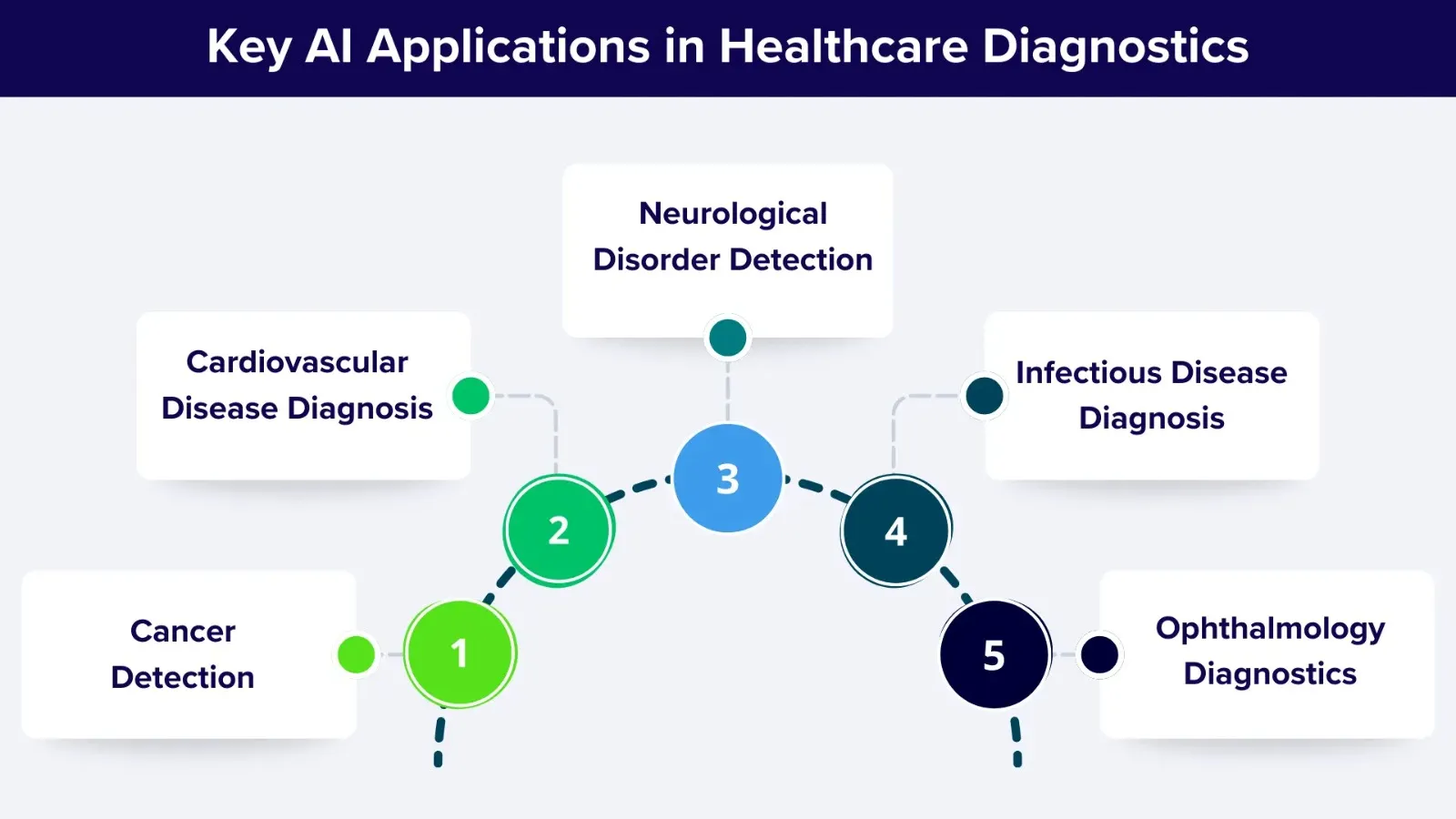
Key AI Applications in Healthcare Diagnostics
The case for AI in healthcare diagnostics gets most convincing when you look at specific disease areas where these tools are already delivering measurable results.
Across cancer, cardiology, neurology, infectious disease, and ophthalmology, AI applications are not just promising on paper. They are working in real clinical environments, with real patients, right now.
Cancer Detection
Cancer is the disease area where AI applications in healthcare diagnostics have attracted the most research attention, the most investment, and the most compelling clinical evidence.
Early detection is the single most important factor in cancer outcomes. The difference between early and late-stage diagnosis can be dramatic. For breast cancer, the five-year survival rate at stage one exceeds 99 percent in many health systems. At stage four it drops below 30 percent. Getting the diagnosis right, and getting it early, is genuinely a matter of life and death.
Cardiovascular Disease Diagnosis
Cardiovascular disease is the leading cause of death globally, responsible for an estimated 17.9 million deaths each year according to the World Health Organization. Diagnostic accuracy in cardiology has direct and immediate consequences for whether a patient survives.
ECG interpretation is one of the clearest examples of how AI diagnostic tools in healthcare are improving cardiovascular outcomes. Electrocardiograms generate large volumes of data, and subtle abnormalities in waveform patterns can indicate serious conditions including atrial fibrillation, early myocardial infarction, and long QT syndrome. AI systems trained on large ECG datasets detect these patterns with a consistency that reduces missed diagnoses for conditions that, left undetected, carry serious risks.
AI diagnostics in healthcare is moving cardiology from a reactive specialty toward a genuinely predictive one. That shift has real consequences for how many people make it home from hospital.
Neurological Disorder Detection
Stroke is an area where speed is everything and where AI is delivering meaningful results. In acute stroke care, every minute without treatment increases permanent neurological damage. AI systems integrated into emergency imaging workflows analyse CT and MRI scans for signs of stroke in seconds, flagging positive cases immediately for urgent clinical review.
Alzheimer's detection through imaging is a more recent but rapidly advancing application. AI technologies in healthcare are identifying structural changes in brain MRI scans associated with early-stage neurodegeneration, changes that can appear years before clinical symptoms show up. Earlier identification opens the window for intervention at the point when it is most likely to slow disease progression and protect quality of life.
How AI improves diagnostic accuracy in healthcare is perhaps most profound in neurology. The diseases are serious, the diagnostic windows matter enormously, and the traditional tools for early detection have historically been limited.
Infectious Disease Diagnosis
The COVID-19 pandemic pushed AI applications in healthcare diagnostics for infectious disease forward by years in a very short space of time.
AI powered COVID detection models were developed and validated at remarkable speed, analysing chest CT images and X-rays to identify the radiological patterns of COVID-19 pneumonia. These tools helped clinical teams manage overwhelming diagnostic volumes during peak pandemic periods, providing rapid preliminary assessments that supported human reviewers working under extreme pressure.
When the need is urgent and the data is available, AI diagnostic tools can be built, validated, and deployed at a speed that traditional research and development timelines simply do not allow.
Ophthalmology Diagnostics
Ophthalmology was one of the first specialties where AI diagnostic tools demonstrated performance comparable to specialist clinicians. It remains one of the most developed application areas within AI in healthcare diagnostics today.
Diabetic retinopathy screening is the standout use case. Diabetic retinopathy is a leading cause of preventable blindness worldwide, affecting an estimated one in three people with diabetes to some degree. It is highly detectable through retinal imaging when screening is consistent and coverage is broad.
AI retinal imaging systems analyse fundus photographs and identify the presence and severity of diabetic retinopathy with accuracy validated against specialist review in multiple large studies. DeepMind developed one of the earliest and most widely cited of these systems, demonstrating performance comparable to expert ophthalmologists across tens of thousands of retinal images.
This is how AI improves diagnostic accuracy in healthcare in the most practical sense. Not just in academic studies, but in real-world programs serving real patients in settings that previously lacked the specialist infrastructure to deliver consistent, high-quality diagnostic care.
Implementation Roadmap: Adopting AI Diagnostics in Healthcare
Deciding to invest in AI in healthcare diagnostics is one thing. Actually implementing it in a way that works for your clinical environment, your staff, and your patients is another.
The good news is that adoption does not have to be overwhelming. It becomes manageable when you break it down into clear, deliberate steps. Here is a practical roadmap that healthcare organisations can follow.
Step 1: Assess Your Diagnostic Challenges
Start by identifying where your biggest diagnostic problems actually sit.
Are missed findings a recurring issue in radiology? Are diagnostic delays creating backlogs in pathology? Is your emergency department struggling with triage accuracy under high patient volumes?
The most successful implementations of AI diagnostic tools in healthcare begin with a clear and honest assessment of the specific gaps they are trying to close. AI is not a blanket solution. It works best when it is deployed against a well-defined problem.
Talk to your clinical teams. Review your diagnostic error data. Map out where delays, inconsistencies, and missed findings are most common. That picture tells you where to start.
Step 2: Collect and Prepare Your Medical Data
AI systems are only as good as the data they learn from. Before any model gets built or deployed, your data needs to be in order.
That means collecting the right types of clinical data, medical imaging, electronic health records, lab results, pathology reports, and ensuring it is clean, labelled accurately, and representative of the patient population the system will serve.
Data gaps and demographic imbalances in training datasets are one of the most common reasons AI diagnostics in healthcare underperforms in real clinical settings. Investing time in data preparation at this stage saves significant problems later.
Step 3: Choose the Right AI Models and Tools
Not every AI model suits every diagnostic task. The right choice depends on what you are trying to detect, what data you have available, and how the tool needs to integrate with your existing clinical workflow.
Deep learning models work well for imaging analysis. NLP tools are better suited for extracting clinical insights from written records. Predictive analytics models serve risk stratification and preventive care programs. Many real-world deployments combine several of these approaches.
Working with an experienced AI/ML development company at this stage makes a meaningful difference.
Step 4: Integrate with Existing Healthcare Systems
One of the most common implementation challenges is getting AI powered diagnostic tools to work smoothly within existing clinical infrastructure.
Most hospitals are running EHR platforms, imaging systems, and laboratory software that were built at different times and were not designed with AI integration in mind. Getting data flowing between these systems and your new AI tools requires careful technical planning.
Prioritise interoperability from the start. Systems that use standardised data formats and support established integration protocols create far fewer problems during deployment than proprietary systems that require custom workarounds at every connection point.
Step 5: Clinical Validation and Testing
Before any AI diagnostic tool goes live in a real clinical setting, it needs to be rigorously validated.
This means testing the system against real patient data, measuring its performance against established clinical benchmarks, and evaluating how it performs across different patient demographics and clinical presentations. A tool that performs well in a controlled research environment does not automatically perform well in a busy hospital department.
Clinical validation also means involving frontline clinicians in the testing process. Physicians and nurses who will actually use the system day to day will identify practical issues, workflow friction points, and edge cases that technical teams would not catch on their own.
Validation is not a one-time event either. It is an ongoing process that continues after deployment as the system encounters new cases and clinical environments evolve.
Step 6: Train Your Medical Staff
Technology alone does not improve diagnostic outcomes. The people using it need to understand what it does, what it cannot do, and how to work with it effectively.
Training for AI diagnostic tools in healthcare needs to cover more than basic operation. Clinical staff need to understand how to interpret AI outputs critically, when to follow a recommendation and when to override it, and how to escalate concerns when the system behaves unexpectedly.
Building confidence and competence among clinical teams is what separates implementations that deliver sustained clinical value from those that get adopted superficially and gradually abandoned.
Step 7: Monitor, Optimise, and Improve Continuously
Deployment is not the finish line. It is the beginning of the real work.
AI systems need continuous monitoring to ensure they are performing as expected in real clinical conditions. That means tracking key performance metrics, reviewing cases where the system and the clinician disagreed, and identifying any drift in accuracy over time.
Optimisation is an ongoing process. As new patient data becomes available, as clinical guidelines change, and as the patient population evolves, the system needs to be retrained and recalibrated to stay accurate and clinically relevant.
Why Choose AppZoro for AI in Healthcare Diagnostics?
Building effective AI diagnostic tools for healthcare is not just a technology challenge. It is a clinical challenge, a regulatory challenge, and an integration challenge all at once.
AppZoro understands all three. We have spent years working at the intersection of healthcare and AI, building solutions that perform in real clinical environments, not just in controlled development settings.
Here is what that means in practice.
Healthcare AI Expertise
We are not a generalist technology company that has recently added healthcare to a service list. Healthcare software development is core to what we do.
Our team has hands-on experience building AI solutions for hospitals, diagnostic centres, and healthcare networks. We understand clinical workflows, the practical realities of how medical staff interact with technology under pressure, and the specific demands that healthcare environments place on software systems.
That experience shapes everything we build. AI diagnostic tools in healthcare that look good in a demo but create friction in a real clinical workflow do not deliver value. We design for the environment where the tool will actually be used.
Custom AI Diagnostic Solutions
Every healthcare organisation has different diagnostic challenges, different patient populations, different infrastructure, and different clinical priorities.
We do not offer off-the-shelf tools dressed up as custom solutions. We build diagnostic AI in healthcare that is genuinely tailored to the specific needs of the organisation we are working with.
That means starting with a deep understanding of the clinical problem, building models trained on relevant data, and designing interfaces and workflows that fit the way your clinical teams actually operate. The result is a tool that solves your specific problem, not a generic solution that approximates it.
Compliance with Healthcare Regulations
Healthcare software development without rigorous compliance is not healthcare software development. It is a liability.
Every solution we build is developed with HIPAA compliance built in from the architecture up, not added as a layer after the fact. We understand the regulatory frameworks that govern AI diagnostic tools in healthcare across different markets and we design our development process to meet those requirements at every stage.
For healthcare organisations navigating the regulatory complexity around AI diagnostic tools, having a development partner who understands that landscape from the inside makes the entire process significantly more straightforward.
Integration with Healthcare Ecosystems
An AI diagnostic tool that cannot connect cleanly with the systems your clinical teams already use will not get used.
AppZoro builds solutions designed for real-world healthcare ecosystems. We integrate with major EHR platforms, telehealth systems, laboratory information systems, and medical imaging infrastructure. Our healthcare application development services are built around making new tools work within existing environments rather than disrupting them.
Whether you are adding AI capabilities to an established hospital infrastructure or building a new digital health platform from the ground up, we have the integration experience to make it work in practice, not just in theory.
If you are exploring what AI in healthcare diagnostics could look like for your organisation, we would like to talk. The right implementation starts with the right conversation.
Conclusion
The case for AI in healthcare diagnostics is no longer theoretical. It is clinical, measurable, and growing stronger every year.
Diagnostic errors affect millions of patients annually. They delay treatment, increase costs, and in the most serious cases, cost lives. Traditional diagnostic processes, built on clinical expertise and individual judgment, are genuinely valuable. But they carry limitations that cannot be solved through training or process improvement alone.
AI diagnostic tools in healthcare address those limitations in practical ways. They process data at a scale no human team can match. They detect patterns consistently without fatigue or bias. The future of AI driven diagnostics will bring multimodal analysis, digital twins, real-time monitoring, and increasingly autonomous preliminary assessments. Healthcare organisations that start building their AI capabilities thoughtfully now will be significantly better positioned to benefit from those advances as they arrive.
The path forward is clear. Adopt AI responsibly.
If your organisation is ready to explore what AI in healthcare diagnostics can do for your diagnostic workflows, your clinical outcomes, and your patients, AppZoro is ready to help you get there.
We build AI diagnostic solutions that work in the real world. Reach out to our team and let us start with a conversation about what is possible for you.
Leave a Comment