
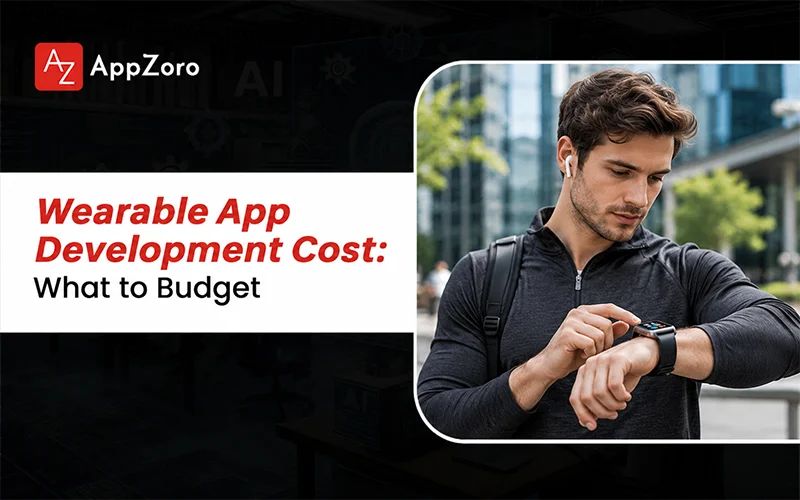
Say a founder sketches a running-watch app on a napkin. Heart rate, pace, a vibration at kilometre five, a clean summary on the phone afterwards. Four screens, maybe five. She assumes the tiny display means a tiny bill, and the first quote she gets back is three times her guess.Nobody’s padding the estimate. The screen is small, but the app behind it has to read sensors that never stop, survive a flaky Bluetooth connection, sync to a phone, push to a cloud backend and still last through a long run on a battery the size of a coin. Each of those links costs engineering time, and each one has to be tested on real hardware.The sections below cover the tiers, the cost drivers, how to build a wearable app development cost estimation of your own, the platform decision, hidden fees and the maintenance bill that arrives after launch. If you’re still shaping the product itself, you’ll want to start with AppZoro’s guide to how to develop a fitness app, then come back here to price it.
Wearable Application Development Cost by Complexity
Wearable application development cost swings widely because “wearable app” covers very different products. A step logger and a clinical monitoring platform share a category name and almost nothing else.
| Tier | What It Looks Like | Typical Cost | Typical Timeline |
| MVP | One platform, a handful of tracked metrics, simple phone companion | $50,000 to $120,000 | 3 to 5 months |
| Mid-scale | Live sensor sync, several devices, analytics, third-party integrations | $120,000 to $250,000 | 6 to 9 months |
| Enterprise | Multiple wearables or custom hardware, strict compliance, large data volumes | $250,000 to $500,000+ | 9 to 18 months |
The mid-scale band lines up with what AppZoro publishes in its fitness app development cost guide, where wearable-integrated apps with real-time sync run from roughly $120,000 to $250,000. These tiers are planning ranges, not quotes. Your device list, data volume and compliance needs will push you up or down inside them, and it’s far better to hear that now than at kickoff.
What Drives Wearable App Development Cost
Think of a wearable product as layers, and each layer has its own price tag that you’ll have to cover. Here’s how the effort usually spreads across a mid-scale build.
| Cost Component | What It Covers | Typical Range |
| Product design and UX | Small-screen layouts, glanceable flows, phone companion screens | $15,000 to $40,000 |
| Device and sensor integration | Heart rate, steps, GPS, pairing, background tracking | $25,000 to $80,000 |
| Mobile companion app | Sync, alerts, settings, history views | $30,000 to $100,000 |
| Backend and APIs | Data flow, storage, accounts, device communication | $40,000 to $120,000 |
| Security and compliance | Encryption, access control, privacy work | $15,000 to $50,000 |
| Infrastructure setup | Servers, storage, monitoring | $15,000 to $50,000 |
| Analytics and reporting | Trends, dashboards, exports | $10,000 to $30,000 |
You won’t need every row at full size, and that’s good news for your budget. A tracker that only reads from the phone’s health platform skips most of the device layer. But if you’re shipping your own hardware, you’ll need all of it, plus firmware work on top.
Cost to Develop a Wearable Tracker App
If you’re pricing a tracker specifically, the cost to develop a wearable tracker app depends on how many metrics you capture and how live the data needs to be. Logging steps once an hour is cheap. Streaming heart rate in real time while the screen is off? That’s a different conversation.
| Feature | Typical Cost |
| Onboarding and profile | $4,000 to $10,000 |
| Device pairing and setup | $6,000 to $15,000 |
| Sensor tracking (heart rate, steps, sleep) | $10,000 to $25,000 |
| Real-time sync | $15,000 to $40,000 |
| GPS and motion tracking | $10,000 to $28,000 |
| Alerts and notifications | $3,000 to $8,000 |
| Reports and charts | $8,000 to $20,000 |
| Health platform integration (HealthKit, Health Connect) | $5,000 to $20,000 per integration |
Real-time sync is the line item that surprises people most. It looks like one switch, but it’s really battery life, connection handling, offline queues and backend load all at once. For a fuller walk-through of the device side, AppZoro’s wearable app development guide covers architecture and tooling in more depth.
Platform and Device Choice: The Quiet Budget Lever
This is the decision people make too casually, and it can quietly sink a budget. Each platform brings its own SDK, sensors, performance limits and test matrix, so every extra device multiplies QA, not just code.
| Option | Cost Effect | Worth Knowing |
| Apple Watch (watchOS) | Medium | Tight hardware and software control, smoother performance |
| Wear OS | Medium | More device variety, more testing |
| Cross-platform phone app plus native watch module | Medium to high | Shared phone code, but watch code usually stays native |
| Fitness bands and third-party devices | Medium to high | Depends on vendor APIs and how open they are |
| Custom hardware | High | Firmware, pairing and certification work on top |
Cross-platform frameworks can trim the phone side, but they rarely save much on the watch itself, because wearable features lean on platform-specific APIs. Don’t count on big savings there. One practical note: Google has been steering developers from Google Fit towards Health Connect, so check which health platform APIs are current before scoping integrations.
How to Do a Wearable App Development Cost Estimation
A solid wearable app development cost estimation starts with hours, not hunches. Here’s a simple method that works for early budgeting.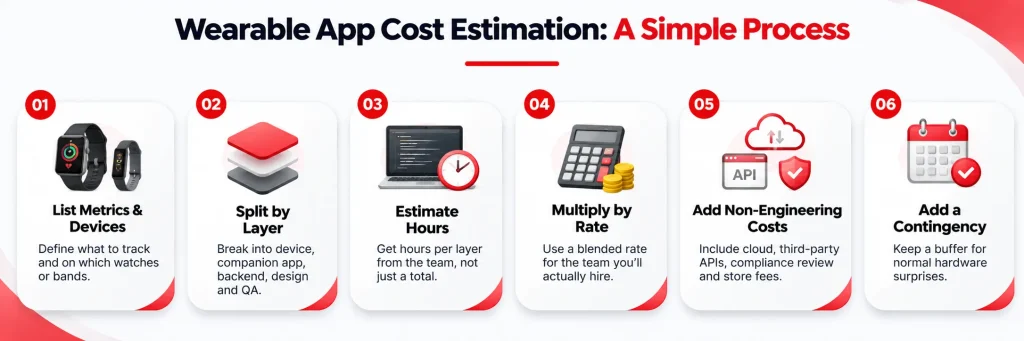
- List the metrics and devices. What gets tracked, and on which watches or bands?
- Split by layer. Device, companion app, backend, design, QA.
- Estimate hours per layer. Ask the team to show the numbers, not just a total.
- Multiply by a blended rate. Use the rate for the team you’d actually hire.
- Add the non-engineering lines. Cloud, third-party APIs, compliance review, store fees.
- Add a contingency. Hardware surprises are normal, so budget a cushion.
To see why the rate matters, take a mid-complexity tracker estimated at about 1,800 all-in hours across design, build, QA and project management. That’s an illustration, not a quote.
| Blended Rate | Total |
| $50 per hour | $90,000 |
| $90 per hour | $162,000 |
| $150 per hour | $270,000 |
Same scope, three very different bills, and you’ll see all three in the quotes you collect. Typical rates by region run from $120 to $200 per hour in North America, $90 to $160 in Western Europe, $40 to $80 in Eastern Europe and $25 to $60 in India and Southeast Asia. A lower rate isn’t automatically cheaper, though, and you shouldn’t assume it is. Rework and slow product decisions can erase the saving by month six, and that happens more often than people expect.
What Makes the Number Climb
A few choices push wearable projects up faster than anything else, and they’re worth knowing before you sign.
- Continuous data. Always-on sensors mean streaming, buffering and bigger storage bills.
- Multi-device sync. The same user on a watch, a phone and a tablet needs careful conflict handling.
- AI features. Pattern detection and recommendations add data pipelines and model upkeep. A tracker without AI might sit near $50,000 to $150,000, while advanced prediction features can push a build to $250,000 or more.
- Health data and compliance. HIPAA applies in some cases and not others, GDPR applies to many users, and the FTC’s health breach rules can reach consumer health apps outside HIPAA. Get legal input early, because compliance work shapes architecture.
- Third-party integrations. Each health platform or analytics tool needs setup and ongoing care.
Hidden Costs After Launch
Most budgets cover the build and miss the running costs, and you don’t want to find that out in month ten. In a wearable product those costs never switch off, because your users’ devices keep sending data around the clock.
- Cloud and storage. Sensor data piles up quickly, and the bill grows with every active user.
- Device and OS testing. New watches and OS releases mean fresh test cycles.
- Third-party API fees. Maps, push services, analytics and health integrations often bill separately.
- Store fees and platform commissions. Subscription revenue shares a cut with the app stores.
- Support tooling. Somebody has to answer the tickets from users whose watches won’t sync.
- Security reviews. Audits and updates continue as long as you hold user data.
Wearable App Maintenance Cost
Wearable app maintenance cost deserves its own line in the budget, because it’s the part founders forget every single time. As a rule of thumb, plan for roughly 15% to 25% of the original build cost per year, covering bug fixes, OS and watch updates, security patches, dependency upgrades and small improvements driven by user feedback.Here’s what that looks like on a $150,000 build. Maintenance at 15% to 25% is about $22,500 to $37,500 per year. Over three years that adds roughly $67,500 to $112,500, so the three-year total lands near $220,000 to $260,000 before cloud and API fees. That’s an example for planning, not a promise, but you can see why the build price alone is a poor guide.If you’ve ever watched a favourite tracker break after a phone update, you know how fast patience runs out. Treat maintenance as part of the product, not an afterthought.
How to Keep Wearable App Costs Under Control
- Launch on one platform first. Prove the idea before paying to support every device.
- Cut the first release down. Three to five core metrics beat fifteen half-working ones.
- Use health platforms instead of rebuilding data collection. HealthKit and Health Connect already hold much of what users generate.
- Prototype on real hardware early. Emulators won’t show you battery, Bluetooth and sensor problems.
- Ask vendors for assumptions in writing. Device list, data volume and support terms should all be on the page.
- Budget for year one after launch. It’s cheaper than an emergency rebuild.
For the wellness side, AppZoro’s wellness app development guide covers where wearables fit into that kind of product.
Conclusion
Wearable app development cost isn’t hard to understand once screen size stops being the yardstick. The expense lives in sensors, sync, backend, testing and the long tail of maintenance, and the smartest budgets plan for all of it from day one. Start small, don’t rush the first device choice and keep a line in the plan for what happens after launch. You’ll thank yourself later.For a realistic number on a specific idea, the AppZoro team can walk through scope, devices and compliance. Explore AppZoro’s fitness app development and wellness app development work, or get in touch for a no-pressure estimate.
 Profile of Sam Agarwal