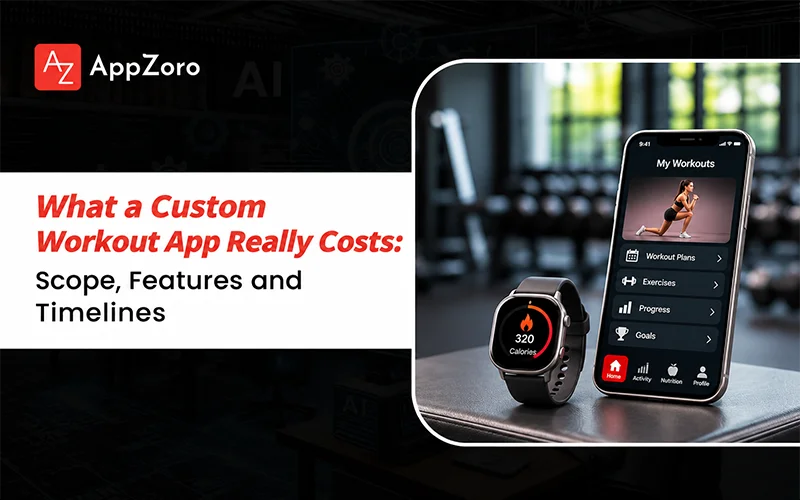
What a Custom Workout App Really Costs: Scope, Features and Timelines

Remember joining a gym in January, writing your first three sessions into a notebook and then losing the whole thing by February because flipping back to last month’s bench numbers was taking longer than the set itself? That is the exact gap a custom workout app is filling and it is also the reason the custom workout app development cost conversation is usually starting in the wrong place. This is why two quotes for what is sounding like the same product are often sitting thousands of dollars apart.
Most founders/gym owners are opening this conversation with a feature list, when the thing they are really buying is a logging and planning loop that somebody is repeating three or four times a week for a year. A feature list is easy to price badly, whereas a loop is forcing the harder questions, meaning who is using it, what they are needing on the gym floor with one hand free and what is happening to their data.
And that loop is really having a short window to prove itself, since UXCam’s 2026 benchmark compilation is putting median Day 30 retention for health and fitness apps at around 5 percent, with the strongest performers reaching 8 to 12 percent. So the product you are paying for has roughly a month to turn into a habit, which is why the budget is working harder in the logging and planning experience than in a long feature list, as AppZoro’s guide on how to develop a fitness app is covering in more depth.
So what should you actually be pricing before a single screen is getting designed? Well, the people you are building for, the first-release scope, the platforms, the data model sitting behind every progress chart and the integrations you are genuinely needing on day one, so let’s break it down.
How Much Does Custom Workout App Development Cost?
The honest answer is that the custom workout app development cost is a range rather than a price and it is moving with seven things, namely who the app is for, how many platforms you are shipping, how deep the workout data model is going, whether coaches are involved, how much custom design is needed, how much backend and sync work is sitting underneath it and how much maintenance you are budgeting after launch.
A plain tracker on one platform, with an exercise library, routines, sets/reps, weights, a rest timer and a history screen, is a genuinely small build landing near the lower tier above. The moment a second platform, coach dashboards, analytics, subscriptions and a smartwatch companion are joining the scope, you are moving through the middle tier towards the advanced one and the reasons are not hard to see, because every one of those is a separate surface to build, test and maintain for years.
The store side is small and predictable and the numbers are worth knowing before they are becoming guesses in a spreadsheet. Apple is charging $99 a year for the Apple Developer Program and Google a one-time $25 for a Play Console account, while the commission is the real line item, since Apple is taking 30 percent as standard and 15 percent under the App Store Small Business Program for developers with up to $1 million in prior-year proceeds and Google is applying 15 percent to auto-renewing subscriptions. On a $30 annual plan that 15 percent is quietly deciding how many paying users your build has to recover. This is not only affecting the launch budget, this is also shaping the business case for each and every year after it. But what inside the product is really moving the number? Let’s take a look.
What Features Affect the Cost of a Custom Workout App?
The workout app features that are shaping the budget are rarely the ones founders are worrying about. An exercise library is mostly content work, whereas the expensive part is the data model sitting underneath it, because sets, reps, weights, RPE, supersets and rest timers all have to be stored in a way that is still queryable two years later when somebody is asking for a twelve-month strength chart.
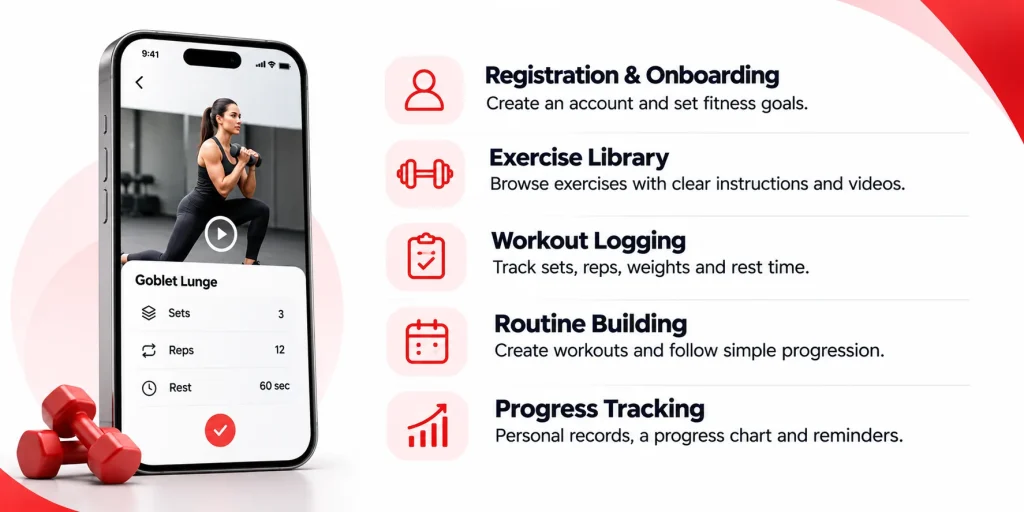
For a first release the core is staying small, resulting in:
- Registration, profiles and a short onboarding capturing goals and experience.
- The exercise library with instructions and demo media.
- Logging and history, with sets, reps, weights and rest timers.
- Routine building and simple progression.
- Personal records, one progress chart and basic reminders.
These don’t just define the first build, they also decide how much of the second one is a rewrite, because a logging schema designed for one user type is rarely surviving contact with coaches/trainers and teams. This is also affecting the brand perception, since an app that is losing somebody’s training history is giving a poor impression before the habit has even started. Everything beyond that core, meaning trainer dashboards, social feeds, detailed analytics, subscriptions and wearable sync, is sitting in the optional column until the loop is proving itself with real users/members and AppZoro’s fitness app development guide is covering that feature-selection call in more depth. So how is all of this translating into scope tiers? Let’s break it down.
Custom Workout App Development Cost by Project Scope
Rather than inventing a figure per feature, this table is comparing three realistic product scopes and that last column is where the quiet budget decisions are hiding:
| Product scope | Representative features | Relative complexity | Major cost drivers |
| Basic workout tracker MVP | Accounts, exercise library, logging, history, one progress chart, reminders | Low to medium | Clean data model, logging UX, one platform, light backend |
| Mid-level workout planner | Routine builder, progression rules, detailed reports, notifications, subscriptions | Medium | Planning logic, aggregation and charting, billing plumbing, second platform |
| Advanced training platform | Coach tools, client rosters, adaptive plans, analytics, social features, wearable sync | High | Multiple user roles, permissions, real-time sync, companion apps, heavier QA |
So a basic tracker is one build, whereas an advanced training platform is really three or four builds sharing a single backend and that is the biggest single reason two quotes for “a workout app” are landing miles apart. The custom workout tracker app cost at the lower tier is also behaving differently over time, since a tracker is mostly needing OS updates while a platform with coaches and subscriptions is needing continuous product work. For a broader view of how scope, team structure, integrations and upkeep are shaping a fitness budget, AppZoro’s fitness app development cost breakdown is the better reference, though it is covering fitness products as a category rather than pricing one workout build. And speaking of what is sitting under the hood, let’s see how technology is moving the number.
How Platform Choice and Technology Affect Development Costs
Platform choice is usually the first real budget decision and it is really affecting testing even more than development. Shipping iOS first is giving you one device matrix and one review process, whereas shipping both platforms from day one is roughly doubling the QA surface even when a cross-platform framework is sharing most of the code, which is why the workout and training app development cost is jumping between a one-platform MVP and a two-platform launch by more than people are expecting.
Native and cross-platform are both defensible and the right answer is depending on what the app is doing rather than on what is trendy, since cross-platform is working well for logging, planning and reporting screens while native is usually behaving better where background activity, health permissions and watch companions are involved.
Underneath all of that, the parts users/members are never seeing are still costing money, resulting in:
- The backend and sync keeping a workout consistent across phone, watch and web.
- Offline handling, because gyms are full of concrete walls and dead spots.
- Analytics, notifications and subscription plumbing with receipt validation and restore flows.
- Third-party APIs such as Apple Health and Health Connect, each with its own permissions model.
These are the line items rarely appearing in a feature list and then appearing in the invoice, which is why a written scope is beating a verbal one every single time. But what about the planning side? Let’s take a look.
Workout Planner App Development: What Adds to the Budget?
Workout planner app development is where budgets are quietly growing, because planning is looking simple on a wireframe and behaving like a rules engine in production. A routine builder with drag-to-reorder, supersets, substitutions and scheduled training days is already more complex than the logging screen and progression logic is adding another layer, since the app has to decide what is happening when somebody is missing a session, failing a lift or repeating a week.
Simple rule-based planning is the sensible starting point, meaning fixed templates, percentage-based progression and substitution lists that a qualified coach has already reviewed, since that route is easier to test and to fix when it is wrong. Adaptive planning is a different build altogether, because it is needing data to learn from, a way to measure whether its suggestions are sensible and expert review before anything is reaching a real person and it is extremely crucial to remember that an automated plan is not medically appropriate for every user, so injury screening, disclaimers and a professional in the loop are belonging in the plan rather than in a later patch. This is not only protecting the user, this is also protecting you.
If the roadmap is widening past training into habits, recovery or nutrition, the product is turning into something broader and the budget is following, so the planning considerations in AppZoro’s guide to building a wellness app are worth reading before that scope is locked in. And speaking of scope expanding quietly, let’s see what wearables are really costing.
Wearable Integrations, Data and Testing Costs
A watch companion is definitely not a settings toggle, it is a second application with its own interface, offline behaviour and release cycle, so beyond the build itself you are paying for device compatibility, permissions handling, real-time sync conflicts when a session is logged in two places and the edge cases only appearing when a watch is drifting out of Bluetooth range mid-set.
The accuracy side is deserving the same honesty. A 2017 Stanford study in the Journal of Personalized Medicine tested seven wrist-worn devices and found that none of them estimated energy expenditure with an error below 20 percent, so wearable readings are working best as context rather than as the number somebody’s progress is judged on, even though newer devices have improved since. Privacy is sitting in the same conversation, since fitness data is sensitive by definition, so consent flows, data minimisation, encryption and a retention policy are belonging in the first release and not in a later compliance scramble.
The practical limits around battery life, phone-to-watch sync and testing on real hardware are covered in AppZoro’s wearable app development guide and it is worth asking whether your first release is genuinely needing a watch app at all. So how long is this taking and what is arriving later? Let’s break it down.
Development Timeline, Maintenance and Hidden Costs
Timelines are following the same scope logic as the budget and AppZoro’s fitness page is stating that an MVP is typically running 3 to 4 months while a mid-level platform with subscriptions and wearable integrations is usually running 5 to 7 months. Those are one company’s delivery norms rather than an industry standard and your own timeline is also depending on how quickly decisions are coming back from your side, which is the variable nobody is putting in a proposal.
The stages are predictable enough, meaning scope, UX and UI with the logging flow first, development in sprints, integration work, device testing and store preparation. And that is not all, because the costs arriving after launch are the ones teams are underestimating most, resulting in:
- OS updates every year, with watch and health APIs changing alongside them.
- Hosting, push, analytics and video delivery, each with its own recurring bill.
- Store fees and commission, continuing for as long as the app is earning.
- Content upkeep, since exercise media and programming are going stale without an owner.
- Support, bug fixing and the small improvements keeping retention from sliding.
Budgeting a maintenance line from day one is making the second year far less painful and it is definitely cheaper than the retrofit otherwise waiting for you. This is the part that is turning a one-off project into a product that is still working from beginning until completion. So how is the number coming down sensibly? Let’s take a look.
How to Reduce Custom Workout App Development Costs Without Sacrificing Quality
The cheapest app is rarely the one with the fewest features, it is the one with the clearest definition, since ambiguity is what is really costing money in development. Name the user and the single problem first, whether that is a lifter logging sets fast, a coach assigning plans to twenty clients, or a gym keeping members engaged between visits and then build only what is serving that.
A sensible cost-control plan is looking like this, resulting in:
- Shipping a small, genuinely useful MVP on one platform before the second is joining.
- Testing the logging and planning loop with real users in a real gym, early.
- Choosing integrations because users are asking, not because competitors are listing them.
- Reusing proven components for auth, billing and analytics instead of customising everything.
- Comparing every quote against one written scope, so the numbers are measuring the same thing.
- Keeping testing, accessibility, security and maintenance inside the budget.
That last point is extremely crucial, since cutting QA or security is not saving money, it is moving the cost into next year with interest attached. If your product is combining training with broader wellbeing features, AppZoro’s wellness app development page is showing how that wider scope is usually described. So who should be building it? Let’s take a look.
How to Choose the Right Fitness App Development Company
Choosing a fitness app development company for a workout product is less about portfolio size and more about whether the team is really understanding repeat-use software, so ask to see something where people are entering data over and over, ask how offline sessions and sync conflicts are handled and ask who is owning the data model when the engagement is ending.
A reasonable checklist is looking like this, resulting in:
- Relevant mobile and fitness experience, with products still live.
- A real discovery stage producing a written scope before any estimate.
- Feature-level estimates instead of one lump sum.
- Hands-on experience with Apple Health, Health Connect and wearable APIs.
- Documented QA, privacy and security practice, including consent flows.
- Clear terms on source-code ownership, documentation and handover.
- A named plan and budget for maintenance after launch.
And that is not all, because the way a vendor is handling the first awkward question is telling you more than any case study, since a partner pushing back on scope early is the one protecting your budget later. If you are wanting that conversation against your own feature list, with the scope written down before any number is attached to it, AppZoro’s fitness app development services page is a reasonable place to start it and we’ve got you covered from beginning until completion. So what is all of this adding up to? Let’s take a look.
Conclusion
So when it is all coming together, the custom workout app development cost is being set by a handful of choices made in the right order, namely who the app is for, how small the first release is staying, how many platforms it is covering, how deep the planning and analytics layers are going, whether wearables and coach tools are in or out and how much maintenance you are budgeting after launch and these choices are extremely crucial because they are shaping both the quote and the product people are keeping on their phone. A well-defined MVP is doing more for a budget than any discount is, since it is turning a vague idea into a scope that vendors can price consistently and your team can actually ship.
And if you are planning a workout tracker, a planner or a full training platform and you are wanting an estimate built around your own users rather than around a generic feature list, AppZoro’s fitness app development team is a reasonable place to start the conversation.
 Profile of Sam Agarwal