
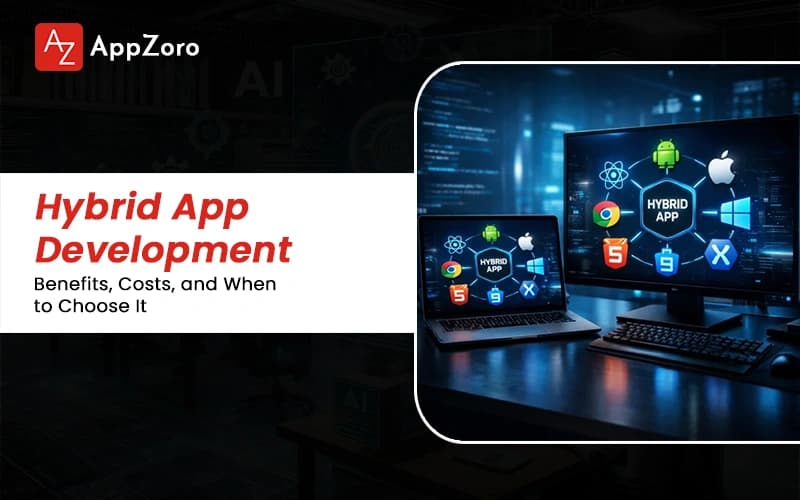
Hybrid app development is the practice of building a single mobile application that runs on both iOS and Android from a shared codebase, instead of writing two separate native apps from scratch. Strong builds in 2026 use modern frameworks to deliver close-to-native performance, often by partnering with a specialized mobile app development company USA to ensure that real backend integration is baked in properly. Most serious hybrid projects land between $40,000 for a focused MVP and over $300,000 for a polished cross-platform product.
Walk into any mobile engineering review on a random morning in 2026 and you will watch the same conversation play out for what feels like the fifth time this quarter. A lead engineer is making the case for going native, a product manager is making the case for shipping faster and somewhere quietly in the corner a CFO is running the numbers on what each path actually costs once you add up two years of engineering salaries side by side.
This conversation used to land squarely on native almost every single time, because the hybrid options simply could not match the polish or raw performance of dedicated iOS and Android builds. That stopped being true somewhere around 2022 and the teams I have watched winning procurement today are increasingly the ones who picked a serious hybrid mobile app development framework, shipped quickly and quietly stopped apologizing about the architecture during sales conversations.
What follows is the version of this conversation an experienced builder would have with a CTO who actually wants to ship something users will love rather than win a debate inside the engineering room. By the end you will know which frameworks earn their seat, what real builds cost and where hybrid still quietly loses to native across specific product shapes.
Why Hybrid App Development Looks Different in 2026
If you were evaluating hybrid app development five years ago, the trade-offs were genuinely uncomfortable in ways that look almost quaint from where we sit today. Animations stuttered visibly on slower phones, native API access felt clumsy enough to make engineers wince and the developer experience was rough enough that most senior teams defaulted to native almost without thinking it through.
That era ended quietly somewhere around 2022, when React Native finished its long architectural rewrite and Flutter crossed the line into genuine production maturity across the ecosystem. The frameworks shipping today deliver close-to-native performance, clean platform integration and a developer experience competitive engineers actually enjoy spending their days inside.
Here is what has actually shifted across the category over the last few years:
React Native and Flutter both crossed the threshold where ninety-five percent of users truly cannot tell the difference from native code on their phones
Capacitor and similar web-to-native bridges quietly matured into legitimate options for content-heavy apps where a web view delivers most of the value
Hiring pools for cross-platform engineers expanded dramatically as more talent moved out of pure native and into hybrid skill sets across the industry
Major brands like Shopify, Microsoft and Discord moved flagship apps onto hybrid stacks, which normalised the architecture across enterprise procurement conversations
What Hybrid Frameworks Actually Deliver Now
Hybrid frameworks now deliver smooth sixty-frame animations, clean access to native APIs and a deployment story that genuinely feels like shipping a single product rather than two separate apps. The key to success is following a modern mobile app development process that treats cross-platform architecture as a unified workflow, closing the performance gap so that most users never notice which stack their favourite app actually runs on.
Why Native-Only Stopped Being the Default Answer
Native-only stopped being the default answer because the cost gap grew uncomfortable for most teams while the quality gap shrank to almost nothing across mainstream use cases. Maintaining two separate codebases for fundamentally similar features quietly burns engineering time that competitors running a hybrid simply spend on product work instead and that compounds across every quarter that passes.
The New Bar Set by Cross-Platform Polish
The new bar in this category got set quietly by a handful of leaders who shipped polished cross-platform apps and watched their App Store reviews stay every bit as high as their native competitors. Founders launching today are not competing against the rough early-era hybrid apps that defined this category in 2018 but against products users genuinely love using.
What Is Hybrid App Development and How Does It Actually Work
If you have ever Googled what hybrid app development is and walked away more confused than when you started, you are honestly not alone across the founder community. Hybrid apps development means writing a single codebase that runs across multiple platforms, an approach often detailed in a custom mobile app development guide to help teams decide between true cross-platform compilation or web-view wrappers based on their specific product requirements.
Hybrid apps development means writing a single codebase that runs across multiple platforms, typically using either a cross-platform framework that compiles down to native components or a web view wrapped neatly inside a native shell.
Here is how the architectural definitions actually map out in practice today:
True cross-platform frameworks like React Native and Flutter compile to genuine native components and deliver performance that most users cannot distinguish from native
Web-view hybrids like Capacitor and Cordova wrap a web application inside a native shell, which works beautifully for content-heavy products with simple interaction patterns
Progressive web apps technically count as hybrid in some definitions but increasingly serve their own separate category as web platforms have matured significantly
What Is Hybrid Mobile App Development in One Sentence
Hybrid mobile app development, at its simplest, is the practice of writing one mobile codebase that runs on both iOS and Android, instead of writing two separate native apps. That single change in approach quietly reshapes hiring decisions, cost models, timeline expectations and maintenance reality across the entire lifecycle of the product.
How Hybrid Differs From Native and Pure Web
Hybrid differs from native because the codebase is shared rather than duplicated across platforms and it differs from pure web because the user experiences a real mobile app rather than a browser tab dressed up to look like one. The architecture sits in the comfortable middle ground that captures most of the native's polish at most of the web's velocity inside the same build.
Why the Distinction Matters During Procurement
The distinction matters quietly during procurement because some buyers carry strong opinions about hybrid versus native that are usually rooted in painful experiences from the pre-2022 landscape. Educating buyers gently on what hybrid app development actually looks like today often turns a near-rejection into a genuine evaluation, which is exactly the conversation you want.
The Best Hybrid App Development Frameworks Worth Knowing in 2026
The hybrid app development frameworks worth taking seriously in 2026 have narrowed down to a handful of mature choices, which is a relief after the chaotic early years of this category. The strongest teams pick a framework based on hiring market and performance needs, often knowing how to choose a mobile app development company that can debug under pressure when something breaks the night before a major product launch.
The strongest teams pick a framework based on hiring market, real performance needs and the team's existing expertise rather than chasing whichever framework happens to be trending publicly this quarter. The right framework is genuinely the one your engineers can debug under pressure at 3 a.m. when something breaks the night before launch.
Here are the hybrid app development frameworks earning their seat in 2026:
React Native remains the default for teams with JavaScript expertise, deep ecosystem support and a hiring pool you can actually fish in across most cities
Flutter has matured into a serious alternative with excellent performance, beautiful default widgets and a developer experience teams genuinely enjoy day to day
Capacitor and Ionic remain strong options for content-heavy products where a web view inside a native shell delivers most of what the product needs
Kotlin Multiplatform has emerged as a credible newer option for teams already deeply invested in native who want to share business logic across platforms
When React Native Genuinely Wins
React Native genuinely wins when your team already knows JavaScript, your hiring market favours React engineers and your product needs broad ecosystem support for payments and analytics. The maturity of the community in 2026 means almost every problem your team will hit while you build a React Native application already has a documented solution sitting somewhere on GitHub, making it a highly reliable path for rapid shipping.
When Flutter Earns Its Premium
Flutter earns its premium when raw performance matters, when consistent UI across both platforms is genuinely important to your design team or when your engineers value the widget system. Teams that follow a comprehensive Flutter app development guide tend to defend the call passionately, as the combination of Dart and hardware-accelerated rendering provides an excellent developer experience and a highly polished end-user product.
When Web-View Hybrids Like Capacitor Still Win
Web-view hybrids like Capacitor still quietly win for content-heavy products where most of the user experience is fundamentally web content presented through a clean native shell. Wrapping a polished web application inside a native container remains the cheapest credible path to a shipped mobile product and the trade-offs are perfectly acceptable across many serious use cases.
A Real Build: Freedom RideShare Rentals
Flutter's case for cross-platform performance isn't just a framework comparison chart — it shows up in real builds under real time pressure. Freedom RideShare Rentals, a Houston-based vehicle rental company serving gig-economy drivers, needed an iOS and Android app fast enough to launch on one timeline and one budget, with a web dashboard to match — exactly the shape of problem hybrid architecture exists to solve.
AppZoro built the mobile app in Flutter, shipping a single codebase to both iOS and Android instead of maintaining two native teams, while a React.js web app gave the company a matching browser experience without starting from scratch on a second product. The backend ran on Node.js and AWS, with Firebase handling authentication and account recovery. On top of that shared foundation, the team layered driver license verification, real-time vehicle tracking with predictive maintenance alerts and compatibility with the verification requirements Uber, Lyft and similar platforms impose on anyone driving for them — plus Podium for customer communication.
None of that required two parallel native codebases. It required one Flutter codebase, one backend and a clear line between what had to be shared and what had to be platform-specific — same-day booking, single-tap rental extensions, unlimited mileage — which is the exact trade-off this guide keeps coming back to: hybrid wins when the product needs to ship broad and fast without the user ever feeling like they got the "cross-platform version" of the app.
The Phases of a Hybrid Build That Actually Ships Clean
Building a serious hybrid product follows a structure that looks similar to native builds on the surface but with specific phases that decide whether your shared codebase pays back later. It requires a carefully selected tech stack for mobile app development that handles navigation patterns, state management and native module strategy efficiently across both the shared code and platform-specific bridges.
A typical project runs through six defined phases across four to nine months total, depending on the scope and complexity of the product surface area. Each phase has its own deliverables, reviewers and quiet ways of going sideways when nobody is watching the platform-specific edge cases carefully enough.
Here is how a healthy phase breakdown actually looks for serious builds in 2026:
Discovery and framework selection runs two to four weeks covering team skill audit, performance requirements and the integration list the product genuinely needs
Architecture and platform planning runs two to three weeks covering navigation patterns, state management, native module strategy and the deployment approach
Core development runs twelve to twenty-four weeks producing the shared codebase, the platform-specific bridges and the integration with backend services
Platform-specific polish runs four to six weeks handling iOS-specific and Android-specific behaviours where the framework's defaults are not quite right
QA, testing and store submission preparation runs four to six weeks covering shared and platform-specific testing across real devices the team owns
Deployment and post-launch maintenance run indefinitely covering bug fixes, OS upgrade compatibility and the small feature work from real user feedback
Discovery Decisions That Decide Everything Later
Discovery is the cheapest phase to invest in properly and the most expensive to skip across every hybrid project I have followed shipping to real users. A two-week framework selection phase that costs ten to twenty thousand dollars routinely saves four to twelve months of painful rework if your team picks the wrong stack and has to migrate later.
The Platform-Specific Polish Most Teams Forget
The polish phase most teams forget covers the iOS-specific and Android-specific behaviours where the hybrid framework's defaults do not quite match platform conventions cleanly. Skipping this work is exactly how teams ship apps that feel almost right and quietly trigger user reviews complaining about something feeling subtly off across the interface.
Why Store Submission Trips Up First-Time Hybrid Teams
Store submission trips up first-time hybrid teams because Apple and Google both have specific requirements that hybrid apps occasionally fail on the first submission attempt. Knowing these requirements upfront and building toward them across the QA phase prevents the painful last-minute rework that quietly delays many first launches in this category.
Hybrid App Development Cost: Real Numbers and Hidden Realities
Most founders ask about hybrid app development cost as if there is one clean number that applies neatly across every project shape inside the category. However, a detailed mobile app development cost breakdown reveals that the build cost is roughly thirty to forty percent of the real three-year spend, with the rest showing up as infrastructure, third-party API fees and maintenance budgets.
The other sixty to seventy percent shows up as cloud infrastructure, third-party API fees, app store cuts, support staffing and the maintenance budget every founder quietly underestimates during their initial pitch deck preparation. Planning honestly for the full picture from day one is meaningfully cheaper than discovering it month by month across the operational year afterward.
Here is how realistic hybrid app development cost actually breaks down for serious builds in 2026:
A focused MVP covering both platforms with three to five core features lands between $40,000 and $80,000 for a clean build with reasonable polish
A full hybrid product with rich features and integrations across both platforms lands between $80,000 and $200,000 depending on scope and complexity
A premium hybrid product with native modules, video, AI features or deep backend integration lands between $150,000 and $300,000 across the first version
Cloud infrastructure typically runs between $200 and $5,000 monthly depending on user volume, feature usage and integration traffic patterns over time
Year-one maintenance typically costs between fifteen and twenty-five percent of original build cost annually, more if shortcuts were taken anywhere upfront
Why Hybrid Saves Thirty to Forty Percent Over Native
Hybrid saves thirty to forty percent over native primarily through the shared codebase that lets one engineer ship a feature for both platforms in roughly the time it would take to ship for one platform natively. That saving translates directly into either more runway, more features or simply better polish across the limited budget early-stage teams genuinely operate inside every quarter.
The Hidden Costs That Trip Up First-Time Hybrid Builds
The hidden costs that trip up first-time builds tend to be the platform-specific polish work, the native modules required for specific features and the maintenance burden as iOS and Android both keep updating their platforms across the year. Budget realistically for these costs upfront rather than discovering them halfway through launch month when your runway is least forgiving.
Year One Maintenance Reality Senior Teams Plan For
Year one of maintenance covers bug fixes, security patches, framework upgrades, OS upgrade compatibility, dependency updates and the small feature work from real user feedback after launch. Budget honestly for this from kickoff or you will quietly pay double during a year when your runway can least afford the surprise sitting on the operational invoice.
Benefits of Hybrid App Development
The benefits of hybrid app development compound across years in ways most founders genuinely underestimate during their initial framework selection conversation. The shared codebase, the smaller engineering team, the faster feature shipping and the simpler maintenance story all add up to real competitive leverage across the lifecycle of the product in market afterward.
That said, hybrid is not the right answer for every product shape and the teams who pretend otherwise often regret the call somewhere around month nine of operation. Honest evaluation of where hybrid wins and where it quietly loses is the most useful framing you can bring into early planning conversations with skeptical stakeholders.
Here are the benefits worth knowing alongside the trade-offs worth respecting honestly:
The shared codebase saves roughly thirty to forty percent of native cost while letting smaller teams ship noticeably more product across the same calendar timeline
Faster shipping velocity compounds across years as features that would take two native teams now ship from one cross-platform engineer in similar calendar time
A smaller hiring footprint genuinely matters for early-stage teams competing against the deeper pockets of established native-first competitors operating in market
Hybrid still loses to native for performance-critical workloads like real-time motion tracking, intensive video processing or tight wearable integration across systems
Why the Shared Codebase Wins Long Term
The shared codebase wins long term because every feature your team ships works on both platforms simultaneously, which compounds engineering productivity quietly across the years. Native teams shipping the same feature set need roughly twice the engineering capacity and that capacity gap compounds into a real competitive advantage for the hybrid team across many quarters.
Where Hybrid Quietly Loses to Native
Hybrid quietly loses to native for products that depend on real-time motion tracking, intensive image processing, complex haptics or deep platform-specific integration that hybrid frameworks still handle slightly less elegantly today. Strava, Apple Fitness and similar performance-critical products genuinely ship native for defensible reasons that show up in their App Store reviews.
The Hiring Reality That Often Decides the Choice
The hiring reality often decides the choice in practice because finding senior React Native or Flutter engineers is meaningfully easier than staffing parallel native iOS and Android teams across most cities. Understanding how to hire the best mobile app developer for these hybrid frameworks allows teams to scale their engineering capacity without doubling their headcount costs, providing a real competitive advantage in a tight talent market.
What Senior Teams Quietly Get Right About Hybrid Builds
The best teams I have watched develop hybrid app products successfully share a small set of habits that compound quietly across the lifecycle of the product. They are not winning because they picked perfect frameworks at kickoff or hired the most expensive engineers anywhere in their region across the team.
They are winning because they treat hybrid as a real architectural commitment rather than a default choice they made simply to save money. That posture changes nearly every decision they make across phases and it shows up clearly in their user retention numbers and App Store review scores across the first two years afterward.
Here is what the senior teams I respect quietly do differently when they develop hybrid app products:
They invest seriously in framework selection during discovery, because they know the choice ripples across hiring, performance and maintenance for years afterward
They protect performance budgets ruthlessly across every feature, because hybrid apps perceived as slow lose users faster than almost any other failure mode in this category
They embrace platform-specific polish rather than fighting against it, accepting that hybrid genuinely means handling iOS and Android conventions thoughtfully rather than uniformly
Why Framework Selection Compounds Across Years
Framework selection compounds across years because the choice ripples directly across hiring decisions, ecosystem maturity and the long-term maintenance burden your team carries quietly. Teams that treat this decision seriously during discovery ship noticeably better products than teams that picked whatever was trending on Twitter during their initial planning week.
How Senior Teams Handle Performance Discipline
Senior teams handle performance discipline by treating cold start time, navigation responsiveness and animation smoothness as first-class engineering concerns from the very first sprint. Hybrid apps that feel sluggish lose users within the first thirty seconds of opening and that perception is genuinely hard to recover across the entire year after launch.
Why Platform-Specific Polish Earns User Love
Platform-specific polish earns real user love because users genuinely notice when an app feels native to their platform rather than uniformly cross-platform across the experience. Respecting iOS conventions on iOS and Android conventions on Android is what separates a hybrid app users genuinely love from one users tolerate quietly until something better arrives.
If you are weighing your next hybrid build and want a no-pitch second opinion on a vendor quote sitting on your desk, our senior team reviews these proposals for founders almost every week. Happy to flag anything underscoped before you sign the contract.
Final Thoughts
Hybrid app development in 2026 is genuinely a better default than it was three years ago and the playbook for shipping something users actually love is more legible across the category than it has ever been before. The teams who win are not the ones with the biggest budgets or the flashiest frameworks anywhere on the market today.
They are the ones who pick the right framework for their hiring market, scope platform-specific polish honestly into the build and treat the shared codebase as the long-term advantage it genuinely is across the lifecycle. That posture quietly changes the build cost, the timeline and the user love your product accumulates across the first critical year of operation.
If the proposals on your desk feel impossible to compare honestly, get a third opinion from someone who has actually shipped hybrid products to real users at scale before. The right partner walks you through the framework trade-offs without flinching, helping you navigate common mobile app development challenges and ensuring your posture changes the build cost, the timeline and the user love your product accumulates.
Leave a Comment