
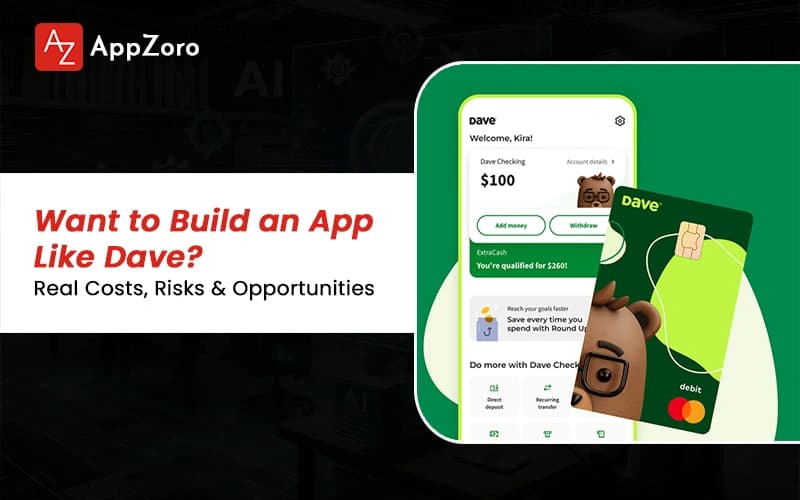
Quick Answer: Developing apps like Dave means building a regulated cash advance product, not just a slick interface. In 2026, many successful fintech founders partner with a mobile app development company USA to ensure the machinery—bank connections, risk models, and compliance—is built to professional standards. A real MVP runs $25,000 to $150,000 over four to six months, as the hard part was never the app itself, but the financial infrastructure and the regulation underneath it.
It usually starts with a screenshot. A founder shows me Dave's clean little interface and says, "I want that, how hard can it be?" I get the instinct, the app looks simple and the market is enormous. However, following a complete custom mobile app development guide is essential here, as it helps you understand that the invisible bank-data access and AML layers are what separate a real product from a demo that can never legally launch in the financial marketplace.
Here's what trips most first-timers up. A cash advance app isn't really a video app or a marketplace with money bolted on. It's a financial institution wearing a friendly logo. You're touching people's bank accounts, fronting them money and pulling it back on payday and every step of that is watched by regulators who do not grade on effort. Build it like a normal app and you'll either get stuck before launch or get a very expensive education afterward.
This is the straight version I wish more founders had heard before they signed anything. What it actually takes to build apps like Dave in 2026, which model to choose, where the real cost and risk hide and how to tell a team that's shipped fintech from one that's about to learn on your dime. Some of this the sales decks skip. I won't.
Why Build Apps Like Dave in 2026?
The pull toward building apps like Dave is easy to understand: the market is huge, the need is permanent and the model is proven. By evaluating the strategic mobile app development benefits, such as recurring usage and clear monetization through fees or subscriptions, you can see how this category offers a defensible moat that scares off lazy competitors once you have successfully integrated the necessary financial plumbing.
Dave proved the demand. Earnin, MoneyLion and a dozen others proved it scales. So the opportunity is real, which is exactly why the space is crowded and why doing it properly matters more than doing it fast.
A few things make this category genuinely attractive to build for, if you go in clear-eyed:
Recurring usage, since people who use a cash advance once tend to come back, which means real retention if the product is fair.
Clear monetization, because unlike a free social app, an advanced tool earns from day one through fees, tips or subscriptions.
A defensible moat, as the compliance and bank-data work that scares off lazy competitors, becomes your barrier once you've done it.
The Opportunity Is Real but So Is the Bar
The trap is assuming "proven market" means "easy entry." The reason apps like Dave look simple is that the companies behind them spent years and serious money on the invisible parts. Navigating common mobile app development challenges such as reliably linking banks and ensuring high-uptime infrastructure is vital to earning user trust. That is the real bar, and it is much higher than the clean UI and friendly logo might initially suggest to a first-time builder.
What earns trust and a place in the app store, is the boring infrastructure: reliable bank links, honest fees and compliance that holds up. That's the bar and it's higher than the clean UI suggests.
Where Dave Itself Set the Template
It helps to study what Dave actually got right, because you're building against that benchmark. Its $1 base membership kept the entry barrier low, the $500 ceiling was generous enough to matter and the budgeting tools gave people a reason to stay between advances.
When Dave shifted to a flat 5% fee on every advance, it also showed the lever every founder will eventually pull: monetization. Knowing how the leaders priced and packaged their product is the cheapest market research you'll ever get.
Cash Advance Apps Like Dave vs. Money Lending Apps Like Dave: Pick Your Model
Before a line of code, every team building apps like Dave faces the decision that shapes the entire build: are you building a cash advance product or a lender? This split matters for concrete reasons; in the realm of enterprise mobile app development, deciding whether you fall under non-recourse cash advance rules or state lending laws determines which identity integrations and audit trails procurement teams will eventually verify during their security reviews.
Money lending apps like Dave extend credit the user hasn't earned and charge interest for it, which behaves like a small loan and lives under a much heavier set of rules.
This isn't a branding choice; it decides which laws you live under. The split matters for a few concrete reasons:
A non-recourse cash advance, with a flat fee and no mandatory interest, often isn't legally classified as a loan, which lightens the regulatory load.
An interest-charging model falls squarely under state lending laws, licensing and rate caps in every state you operate.
The repayment mechanics differ, since advances pull automatically on payday while loans usually run on their own schedule and need different servicing.
Why Most Founders Should Build Cash Apps Like Dave First
For most teams starting out, building cash apps like Dave, the earned-wage kind, is the saner first move. Utilizing hybrid app development allows for a faster, cheaper path to launch on both iOS and Android, which is especially effective when the non-recourse, no-interest structure keeps you out of the heaviest lending regulations and streamlines your initial market entry while preserving capital for future scale.
They also feel friendlier to users, since there's no APR and no debt spiral by design and that goodwill is part of why the category took off. You can always add lending products later, once you have the licenses and the risk data to support them.
When the Lending Model Earns Its Complexity
That said, the lending route isn't wrong, it's just heavier. If your plan needs larger amounts or longer repayment than a paycheck advance allows, you're genuinely in lending territory and should embrace it rather than dodge it.
Building money lending apps like Dave means getting state licenses, building real underwriting and handling adverse-action notices under FCRA, all of which cost time and money. The payoff is a product that can do more than bridge to Friday. Just go in knowing the compliance bill is bigger.
The Core Build: What Sits Behind Apps Like Dave Cash Advance
Once the model is settled, you can scope the actual build and the feature set. Adhering to a standard mobile app development process ensures that risk tuning and compliance work are treated as foundational steps rather than launch-day formalities, protecting the project from being derailed by unexpected regulatory scrutiny. This unglamorous sequence is what separates the teams that ship reliably from those that get stuck in an endless cycle of mid-build architectural rework.
Build phase | Rough cost | Timeline | What it covers |
Discovery & compliance plan | $8,000–$20,000 | 3–5 weeks | Model, licensing map, risk approach |
MVP build | $25,000–$80,000 | 12–16 weeks | Onboarding, bank sync, advances, payout |
Risk tuning & beta | $15,000–$40,000 | 6–10 weeks | Underwriting, fraud, real-user testing |
Scale & extras | $50,000+ | Ongoing | AI underwriting, payroll links, banking |
That table is the honest shape of the build and the pattern jumps out fast: the MVP is only part of the spend. The risk tuning and compliance work that surrounds it often costs as much as the app itself and skipping them is how a launch quietly turns into a recall.
The Features Users See and the Ones They Don't
The visible features are the easy brief: a clean signup, a balance, and a repayment screen. However, it is crucial to understand how long it takes to develop mobile apps of this complexity, as moving money in seconds and verifying identities across multiple states adds months of background engineering that UI-only timelines often overlook. A founder who budgets only for the screens is budgeting for maybe a third of the real work required to launch.
A founder who budgets only for the screens is budgeting for maybe a third of the real work and the missing two-thirds is exactly where these products live or die.
Don't Forget the Budgeting Hook
One thing the leaders understood is that apps like Dave that people open only when they're broke make for a fragile business. The budgeting tools, balance forecasts and bill reminders are what keep users engaged between advances and lower your risk at the same time.
They aren't a nice-to-have you add in version three. Built early, they turn a one-off rescue into a product people actually keep on their phone.
The Hard Parts: Bank Data, Compliance and Underwriting
This is where building apps like Dave gets genuinely hard and where the real risk lives. Any of the advanced apps like Dave you admire rests on three pillars that consumers never think about: bank data access, regulatory compliance and underwriting. Get these right and the app feels effortless. Get them wrong and you either can't launch or you bleed money to fraud and defaults.
Bank data comes first, because everything else depends on it. You connect to users' accounts through open-banking providers which let you read income and spending to judge risk. You must choose the right mobile app database to ensure that this sensitive income data is stored securely and remains accessible for the sub-second latency required for real-time advance approvals and automated risk checks throughout the daily operating cycle.
Compliance Is the Architecture, Not a Checkbox
The costliest mistake I see is treating compliance as something to bolt on near launch. State lending laws, fee caps, and AML obligations all influence how you store data and move money, so they have to shape the build from the first sprint. Implementing rigorous mobile application security testing strategies is non-negotiable to protect this data from breaches that could lead to immediate regulatory shutdowns or a total loss of customer trust.
Founders building apps like Dave who skip this end up rebuilding the core or worse, launching something a regulator shuts down. Treat compliance as core engineering and budget for a fintech-literate lawyer early.
Underwriting and Instant Payout: Decide Your Margins
The other make-or-break pieces are deciding who to trust and how fast you can pay them. Payout speed matters just as much as risk, and learning how to use AI in mobile app development can help automate underwriting on cash-flow data, keeping defaults from eating your business while leveraging modern rails for instant transfers. Weak underwriting or slow, costly payouts will quietly sink even a beautiful app, regardless of how much you spent on the interface.
Payout speed matters just as much: rails like FedNow and RTP now make truly instant transfers cheaper, which lets you compete on the fast delivery users expect. It's why the advanced apps like Dave that last invest as heavily in their risk model as in their interface. Weak underwriting or slow, costly payouts will quietly sink even a beautiful app.
What It Costs and How to Choose a Partner
After all the moving parts, the real cost of building apps like Dave comes into focus. You should learn how to choose a mobile app development company that asks the right regulatory questions and has a verifiable history of shipping products that move real money. The spread in quotes is almost entirely the invisible work—compliance and bank-data plumbing—which is exactly the work a suspiciously cheap quote leaves out of its proposal.
The spread is almost entirely the invisible work, the compliance, the bank-data plumbing, the risk model, which is exactly the work a suspiciously cheap quote leaves out.
So the partner you choose matters more than almost any other decision. A capable team shows what it knows in the questions it asks before it pitches you:
Do they ask which model you're building, cash advance or lending, before they talk about screens and colors?
Do they raise KYC, AML and state compliance early or treat regulation as someone else's problem?
Have they actually shipped a fintech product that moves real money, with the scars to prove it?
Why the Cheapest Quote Costs the Most
A quote far below the others almost always means someone scoped Dave as a normal app and ignored the fintech underneath. Consulting a detailed mobile app development cost breakdown will reveal that fraud controls and instant-payout integrations are significant line items that must be budgeted for upfront to avoid expensive surprises. Paying a fair price for a team that has built compliant products is nearly always cheaper than paying twice due to a failed review.
Paying a fair price for a team that has built compliant cash advance products is nearly always cheaper than paying twice, once for the cheap build and again for the rebuild after it fails review.
Build, Buy or Partner
You don't have to build every piece from scratch and the smart move is often a mix of licensing and custom work. To manage this balance, you must know how to hire the best mobile app developer who can distinguish between commodity plumbing and the custom underwriting logic that provides your startup with its primary competitive advantage. A good partner helps you draw that line instead of quietly charging you to reinvent everything from the ground up.
The custom work should go where you differentiate, your underwriting, your user experience, your monetization, while the commodity plumbing leans on proven providers. A good partner helps you draw that line instead of quietly charging you to reinvent it.
Thinking of building your own app like Dave? The cash advance space is booming and founders ask us about it constantly but the hard parts hide exactly where consumers never look: the bank-data integration, the lending compliance and the underwriting that keeps the whole thing from sinking.
If you're weighing a fintech build, our senior team has shipped this kind of product and we'd rather map the real costs and regulations with you up front than after launch.
Final Thoughts
Building apps like Dave in 2026 comes down to one mindset shift: you're not building an app, you're building a regulated financial product. For those focused on how to develop an app and make money in the fintech space, success is determined by respecting the hard parts-the bank connections and underwriting-to ensure the business model remains sustainable. Fund the plumbing and the compliance as seriously as the screens, because that's where these products actually live and survive.
The opportunity is genuinely there, the market is enormous and the need is permanent but that same appeal is why the space rewards the teams who respect the hard parts and punishes the ones who don't. Whether you build a flat-fee cash advance or a full lending product, the rule holds: fund the plumbing and the compliance as seriously as the screens, because that's where these products actually live.
So before you commit, get clear on your model, be honest about the regulatory weight you're taking on and talk to people who've shipped fintech that moves real money. The right partner will be straight with you about cost, licensing and risk long before the first screen gets designed. That candor is worth far more than a low quote, because in this category, the shortcuts don't just cost money, they can cost you the right to operate.
Leave a Comment