
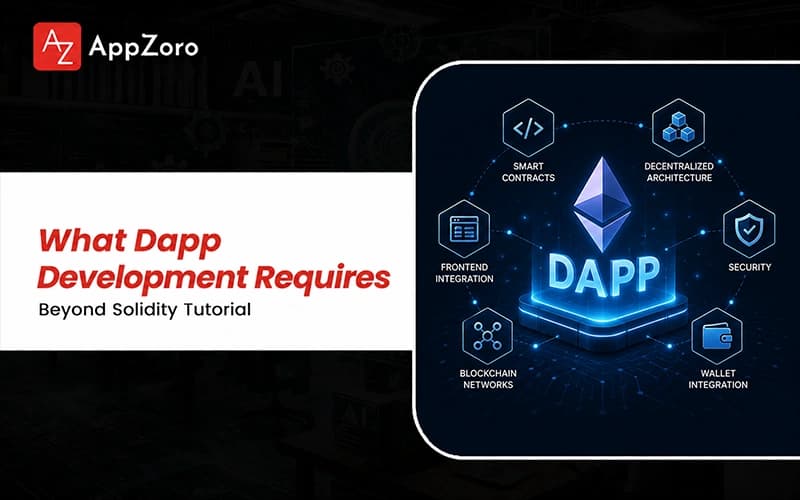
Quick Answer: Dapp development is the practice of building decentralised applications combining smart contracts with frontend interfaces and wallet integration. To ensure high-quality execution, many founders partner with a specialized mobile app development company USA that can navigate the complexities of Hardhat, Foundry, and OpenZeppelin primitives. Modern 2026 builds rely on serious audit work through firms like Trail of Bits before mainnet deployment. Realistic project budget lands between $40,000 for a focused MVP and over $300,000 for serious DeFi protocols.
A founder I work with showed me her smart contract audit report last spring with one finding circled in red: A single reentrancy vulnerability in the staking contract her team was hours from deploying to the Ethereum mainnet. The OpenZeppelin auditor caught it on the third pass, after two earlier reviews missed the same pattern and the founder quietly admitted she had not understood what reentrancy was until that conversation.
The fix took six hours; the alternative would have been losing the entire staking TVL to the first attacker who recognised the pattern. The dapp development conversation that followed was the version most founders never have before signing their first audit engagement.
That story is the version of Web3 reality most teams never hear during chain-vendor pitch decks, because every team selling you their L2 has strong incentives to highlight deployment speed and skip the audit reality, deciding whether your contract holds funds.
Teams shipping in 2026 treat security as a structural design constraint from week one; teams lose fork a template, skip the audit and discover the gap when their contract gets drained on day three.
What follows is the conversation an experienced Web3 builder would have with a founder over coffee rather than the polished pitch deck a chain ecosystem fund delivers. By the end you will know what the work actually requires, where each chain choice breaks at production and how senior teams build through audit gates without losing runway to incidents.
What Is Dapp Development in 2026 and Why the Category Looks Different
What follows is the version of Web3 reality that an experienced builder would share, often starting with a custom mobile app development guide to ensure the backend logic deployed to blockchain networks aligns with business goals. The discipline today means building applications where logic lives in smart contracts, with frontends communicating through wallet integration and chain-aware libraries.
What changed across 2022-2025 was operational maturity. L2 networks (Base, Arbitrum, Optimism, Polygon) became the default deployment target for consumer applications because Ethereum mainnet gas fees made anything but high-value DeFi economically untenable. Account abstraction through ERC-4337 became production-ready, removing the seed phrase UX nightmare. Audit standards matured into something resembling real software engineering rather than theatrical signalling.
Here is what defines the category in 2026:
Smart contracts (Solidity for EVM, Rust for Solana, Vyper for safety-critical logic) deployed to L1 or L2 networks with explicit gas budgets
Frontend integration through wagmi/viem (EVM) or web3.js/Solana wallet adapters, with account abstraction layered for UX
Audit gates before mainnet from firms like OpenZeppelin, Trail of Bits, ConsenSys Diligence, Spearbit or Code4rena
What the Category Means at Its Honest Definition
At its simplest, the category means building applications where critical state and logic live in smart contracts on a blockchain rather than centralised servers, with frontends that interact through wallet-signed transactions. The on-chain versus off-chain choice shapes nearly every architecture decision downstream.
Why L2 Networks Became the Default Target
L2 networks became the default across 2023-2025 because Ethereum mainnet gas fees made consumer applications economically impossible, while Base, Arbitrum, Optimism and Polygon delivered Ethereum's security inheritance at lower transaction costs. The fee differential typically runs 10-100x cheaper.
How Account Abstraction Changed UX Expectations
Account abstraction through ERC-4337 changed UX expectations because users no longer have to manage seed phrases or hold native chain tokens for gas. Modern teams integrate it by default for consumer products to realize the strategic mobile app development benefits of a smoother onboarding experience, which effectively closed the UX gap against centralized competitors in the modern market.
How to Develop a Dapp: The Honest Process Senior Teams Follow
If you are searching for how to develop a dapp without burning runway on security incidents, the honest answer is that the mobile app development process and its order of operations matters more than the framework choice. The teams I watched succeed follow a specific sequence: chain selection, contract architecture, local testing, testnet validation, audit, then mainnet, rather than the parallel chaos first-time teams fall into.
The pattern stabilised across 2024-2025. Pick the chain based on user economics rather than ecosystem hype, write contracts using audited primitives (OpenZeppelin, Solmate), test exhaustively with Foundry or Hardhat, including fuzzing, deploy to testnet for at least two weeks of public exposure, then audit before mainnet:
Chain selection in week one based on transaction cost economics, user wallet preferences and bridge availability, your product needs
Contract architecture using OpenZeppelin libraries for ERC-20, ERC-721, ERC-1155, access control and proxy patterns
Audit engagement four to six weeks before planned mainnet deployment with at least one tier-1 firm
Why Chain Selection Happens Before Contract Writing
Chain selection happens before contract writing because the language, gas model, and wallet ecosystem fundamentally shape what you build. Teams must evaluate various mobile app development frameworks and chain-specific SDKs early on, because realizing your product economics only work on Solana rather than EVM chains at month three usually results in an expensive architectural rewrite.
How Senior Teams Use Audited Primitives
Senior teams lean on OpenZeppelin's libraries for standard token implementations, access control and upgradability rather than writing custom versions. The OpenZeppelin codebase has been audited across thousands of deployments and most exploits I watched across 2023-2025 came from teams reinventing rather than reusing.
Why Testnet Exposure Catches What Local Tests Miss
Testnet exposure catches what local tests miss because real users with real wallets behave differently from your test suite. Running on Sepolia, Base Sepolia or Solana Devnet for two to four weeks before mainnet surfaces edge cases. Foundry fuzzing cannot reproduce.
The Dapp Development Roadmap That Actually Survives Audit Reality
A serious dapp development roadmap in 2026 runs through six phases across four to nine months total, depending on contract complexity and audit scope. This timeline must account for rigorous mobile application security testing strategies to catch reentrancy vulnerabilities and access control gaps, ensuring that the team is shipping a product capable of safely holding customer funds rather than a contract that quietly drains.
The strongest teams I watched scope the sequence to give audit firms enough time and clean enough code to review thoroughly. Rushing the audit window is exactly how reentrancy vulnerabilities, integer overflows and access control gaps slip through:
Discovery and chain selection (2-3 weeks) covering user economics, ecosystem fit and bridge requirements
Contract development (8-16 weeks), producing smart contracts, library integration and test suites
Frontend integration (4-8 weeks), producing the wagmi/viem or web3.js layer connecting wallets
Testnet rollout (2-4 weeks) with real user testing and bug bounty
Audit gate (4-6 weeks) covering at least one tier-1 audit with formal remediation
Mainnet deployment and monitoring (ongoing), covering on-chain monitoring and incident response
Why Discovery Decides the Build Quality
Discovery decides build quality because the team maps user economics, ecosystem fit and audit timeline upfront to produce a detailed mobile app development cost breakdown that survives the launch. Teams skipping this phase often discover that their gas model fails the user base they wanted, forcing them to rebuild their architecture in month three when they should be scaling.
How to Sequence Audit Engagement Correctly
Sequencing audit correctly means booking the firm four to six weeks before planned deployment with code roughly 90% complete. Booking later means accepting a tier-2 firm or delayed launch; booking earlier means paying for audit time when code is still changing meaningfully.
Why Monitoring Cannot Be an Afterthought
Monitoring cannot be an afterthought because mainnet deployment is the start of real work, not the end. Teams using Tenderly, OpenZeppelin Defender or Forta agents catch unusual patterns within minutes; teams without monitoring discover exploits when TVL drops to zero.
Custom Dapp Development vs Templates and the Real Cost Breakdown
The custom dapp development versus template fork conversation hinges on TVL ambition and logic complexity. Forking an audited template (Uniswap V3, Aave V3 or simpler primitives from OpenZeppelin) saves engineering time and inherits proven security properties but locks your product into the original architecture decisions. Custom work costs more upfront but lets you implement logic templates do not cover and own the audit narrative end-to-end.
Most procurement skips the honest cost math because vendors quote contract development separately from audit, monitoring, frontend and post-launch incident response, which decides whether the product survives:
Forked templates with light customisation land between $40,000 and $80,000, including a single audit
Custom builds covering original contract logic plus tier-1 audit land between $90,000 and $200,000
Premium builds for serious DeFi protocols with multi-audit coverage land between $200,000 and $500,000+
Why Template Forks Quietly Inherit Risk
Template forks inherit risk because every modification to the audited base potentially introduces vulnerabilities that the original audit did not cover. Teams forking Uniswap V3 and changing fee logic routinely surface findings that their fork did not anticipate.
When Custom Work Justifies Its Premium
Custom builds justify their premium when your protocol logic differs from existing primitives or when TVL ambition warrants a heavy audit investment. To execute this, you must hire the best mobile app developer with a deep understanding of Solidity or Rust, as owning the audit narrative end-to-end is what protects your protocol from the exploits that frequently target template forks.
Why Cost Estimates Routinely Miss Audit Budget
Dapp development cost estimates miss the audit budget because the contract development quote does not include the $30,000-$150,000 audit fee, remediation engineering or bug bounty budget mainnet contracts need. Founders scoping honestly land projects on budget; founders are missing the audit math rebuild plans mid-procurement.
What Senior Teams Quietly Get Right About Developing Dapps in Production
The strongest teams I watched succeed at developing dapps share disciplines compounding across years. They win because they treat the project with the same rigor found in what is agile methodology, picking practices selectively and protecting team autonomy from ceremonial creep while ensuring that security gates remain a structural design constraint throughout the build.
Here is what senior teams do differently when developing dapps in 2026:
They book the audit four to six weeks before deployment rather than treating it as a last-minute check
They lean on OpenZeppelin libraries and proven primitives rather than reinventing standard patterns
They run a testnet for at least two weeks of public exposure before the mainnet, with bug bounty scoped explicitly
Why Audit-First Architecture Compounds Long-Term Value
Audit-first architecture compounds value because every contract upgrade, integration partner and regulatory review gets faster across the protocol's lifecycle. By preparing for the common challenges of mobile app development early-such as platform churn and maintenance-teams who built audit posture into week-one architecture can spend their days scaling instead of constantly patching vulnerabilities.
How Bug Bounty Programs Catch What Audits Miss
Bug bounty programs through Immunefi or HackerOne catch what audits miss because real attackers think differently from internal teams. The teams I watched succeed scope bounties competitively (typically 10% of TVL for critical findings) and treat researchers as long-term partners.
Why On-Chain Monitoring Decides Incident Response
On-chain monitoring decides incident response because mainnet exploits unfold over minutes rather than hours and teams without monitoring discover exploits when Discord fills with angry users rather than when the first unusual transaction lands.
If you have a dapp engagement on your desk and want a no-pitch second opinion on whether the audit scope covers your real contract risk, our senior team reviews these proposals almost every week. Happy to flag security gaps before you sign.
Final Thoughts
Dapp development in 2026 is a more disciplined category than three years ago but only if you bring audit-first architecture, honest testnet exposure and proper monitoring into procurement. The capabilities of modern Web3 stacks are useful; the surface-level "deploy in a day" promises chain ecosystem funds market are mostly insufficient against real attackers.
If the proposals on your desk feel impossible to compare honestly, you should learn how to choose a mobile app development company that understands the OpenZeppelin patterns and has a verifiable history of shipping secure contracts. The right partner walks you through the audit process without flinching, because they have lived inside enough incidents to know exactly where the architectural patterns break.
Leave a Comment