
RAG in Healthcare: How Retrieval Is Making Clinical AI Safer to Trust
Think about a clinician asking an AI assistant which contrast protocol applies to a patient with reduced kidney function, and getting back an answer that sounds completely authoritative, reads beautifully, and is quietly wrong because the model is recalling guidance that was updated two years ago. Nobody in that moment has any way of telling, because a confident wrong answer and a confident right answer are looking absolutely identical on screen, and this is exactly the problem that has kept so many promising clinical AI projects across the healthcare industrysitting in the sandbox rather than going anywhere near a real patient. So what is RAG in healthcare actually fixing here? Well, it is giving the model a library to check before it opens its mouth, so that each and every answer is being built from documents you control rather than from the model’s memory of the open internet.
The benefits of RAG are real and the clinical research is backing them, however the same research is also showing some failure modes that very few vendors are talking about, so let’s break it down properly.
What RAG in Healthcare Actually Means
Retrieval-augmented generation is an architectural pattern rather than a model. When somebody is asking a question, the system is first searching a knowledge base in real time, which in healthcare might be your clinical guidelines, formulary, protocol library, published literature or the patient record itself, and then it is handing the most relevant passages to the language model along with the question. The model is writing its answer from that retrieved material instead of from memory alone.
This distinction is mattering more than it sounds, and if you want the full architectural comparison, our guide to how retrieval and a plain model really differ is covering it properly. The short version is that RAG is not replacing the model, it is feeding it, and every RAG system is still contains a language model underneath doing the actual writing.
The practical consequence is traceability. A plain model is producing an answer that you simply have to trust, while a retrieval system is producing an answer alongside the documents it came from, which means a clinician can check the source in seconds rather than taking it on faith. Answers that nobody is able to verify don’t just slow adoption down, they also affect the trust that clinicians/care teams are placing in every other answer the system is giving, and this single property of traceability is doing more for clinical adoption than any accuracy benchmark ever has.
But healthcare is not simply enterprise software with stricter passwords, and the differences are running deeper than most teams are expecting, so let’s take a look.
Why Healthcare RAG Is Different From Enterprise RAG
A retail chatbot that is retrieving the wrong returns policy is creating an annoyed customer, while a clinical assistant that is retrieving the wrong dosing table is creating a patient safety incident, and this difference in consequence is reshaping every design decision that follows. On top of that, every build is sitting under HIPAA from day one, which is constraining where your vectors live, who can query them and what gets logged.
The PHI problem is the one that is catching teams out most often. The moment a patient record enters your retrieval pipeline, the embeddings, the vector store, the prompt logs and often the model provider’s infrastructure are all holding protected health information, and each of those is needing a Business Associate Agreement and an audit trail behind it. This is why PHI handling has to be designed in rather than bolted on, because retrofitting it after a pilot has already indexed real charts is usually meaning starting the data layer again.
And that is not all, the source material itself is behaving differently. Clinical documentation is dense, abbreviated, contradictory across time and full of negations that retrieval systems are handling poorly, because “no history of myocardial infarction” and “history of myocardial infarction” are looking almost identical to a similarity search. If your corpus is the EHR records your retrieval layer is reading from, then chunking strategy, temporal ordering and negation handling are becoming engineering problems long before prompt design is.
So with all of that stacked against it, does healthcare RAG actually work? Well, the published evidence is more encouraging than you might expect, and the reasons are not hard to see.
The Benefits of RAG in Healthcare That the Research Is Supporting
The rag benefits worth taking seriously are the ones that have been measured by somebody other than a vendor, and over the past two years a reasonable body of peer-reviewed evaluation has finally accumulated.
| Study | Setting | What it measured | Result |
| Radiology contrast media consultation, PMC (2025) | Local LLM, contrast protocols | Hallucination rate, clinical accuracy | Hallucinations eliminated, 8% to 0%. Accuracy 14.2 to 21.5 of 25 |
| MEGA-RAG, Frontiers in Public Health (2025) | Public health question answering | Hallucination reduction vs four baselines | Over 40% reduction, accuracy 0.79 |
| RAG variants for clinical decision support, Electronics (2025) | 250 de-identified patient records | Twelve RAG variants compared | Best variant reached 5.8% hallucination rate |
| Medical hallucination benchmark, arXiv (2025) | Multiple models and prompting strategies | Structured prompting plus retrieval | Over 10% reduction in hallucinations |
The pattern across all of these is consistent. Retrieval is reliably improving factual grounding against a plain model baseline, and in the better-controlled settings the improvement is substantial rather than marginal. The radiology study is also reporting that the RAG-enhanced local model was responding faster than the cloud models it was tested against, which is mattering a great deal if your compliance position is requiring everything to stay on your own infrastructure.
Beyond accuracy, the benefits of RAG that teams are valuing most in practice are the operational ones. You are updating clinical knowledge by updating documents rather than retraining anything, you are keeping the evidence trail that governance committees are asking for, and you are keeping your proprietary protocols out of a model vendor’s training data entirely. This not only saves you the cost and the delay of retraining every time a guideline changes, this also means your governance team is able to see exactly which document version an answer came from, which is definitely making that review conversation a much shorter one.
All of which is sounding excellent, and it genuinely is, so the obvious next question is where teams are actually putting all of this to work, let’s take a look.
Healthcare RAG Use Cases That Are Reaching Production
The healthcare rag use cases that are genuinely moving past pilot stage are the ones where a correct answer already exists somewhere in a document and the hard part is finding it quickly.
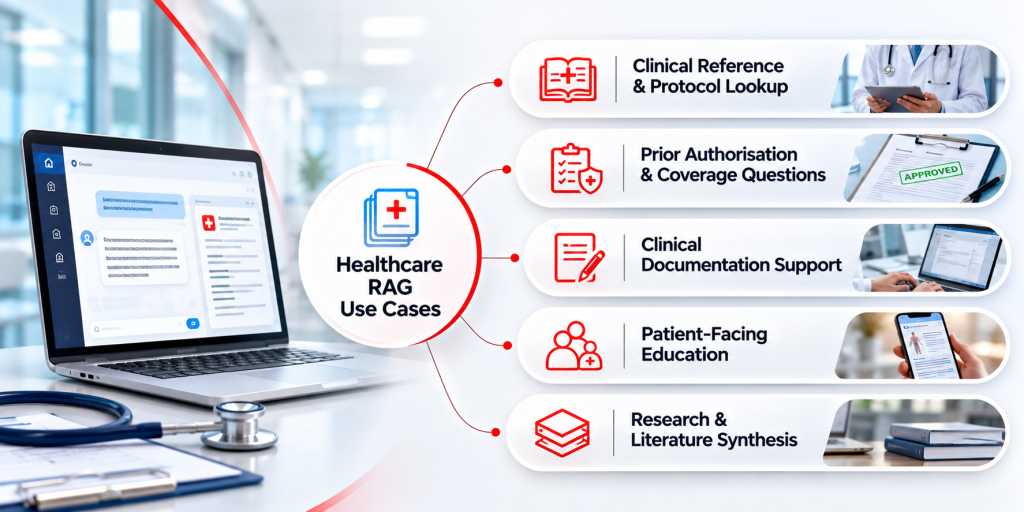
Clinical reference and protocol lookup is the clearest win, where a clinician/pharmacist is asking a question in plain language and getting back an answer with the guideline passage attached. Prior authorisation and coverage questions are another, since payer policy documents are long, changeable and nobody is enjoying reading them. Clinical documentation support is a third, although it is overlapping heavily with clinical documentation and admin workload more broadly.
Patient-facing education is working well too, with answers drawn from your own approved materials rather than from the open web, which is giving your compliance team something they can actually sign off on. Research and literature synthesis is a natural fit, because the whole task is retrieval-shaped from the start.
Two boundaries are worth drawing clearly here. RAG is not a diagnostic model, and diagnostic support is a different problem again that is depending on imaging models and validated clinical algorithms rather than on document retrieval. It is also not a prediction engine, so anything that involves forecasting a risk score rather than retrieving existing evidence is belonging to a different architecture entirely.
Where RAG is genuinely extending is upward, into agents that are acting on what they retrieve by booking, escalating or drafting rather than only answering. All of these use cases are looking excellent in a demo, however a demo is very rarely the place where these systems are coming unstuck, so let’s break down the other side of it.
Where RAG for Healthcare Is Quietly Failing
Here is the part that vendor material is leaving out. Retrieval is improving grounding on average, however the averages are hiding some failure modes that are genuinely alarming once you see them, and rag for healthcare is where the stakes are making them matter.
A 2026 clinical evaluation found that retrieval over raw clinical text produced an 8.7-fold increase in unsupported claims compared with the baseline, which is directly contradicting the assumption that grounding is always helping. The explanation is not mysterious, because raw clinical notes are dense and temporally tangled, so a retriever that is pulling three plausible-looking passages from different admissions is handing the model material that is conflicting with itself. The model is then doing what models do, which is producing something fluent out of whatever it was given.
The Conversation Length Problem
The finding that should be changing how you test is this one. Researchers ran the same clinical query one hundred times at varying dialogue lengths, and with no prior conversation the system was highly reliable at a 5% hallucination rate. After only ten prior exchanges that rate climbed to 40%, and at fifty exchanges it was still fluctuating between 37% and 44%. The cause was irrelevant context accumulating in the conversation history and pulling retrieval off target.
This is extremely crucial for anyone planning a clinical assistant/copilot, because almost nobody is testing this way. Teams are evaluating single questions in isolation, the numbers are looking excellent, and then the system is deployed into a workflow where a clinician is having a twenty-turn conversation across a shift. Single-turn benchmarks are simply not telling you what will happen there.
So the question is not really whether RAG is working, it is what separates the builds that are holding up from the ones that are drifting, and let’s break that down.
What a Clinically Safe RAG Build Is Requiring
The teams that are getting this right are treating retrieval as an information retrieval problem first and a language model problem second, resulting in a build that is prioritising:
- Hybrid retrieval combining dense and keyword search, with a reranker on top.
- Chunking that is respecting clinical document structure rather than cutting at arbitrary character counts.
- Explicit negation and temporal handling, so old and ruled-out findings are not surfacing as current.
- Conversation-length testing, not only single-turn benchmarks.
- Citation display, so every answer is showing the clinician where it came from.
- A clinician in the evaluation loop from the start, not just at user testing.
- PHI boundaries documented across embeddings, vector store, prompts and logs.
The evaluation evidence is supporting this fairly directly, with the clinical decision support study finding that the strongest pipelines were combining dense retrieval, keyword retrieval and cross-encoder reranking rather than relying on vector similarity alone. This is work that is sitting in the retrieval layer, which is precisely where most teams are underinvesting while they are busy comparing models.
Budget is the other thing worth settling early, and since the range is depending so heavily on corpus size, hosting posture and validation load, what implementing AI in healthcare is costing is breaking the numbers down more usefully than any single figure would here. If you want this layer built against your own protocols and record systems rather than assembled from a template, our healthcare software development work is covering the retrieval pipeline and the compliance architecture together.
Conclusion
So, RAG in healthcare is genuinely earning its place, and the peer-reviewed evidence is supporting that rather than only the marketing that is wrapped around it. Retrieval is cutting hallucination substantially against plain model baselines, it is giving clinicians a source they can check, and it is letting you update clinical knowledge without retraining anything. What the same evidence is also showing is that the naive version is failing in ways that single-turn demos are never revealing, particularly across long conversations and messy source text, so the difference between a safe build and a risky one is sitting almost entirely in retrieval quality and in how honestly you are testing it.
If you are scoping a clinical AI build right now and want a straight second opinion on the retrieval design and the PHI boundaries before anything is committed, our healthcare app development team is happy to go through it with you from beginning until completion, and we’ve got you covered whether you are starting fresh or rescuing a pilot that is drifting.
Frequently Asked Questions
What is RAG in healthcare in simple terms?
It is an architecture that lets an AI assistant look things up in your trusted clinical documents before answering, so the response is built from sources you control rather than from the model's training memory.
What are the main benefits of RAG for healthcare teams?
Better factual accuracy, answers that are traceable back to a source document, knowledge you can update by updating files rather than retraining, and your proprietary protocols staying out of a vendor's training data.
Is RAG eliminating hallucinations in clinical AI?
Not reliably. One radiology study did see hallucinations fall from 8% to zero under controlled conditions however, other evaluations are showing rates climbing sharply over long conversations, so retrieval is reducing the problem rather than removing it.
Is healthcare RAG HIPAA compliant by default?
No, compliance is depending on how you are handling PHI across embeddings, the vector store, prompt logs and your model provider, and each of those is needing a BAA and an audit trail of its own.
What is mattering most when building RAG for healthcare?
Retrieval quality, by a clear margin. Hybrid search with reranking, clinically aware chunking, negation and temporal handling, and testing across realistic conversation lengths are all doing more for safety than swapping one language model for another.
 Profile of Lakhan Soni