Picture a Monday morning where three loads are being rescheduled, one driver has called in sick, another is sitting in a dock two hours longer than planned, and your dispatcher is holding all of it together with a shared spreadsheet, a phone and a whiteboard that somebody wiped by accident on Friday. The information is technically all there, it is simply scattered across tools that are not talking to each other, so your dispatcher is spending the morning rebuilding a picture that the system should have been giving them already.
This is where trucking dispatch software development is coming in, pulling load planning, driver assignment, vehicle availability and live status into one screen that your dispatchers/drivers are both working from. If you want the wider view of where this is sitting inside the bigger software picture, our logistics software development guide is covering the full range of systems and how they are connecting to each other.
But what is dispatch software actually doing day to day, and what is it going to take to build one? Well, let’s break it down.
What Is Trucking Dispatch Software and How Does It Work?
Truck dispatch management software is the system sitting between your freight and your fleet, taking a load that needs moving and turning it into an assignment that a specific driver, in a specific truck, is able to run on a specific day. It is holding your load board or order intake, your driver and vehicle availability, your schedules, your live status updates and the records that are proving what happened afterwards, and it is keeping each and every one of those in one place instead of five.
This is where people are often confusing dispatch software with a full fleet platform, and the distinction is extremely crucial when you are scoping a project. Fleet dispatch management software is focused on the assignment and coordination work, meaning who is taking which load and what is happening to it right now. A broader fleet management platform is going wider than that, covering maintenance schedules, fuel programmes, telematics, compliance records and vehicle lifecycle. Plenty of operations are running both, with the dispatch layer handling the daily movement and the fleet system handling the asset, and trucking dispatch software for logistics businesses is usually needing to exchange data with whatever is already running rather than replacing it.
So which features are actually earning their place in that first build? Let’s take a look.
What Features Should Trucking Dispatch Software Include?
The honest answer is that your dispatchers are touching about eight things every hour and everything else is a second-phase conversation. The trucking dispatch software features that are mattering most are the ones removing a phone call, resulting in:
| Feature | Purpose | When it matters |
| Load assignment and dispatch planning | Matching loads to drivers and trucks | First release, always |
| Driver and vehicle availability | Showing who and what is actually free | First release, always |
| Route and schedule coordination | Sequencing stops and delivery windows | First release for multi-stop work |
| Real-time location and status | Answering “where is it” without a call | First release for most operations |
| Driver mobile access and POD | Capturing delivery proof at the door | First release if drivers are remote |
| Notifications and exception handling | Flagging delays while they are fixable | First release, kept simple |
| Customer/broker communication | Sharing status without manual updates | Phase two for most carriers |
| Reporting and dashboards | Measuring utilisation and on-time rates | Phase two, once data is clean |
| Billing, documents and integrations | Closing the loop into accounting | Phase two, depending on your stack |
| Role-based access and security | Keeping dispatch, driver and admin views separate | First release, non-negotiable |
This split is really worth holding onto during scoping, because a first release that is doing the top six properly is beating a bloated launch that is doing fourteen things at seventy percent. Hours-of-service limits under the FMCSA rules in 49 CFR Part 395 are also shaping this list for regulated carriers, since a dispatch screen that is not showing remaining driver hours is sending somebody on a run they are not legally able to finish.
So how is a build like this actually running? Let’s break it down.
How Does Trucking Dispatch Software Development Work?
Truck dispatch software development is starting with the workflow rather than the wireframe, and this is the step that is deciding whether the finished product is being used or quietly abandoned. The team should be sitting with your dispatchers for a day, watching where the phone calls are happening, and mapping the roles properly, because a dispatcher, a driver, an admin and a customer are each needing a very different view of the same load.
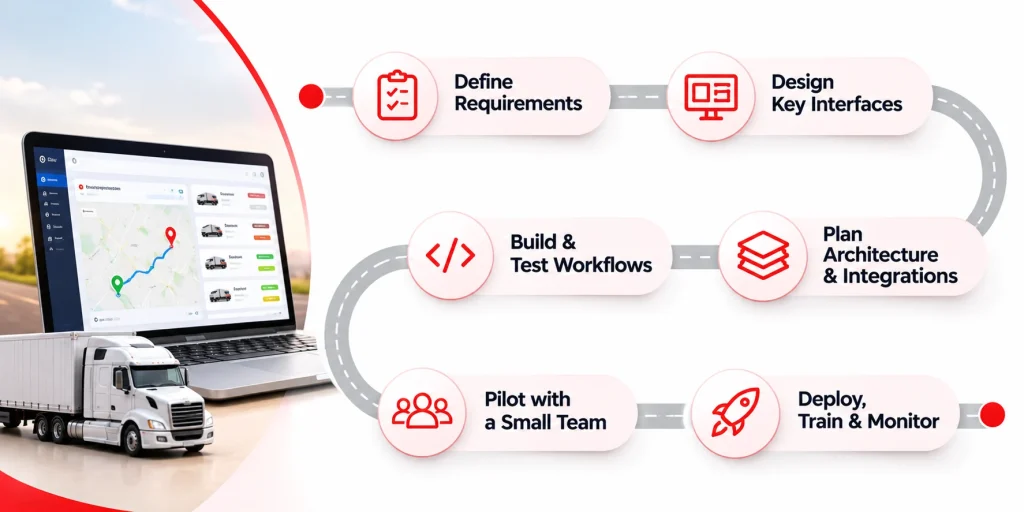
From there the sequence is running roughly like this, from beginning until completion:
- Define requirements and decide what is genuinely in the first release.
- Design the dispatcher board and the driver app, since those two are carrying the whole experience.
- Plan the architecture, the data model and the integrations into your existing tools.
- Build and test the core workflows against messy, realistic data.
- Pilot with one lane or one small team before anybody else is touching it.
- Deploy, train your people properly, then monitor and keep improving.
This is not a fixed timeline and anybody promising you one before seeing your operation is guessing. Custom trucking dispatch software is taking longer when the integrations are deep and moving faster when the scope is being held, and the pilot stage is where most of the honest feedback is arriving, so it is definitely worth protecting that in the plan.
So what is really driving the number at the bottom of the quote? The reasons are not hard to see.
What Affects Truck Dispatch Software Development Cost and Complexity?
There is no universal price for this work, and any figure quoted before a scoping conversation is a sales number rather than an estimate. What is useful is understanding which parts are moving the cost, so you are able to push back intelligently.
| Scope factor | Why it affects development | Questions to ask |
| Number of workflows | Each one is carrying its own rules and edge cases | Which workflows are in phase one? |
| User roles and interfaces | Dispatcher, driver, admin and customer views are separate builds | Who really needs their own screen? |
| Real-time tracking and mapping | Live data and map licensing are ongoing costs | What refresh rate do we actually need? |
| Third-party integrations | ELD, accounting, TMS and load boards each need work | Which integrations are launch-critical? |
| Automated rules and alerts | Rules are needing testing against real exceptions | What should the system decide alone? |
| Reporting and analytics | Depth of history and dashboard complexity | Which three reports matter most? |
| Security and compliance | Access control and data handling requirements | What driver data are we storing? |
| Testing, migration and support | Old data rarely moves cleanly | Who owns this after launch? |
The pressure behind these decisions is real, with the American Transportation Research Institute reporting in July 2026 that the average cost of operating a truck is now sitting at $2.336 per mile, the highest figure in the history of their benchmarking report. That is an industry average across participating carriers rather than your own number, but it is explaining why operators are looking hard at the hours their dispatchers are losing to manual coordination.
So what can automation genuinely take off their plate? Let’s take a look.
How Can Automated Trucking Dispatch Software Improve Operations?
Automated trucking dispatch software is handling the repetitive decisions, and that is where it is earning its money. Load assignment suggestions, alerts when a schedule is slipping, status notifications going out to shippers/brokers automatically, document workflows closing themselves once a POD is captured, and exception reports surfacing the problems while there is still time to fix them. This is removing the status-chasing that is eating your dispatcher’s morning, and it is also improving how your operation is looking from the outside, since a customer who is chasing you for an update is getting a poor impression before the delivery has even started. Our piece on how transportation software solves logistics challenges is going wider on those coordination problems if that is the part you are recognising.
It is worth separating the layers here, because they are often being sold as one thing. Rule-based automation is following the logic you have written, optimisation is finding the best option inside your constraints, predictive analytics is estimating what is likely to happen next, and generative AI is summarising and drafting in plain language. They are useful in different places, and none of them is removing your dispatchers, because a suggestion that ignores a contractual commitment, a safety call or a relationship with your best customer is a suggestion somebody still needs to overrule.
And that is not all, because generative AI is now sitting across the reporting side too, drafting exception summaries and answering plain-language questions about the day. If that is the part you are wanting to understand properly, our breakdown of how generative AI is transforming logistics is covering it in far more depth than this article is able to.
So which route should your business be taking? Let’s break it down.
How Should Logistics Businesses Choose a Truck Dispatch Software Development Approach?
There are really three honest options and the right one is depending on how unusual your operation is.
Ready-made logistics dispatch software is getting you running in weeks and is covering standard carrier workflows well, which is making it the sensible starting point for a lot of small and mid-sized fleets. Configuring or integrating what you already own is the middle path, and it is often being overlooked, since plenty of operations are already paying for a TMS or fleet system with dispatch capability they have never switched on. Custom development is making sense when your freight model, your customer commitments or your existing systems are genuinely not fitting anything on the market, and you are needing to own the workflow rather than bending around somebody else’s.
Custom is definitely not the automatic answer though, and any partner telling you otherwise before understanding your operation is selling rather than advising. A twelve-truck regional carrier, a national brokerage and a specialised heavy-haul operation are each needing something different, and the deciding factors are usually your fleet size, your freight model, your operating region and whatever is already running in your back office. If your dispatch work is connecting into wider freight coordination and shipment visibility, our logistics software solutions page is showing what that engineering work is involving.
Conclusion
Trucking dispatch software development is going well when it is starting from one clear operational problem rather than a feature list, when the first release is prioritised around what your dispatchers are doing every hour, when the integrations are planned early instead of discovered late, and when your people are trained properly enough to actually adopt it. The measurable goals matter too, since a dispatch board that nobody is opening on a Tuesday morning is telling you the workflow never really changed.
And if you are weighing up whether to buy, configure or build for your own operation, we’ve got you covered, so talk to our team about how your dispatch is running today and we will walk you through the transportation software solutions that are fitting the way your business is actually working.
Frequently Asked Questions
What is trucking dispatch software development?
It is the work of designing and building a system your dispatchers are using to assign loads, match drivers and trucks, coordinate schedules and track status, usually alongside a driver mobile app and the integrations into whatever you are already running.
What features are essential in truck dispatch management software?
Load assignment, driver and vehicle availability, schedule coordination, real-time status, driver mobile access with proof of delivery, exception alerts and role-based access are the ones carrying a first release. Customer portals, billing and deep analytics are usually fitting better in phase two.
How much does trucking dispatch software development cost?
There is no reliable single figure, because the cost is being driven by your workflow count, your user roles, your real-time tracking needs and above all your integrations. Any quote arriving before a proper scoping conversation is worth treating carefully.
What is the difference between dispatch software and fleet management software?
Dispatch software is focused on assignment and daily coordination, meaning who is running which load and what is happening right now. Fleet management is going wider into maintenance, fuel, telematics, compliance and the vehicle lifecycle, and many operations are running both together.
Should a trucking company buy existing software or build a custom solution?
Buy when your workflows are reasonably standard, configure what you already own when the capability is sitting there unused, and build custom only when your freight model or integration needs are genuinely not fitting the market.
 Profile of Lakhan Soni