Digital Transformation in Logistics: Technologies, Benefits and Challenges
Think about the last time a customer called asking where their shipment was, and the honest answer was that nobody really knew. The dispatcher was checking one screen, the warehouse was checking another, the carrier portal was showing a status from yesterday evening, and somebody ended up phoning the driver to find out what the systems should have been telling everyone already. Situations like these don’t just waste an afternoon, they also affect the brand perception, because a customer who is chasing you for updates is quietly deciding whether to keep giving you freight.
This is where digital transformation in logistics is stepping in, connecting the systems that are currently working in isolation so that one version of the truth is available to dispatch, the warehouse, the back office, and the customer at the same time. If you are approaching this from the software side specifically, our breakdown of logistics software development is covering the tools, tech stack and integration decisions in detail.
But what is transformation really meaning here, beyond buying another tool? Well, it is mostly about changing how decisions are being made, so let’s break it down.
What Is Digital Transformation in Logistics?
The phrase is getting thrown around very loosely these days, so it is worth separating three things that people are usually treating as one and the same. Digitization is simply turning your paper into digital files, so your proof of delivery is becoming a scanned PDF instead of a carbon copy sitting in a folder somewhere. Digitalization is going one step further and using a digital tool to run the process you already have, so that same proof of delivery is being captured by your driver/courier in an app rather than being scanned once he is back at the depot. Transformation is the really big shift though, where the process itself is being redesigned around the data, so the moment that delivery is confirmed the job is closing itself, the invoice is being triggered, the customer is being updated and your on-time performance report is being fed, without anybody on your team touching a single thing.
| Stage | What is changing | Typical example | What stays the same |
| Digitization | The format | Scanned PODs | The manual process |
| Digitalization | The tool | Driver app for PODs | The workflow steps |
| Digital transformation | The process | POD triggers invoice and reporting | Very little |
This distinction is extremely crucial, because a company that has bought five digital tools and is still rekeying data between them has digitalized without transforming anything at all. Real digital transformation logistics work is touching people, processes, data and technology together, and that is exactly why it is taking longer and is worth far more than a software purchase. So why is it becoming unavoidable now? Let’s take a look.
Why Is Digital Transformation Important in the Logistics Industry?
The pressure is coming from several directions at once, and the reasons are not hard to see.
Cost is the obvious one, with the American Transportation Research Institute reporting in July 2026 that the average cost of operating a truck reached $2.336 per mile in 2025, the highest in the history of its benchmarking report, although that figure is an industry average across participating carriers rather than a number every operation is going to recognise on its own P&L.
Trade volatility is the second pressure, and it is the one that is punishing anybody planning capacity on last quarter’s spreadsheet. Bureau of Transportation Statistics data is showing North American transborder truck freight at $104.4 billion in June 2026 against $84.9 billion in June 2025, a 23% year on year increase. That figure is measuring the dollar value of cross-border freight rather than tonnage, and BTS itself has noted that value and weight have been drifting apart since 2021, so it is telling you the market is moving fast rather than telling you exactly how many more trucks are crossing.
Customer expectations are the third, because shippers and consumers are now expecting a tracking link rather than a phone number, and an operation that cannot produce one is giving a poor impression before the delivery has even started. And that is not all, because the coordination problem is growing with every partner you are adding, since carriers, warehouses, customs brokers and customers are all holding one piece of the picture and none of them are seeing the whole thing. Digital transformation in logistics industry terms is really about closing those gaps before they are turning into missed windows, detention charges and lost accounts.
Which Technologies Are Driving Digital Transformation in Logistics?
No single technology is doing this on its own, and the useful ones are working together rather than in isolation. Cloud logistics and transportation platforms are giving everybody the same view from any location, which is removing the version control problems that local installations were quietly creating for years. Real-time tracking, IoT sensors and telematics are feeding live location, vehicle condition and cargo condition into that view. Predictive analytics and demand forecasting are helping with capacity planning, although they are only ever as reliable as the historical data sitting behind them. Workflow automation and digital documentation are removing the rekeying that is eating hours every single week, and data integration through APIs and shared dashboards is the layer that is making all of the above actually talk to each other.
| Technology | Practical logistics use | Business value | What it needs first |
| Cloud platforms | Shared operational view | One source of truth | Reliable connectivity |
| Real-time tracking and IoT | Live shipment and vehicle status | Fewer status calls | Device coverage and fitting |
| Predictive analytics | Demand and capacity planning | Better forward decisions | Clean historical data |
| Workflow automation | Documents, invoicing, alerts | Less manual rekeying | Agreed process rules |
| APIs and data integration | System to system exchange | Connected operations | Data standards and mapping |
| TMS, WMS and fleet systems | Planning and execution | Operational control | Clear scope per system |
Generative AI is now sitting across several of these, drafting documentation, summarising exceptions and supporting planners, and since that genuinely deserves more space than one paragraph, our breakdown of how generative AI is transforming logistics is worth reading if that part of the stack is what you are evaluating right now.
How Does Digital Transformation Improve Logistics Operations?
The improvements are showing up in very ordinary places rather than in dramatic ones, resulting in:
- Shipment status being visible without anybody phoning a driver.
- Dispatch decisions being made against live capacity instead of yesterday’s plan.
- Inventory and dock scheduling being coordinated rather than guessed.
- Documentation being generated once and reused across billing and compliance.
- Customers receiving updates automatically instead of chasing them.
- Exceptions being flagged while there is still time to fix them.
- Reporting being produced from operational data rather than rebuilt by hand each month.
This is not only saving administrative hours, this is also changing what your team is spending its day on, because a planner who is no longer chasing statuses is free to handle the shipments that genuinely need judgement.
A useful example is detention and dwell time, where a connected system is showing how long trucks are actually waiting at each site, which is turning an argument with a customer into a conversation backed by timestamps. Another is empty running, where linking dispatch data with order data is revealing backhaul opportunities that nobody could see while the two systems were sitting apart. Most of this is depending on the vehicle data layer underneath, and our guide to fleet management technologies is covering what that layer is actually producing and what it is needing from you first.
What Are the Biggest Challenges in Logistics Digital Transformation?
The honest part of this conversation is that most transformation projects are struggling for reasons that have nothing to do with the software being bad.
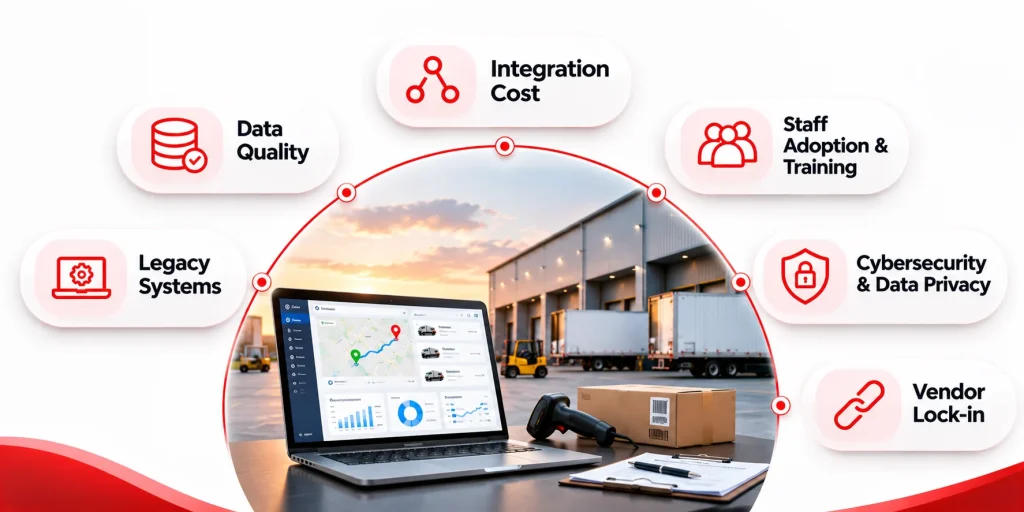
Legacy systems are the first wall, because a twenty year old TMS with no API is forcing either an expensive integration layer or a full replacement, and neither of those is a small decision. Data quality is the second, and it is the one quietly killing projects, since inconsistent addresses, missing timestamps and three different spellings of the same customer are producing dashboards that nobody in the room is trusting. Integration cost is the third, and it is routinely underestimated, because connecting to carrier systems, EDI partners and an existing ERP is where most of the budget is really going.
Then there are the human factors, including staff adoption, training time and the entirely understandable resistance of a dispatcher who has run the operation from a whiteboard for fifteen years. Cybersecurity, data privacy and vendor lock-in are all belonging on the same list, since connected operations are expanding your exposure and long contracts are limiting your options later. If the fragmented systems and coordination problems are the part you are recognising most, our piece on how transportation software solves logistics challenges is going deeper into those specific operational pain points.
How Can Businesses Implement Digital Transformation in Logistics?
The approach that is working is boring and sequential rather than ambitious, and it is running roughly like this, from beginning until completion:
| Stage | Key action | What to measure |
| Assess | Map current workflows and find the costliest one | Time and cost per task |
| Define goals | Agree what success looks like in numbers | Baseline for each goal |
| Audit | Review systems, data quality and integrations | Data error rate |
| Prioritise | Pick one workflow for phase one | Scope held or expanded |
| Evaluate options | Compare ready-made, integration and custom build | Fit against actual need |
| Pilot | Run with one team or lane | Adoption and error counts |
| Train and assign | Give the system an owner | Active users per week |
| Improve | Adjust from operational feedback | Change in baseline metrics |
The step that most companies are skipping is the audit, and it is the one deciding everything afterwards, because you cannot integrate data that nobody has cleaned and you cannot automate a process that three people are running three different ways. The other common mistake is scope, since replacing the whole stack in one go is creating a project long enough for the business case to change underneath it. Picking one workflow, proving it works in the real operation and then expanding is far less exciting and far more likely to finish. The build, buy or customise question is usually landing at the evaluate stage, and our transportation software development guide is working through that decision with realistic cost ranges attached.
How Is Digital Transformation in Transportation Connected to Logistics?
Transportation and logistics are related but they are not the same thing, and the difference is mattering a lot when you are scoping a project. Transportation is the physical movement, meaning fleets, drivers, routes, dispatch and delivery. Logistics is wider, covering warehousing, inventory, order management, documentation and the coordination of everything from supplier until customer. Digital transformation transportation work is usually starting with fleet and shipment visibility, while logistics transformation is about connecting that movement data to what is happening in the warehouse and the order book.
The connection is where the value is really sitting, because a delivery ETA is only useful if the warehouse is seeing it and the customer service team is seeing exactly the same thing. Trucks are carrying the clear majority of US domestic freight, with Federal Highway Administration figures putting it at 64% by weight and 69% by value, so for most operations the transportation layer is where the data is either flowing into the rest of the business or getting stuck somewhere on the way. Companies evaluating engineering support on that side can look at our transportation technology solutions to see what that work involves in practice.
How Can Businesses Measure the Results of Logistics Digital Transformation?
Measurement is where a lot of these projects are quietly falling apart, and it is almost always because nobody wrote down what things looked like before the rollout started. Once the new system is live, everything is feeling a bit faster and everybody has an opinion about it, but opinions are not going to help you when your CFO is asking what the spend actually bought, so the baseline you are capturing before anything is installed is extremely crucial. This is also protecting you from the other common trap, which is quietly swapping in new metrics halfway through because the original ones are not telling the story you were hoping for.
The indicators worth capturing are the ones tied to the workflow you are fixing, resulting in:
- On-time delivery and shipment visibility coverage.
- Manual processing time per order or per load.
- Exception resolution time, from the alert until it is closed.
- Vehicle utilisation and empty miles, where that is applying to you.
- Data accuracy rates across your key records.
- Inbound customer/shipper enquiry volume.
- Actual weekly adoption among the dispatchers/planners who are meant to be using it.
That last one is telling you far more than most dashboards ever will, because a platform that nobody is opening on a Tuesday morning is telling you the workflow was never really redesigned, it was simply given a new login screen. This is the number we are asking about first whenever a client is saying their system is not delivering, and more often than not the system is fine and the workflow underneath it never changed.
Conclusion
Digital transformation in logistics is working best when it is being treated as an operational project with a technology component rather than a technology project with operational side effects, and the companies getting real value from it are the ones that named a specific problem, cleaned the data sitting behind it, connected the systems that needed to talk and then supported the people who had to change how they worked. The pressure from costs, volatile trade flows and customer expectations is not easing any time soon, so the question is less about whether to modernise and more about which part of the operation is hurting enough to go first.
And if you are weighing up integrations, automation or a custom build for your own operation, we’ve got you covered, so talk to our team about your requirements and the logistics software solutions that are fitting the way your business is actually running today.
Frequently Asked Questions
What is digital transformation in logistics?
It is the process of redesigning logistics workflows around connected systems and shared data, so that shipment, warehouse, documentation and customer information is working together rather than sitting in separate tools.
What are examples of digital transformation in logistics?
Common examples are real-time shipment tracking replacing status calls, driver apps replacing paper proof of delivery, automated invoicing triggered by delivery confirmation, and dashboards that are pulling dispatch, warehouse and carrier data into one view.
What technologies are used in logistics digital transformation?
Cloud platforms, real-time tracking, IoT sensors, predictive analytics, workflow automation, API based data integration and core systems such as TMS, WMS and fleet management software.
What are the main challenges of digital transformation in the logistics industry?
Legacy systems without modern integration options, poor data quality, underestimated integration costs, staff adoption and training, cybersecurity and privacy obligations, and long term vendor dependence.
How does digitalization in logistics industry operations improve efficiency?
Mainly by removing manual rekeying and status chasing, surfacing exceptions early enough to act on them, and giving planners accurate information at the moment they are making a decision.
 Profile of Lakhan Soni