
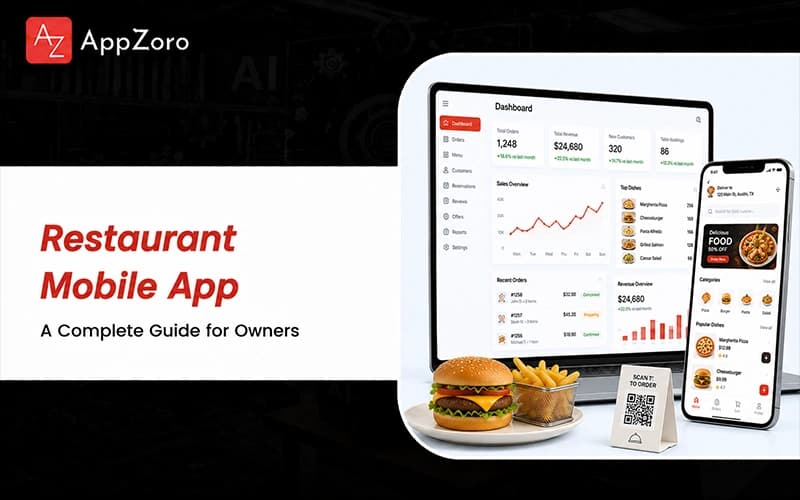
Quick Answer: A restaurant mobile app is a branded ordering and loyalty platform that lets your guests browse the menu, pay, and earn rewards directly without an aggregator. Many successful brands partner with a mobile app development company USA to build a guest experience people actually reopen and a clean link into their kitchen and point-of-sale. A basic MVP starts around $15,000, while a full custom platform with loyalty and tight POS integration runs from $80,000 into six figures.
Picture someone on the couch on any random Tuesday, hungry, thumb scrolling through three delivery apps deciding where to order from. That is your real user and that one moment should shape every decision in your build. The habit is the whole game, and understanding the strategic mobile app development benefits like first-party data and direct push notifications is what helps small brands outcompete national aggregators.
A restaurant app that makes someone hunt for the reorder button or forces them to rebuild their basket from scratch has lost to the slicker aggregator before the food is even cooked. Building the app is the easy part. However, you should consult a comprehensive mobile app development cost breakdown to ensure you have enough budget for the marketing required to get a real person to reopen it next week instead of defaulting to Uber Eats.
So what does it take and where does the money actually go? Mostly into the parts nobody sees until something breaks, so here is the honest version. Following a standard mobile app development process ensures you build for high-pressure Friday night rushes rather than just creating a clean demo that fails once real order volume hits the backend:
What a Restaurant Mobile App Really Involves in 2026
Search for a restaurant mobile app and you will get a tidy feature list, as if the work were just a menu screen and a pay button. It is not. Underneath sits a live ordering system, a loyalty engine tied to your real margins, payments that settle straight to you and a connection into the kitchen where a slow or wrong order has real consequences for the guest experience.
You are paying for three connected things, not one:
A guest-facing app that nails the menu, makes reordering effortless and shows an honest prep time instead of a hopeful one.
A loyalty and rewards layer that actually pulls people back on a quiet midweek night, rather than sitting as a forgotten points balance.
A back-of-house link into your point-of-sale and kitchen display, so every order lands clean without a stressed staffer re-keying it by hand.
You Are Building Three Things, Not One
The first surprise in mobile app development for restaurants is that one app is really three connected products at once. The guest gets the spotlight but the kitchen integration decides whether your staff actually trust the thing during a Friday rush. Skip the loyalty engine and you have built a fancy ordering screen that competes with the aggregators on nothing but your own brand name, which is rarely enough on its own.
Reorders and Loyalty Are the Whole Game
Getting a hungry guest to choose your app over a delivery aggregator sounds simple until you watch real ordering habits up close. The app has to remember their usual and give them a reason—points or perks—to come back. This is why founders must research how to develop an app and make money through repeat transactions and loyalty loops rather than just focusing on a flashy one-time download.
On-Demand Mobile Apps for Restaurants
This is where building mobile apps for restaurants stops being a design exercise and becomes a retention business. Nobody keeps an app they used once on a whim. If you are currently learning how to develop a food delivery app for your own fleet, you only beat the national platforms by being faster, cheaper to the guest, or genuinely more rewarding across every single order.
A few things decide whether the app earns repeat orders and none of them live on the launch-day screenshots:
Enough reason to come back, because a loyalty offer built around your real margins is what turns a one-time download into a Tuesday-night habit.
Effortless reordering, since every extra tap between a craving and a confirmed order is a chance for the guest to give up and open Deliveroo instead.
Honest prep times and live order tracking, because the wait feels half as long when someone can watch their food being made and brought over.
Repeat Orders Beat Every Flashy Feature
You can add features forever. You cannot fake the habit of a regular who opens your app without thinking because the last five orders were fast, accurate and quietly rewarded. The restaurants that win obsess over the second and tenth order first, which is how a serious restaurant mobile app grows a loyal base instead of chasing one-time installs that never return.
Trust, Payments and the Guest Experience Are the Product
A guest is handing you their card and trusting your kitchen to deliver exactly what they pictured, so trust here is not a feature; it is the whole premise. Implementing rigorous mobile application security testing strategies protects that credit card data and biometric info, ensuring that saved cards and secure payments through Apple Pay remove all doubt from the checkout process.
Restaurant App Cost, Tier by Tier
So what does a restaurant mobile app come to once you count the ordering, the loyalty and the integration behind it? It depends on the scope and the honest ranges are wider than the cheap numbers floating around online. For instance, the Android app development cost might fluctuate depending on whether you need support for various rugged kitchen-side tablet models or just consumer handhelds, typically ranging from $15,000 for an MVP to over $100,000 for multi-site scale:
Build Tier | Rough Cost | What You Get |
Single-location MVP | $15,000–$30,000 | One site, menu ordering, GPS delivery zone, basic payments |
Full branded platform | $50,000–$90,000 | Guest app, loyalty engine, POS and kitchen integration |
Custom or multi-site scale | $100,000+ | Custom loyalty, multi-location, delivery logic, real scale |
Ongoing each year | 15–25% of the build | Maintenance, OS updates, payments and menu upkeep, features |
Those numbers cover the build, not the months of marketing it takes to actually get your regulars to download and reopen it. The cost that hurts owners most is rarely the code; it is the work of pulling people off the aggregators and onto your own app for good.
Why the Cheapest Quote Costs the Most
A five-thousand-dollar quote usually means a single menu screen, a basic payment link and none of the loyalty or POS integration that makes the app actually work. The kitchen integration, the rewards engine and the marketing all surface later as costly extras you never budgeted for. Paying a fair price for a team that scopes the whole thing up front is almost always cheaper by the end of year one.
Build It Custom or Buy a Template and Where AI Helps
At some point, you choose between a quick off-the-shelf platform and a custom build, and the answer hinges on how unusual your menu and growth plans really are. Evaluating modern mobile app development frameworks like Flutter or React Native can help you decide between a flexible cross-platform approach or a rigid template box that you might pay monthly for forever.
AI has started to earn its place in restaurant apps but only where it lifts orders or saves the team real time. Learning how to use AI in mobile app development can help you build smarter recommendation engines that learn what a guest tends to order and nudge the add-on or upgrade they were probably going to want anyway:
Smarter recommendations that learn what a guest tends to order and nudge the add-on or upgrade they were probably going to want anyway.
Demand prediction that helps the kitchen prep for a busy window before the orders flood in, cutting waste on the slow nights.
Support automation, where a model handles the routine "where is my order" questions so your staff focus on the food and the floor.
Template Platform or Custom Build
The biggest fork in mobile app development for restaurants is whether you rent or own. A template platform gets a single location live cheaply and fast, while a custom build pays back once your loyalty logic, menu complexity or multi-site ambition outgrows the rigid box. Trying to bend a template into something it was never built for is how owners waste a year before rebuilding properly anyway.
Where AI Earns Its Keep in the Kitchen
The useful AI in a restaurant app is boring and that is exactly why it works. It sharpens recommendations and predicts busy windows so the kitchen is ready. Selecting the right tech stack for mobile app development ensures these smart features talk to your POS and kitchen display without latency, clearing the routine questions that often bury small floor teams.
If you have a quote for a restaurant app that only describes a menu and a pay button, you are seeing a sliver of the restaurant mobile app you actually need. Our senior team reviews these proposals most weeks and we would much rather flag the missing loyalty engine, the POS integration and the marketing math now than after you have spent the budget.
Final Thoughts
A restaurant mobile app in 2026 is a margin and loyalty business wearing an app, not the other way around. To reach this stage, you must hire the best mobile app developer who understands the unglamorous backend work and the months it takes before your regulars finally reach for your app by habit. If your quote feels suspiciously clean, talk to someone who has shipped a restaurant mobile app and watched the reorder curve up close.
The owners who win do not launch a flashy app and hope. They get the menu and reordering right, build loyalty that genuinely changes behavior and earn the second order one guest at a time. It sounds slow. It is also the only version that survives contact with a real Tuesday-night craving and three delivery apps fighting for the same order.
If your quote feels suspiciously clean, talk to someone who has shipped a restaurant mobile app and watched the reorder curve up close. A good partner is honest about the three pieces, the loyalty work and the months it takes before your regulars finally reach for your app by habit.
Leave a Comment