Picture a freight operation where the shipment status is living in a spreadsheet, the drivers are being updated by phone, the customer is emailing for an ETA that somebody has to go and find, and the warehouse is working from a printout that was accurate at eight in the morning. Everybody knows an app would fix most of this, and the conversation is going well until somebody asks what it is going to cost, and the room goes quiet because nobody is able to answer that without guessing.
This is where estimating logistics app development cost is getting misunderstood, because people are counting screens and ticking features when the budget is actually being decided by how many user roles you are supporting, how many systems you are connecting into, how fresh your tracking data needs to be and how much testing those connections are going to need. Two apps with the same fifteen screens are easily differing by a factor of three once the integrations are understood. If you want the wider picture of where a mobile app is sitting inside your overall systems, our logistics software development guide is covering the full range of logistics software and how the pieces are connecting.
But what should you actually be budgeting for? Well, let’s break it down.
How Much Does Logistics App Development Cost?
Let’s be honest about the data first, because this is where most cost articles are quietly misleading you. There is no published, methodologically transparent cost study for logistics apps specifically, so anybody quoting you a precise logistics figure is really handing you a general app number with a logistics label stuck on it. What does exist is general mobile app benchmarking, and the two sources worth citing are not even agreeing with each other:
| Source | What it measures | Figure | Limitation |
| Clutch Mobile App Pricing Guide, 2026 | First-party client reviews of completed app projects, all app types, global | Average project $90,780.11 over roughly 11 months, most landing between $10,000 and $49,999, agency rates $25 to $49 an hour | Review data skewing toward smaller projects, and not logistics-specific |
| GoodFirms app cost survey of 167 app development companies | Vendors estimating their own work by stage and complexity | US average around $38,200, with annual maintenance put at roughly 25% of development cost | Undated, and vendor estimates rather than completed project data |
That gap between $38,200 and $90,780 is really the whole point of this section. Two reputable sources, both surveying the app development market, are landing more than twice apart from each other, which is telling you clearly that an industry average is not a quote and never was. A logistics mobile app is also sitting toward the upper half of whichever band you prefer, because the features defining it, meaning live tracking, a driver app, a dispatcher view and integrations into systems you already run, are exactly the features that are pushing a project out of the simple tier.
So rather than quoting you a band that is really somebody else’s project, here is the more useful way to think about the cost of the logistics app development work, which is by complexity:
- A focused first release, meaning one workflow, two user roles, basic tracking and no deep integrations, is the cheapest honest starting point.
- A mid-complexity build, with driver and dispatcher apps, real-time tracking, notifications and one or two integrations, is where most logistics projects are genuinely landing.
- A full platform, with multiple roles, warehouse and ERP connections, analytics and automation, is a different category of project altogether, and our logistics software development guide is covering what that tier involves in far more detail.
The operational pressure behind all of this is definitely real, with the American Transportation Research Institute reporting on 15 July 2026 that the industry-average cost to operate a truck reached $2.336 per mile in 2025, which is 3.4% higher than the previous year and the highest per-mile cost in the history of their report. That figure is coming from a survey of for-hire US and Canadian carriers covering 182,248 combination truck-tractors, so it is an industry benchmark rather than your own number, but it is explaining very clearly why operators are looking hard at the hours they are losing to manual coordination.
So which factors are really moving that number? The reasons are not hard to see, so let’s take a look.
Which Factors Affect Logistics Mobile App Development Cost?
The factors below are the ones your development partner should be asking about before they are giving you any figure at all. If somebody is quoting you without working through these, they are pricing a guess.
| Cost factor | Why it affects the budget | Questions to resolve before development |
| Scope and workflow complexity | Each workflow is carrying its own rules and exceptions | Which single workflow is hurting most right now? |
| Number of user roles | Drivers, dispatchers, admins, customers and warehouse staff each need their own experience | Who genuinely needs their own view in release one? |
| Platform requirements | Android, iOS, web and cross-platform are different cost profiles | Are drivers on company devices or their own? |
| Live tracking and maps | Real-time data and map licensing are both build cost and running cost | How fresh does the location data really need to be? |
| Third-party APIs and integrations | TMS, ELD, accounting and carrier systems each need building and testing | Which integrations are launch-critical versus phase two? |
| Security and access control | Role separation and driver data handling are adding design and testing work | What driver and customer data are we storing? |
| UI/UX design | A driver using one hand in a cab is needing different design work | Where and how are people actually using this? |
| Testing, deployment, maintenance | Integration testing is heavier here than in a normal app | Who is owning this after launch? |
The distinction worth holding onto is between a first-release feature and a later one. A driver who cannot see today’s assigned loads has no app at all, so that is release one. A customer-facing portal is genuinely valuable, but your operation is surviving without it today, so that is phase two. This single decision is moving the budget more than any negotiation on hourly rate ever will.
So how are the features themselves translating into money? Let’s break it down.
How Do Logistics App Features Affect the Development Budget?
Features are not costing the same amount just because they are taking the same space on a slide. What is driving the cost is how much is happening behind the screen, how many systems are involved and how badly it is hurting when the feature fails.
| Feature group | Business purpose | Relative complexity |
| Shipment and order management | Holding the core record everything else references | Medium |
| Driver assignment and dispatch | Matching loads to drivers and trucks | Medium |
| Real-time GPS tracking | Answering “where is it” without a phone call | High, plus ongoing map and data costs |
| Route planning and delivery updates | Sequencing stops and keeping everybody current | High if optimisation is involved |
| Proof of delivery and documents | Capturing signatures, photos and paperwork at the door | Low to medium |
| Customer notifications and visibility | Removing inbound status calls | Medium, depending on channels |
| Billing, reporting and dashboards | Closing the loop into finance and performance | Medium to high |
| Warehouse, fleet, ERP and TMS integrations | Making the app part of the operation rather than another silo | High, and usually underestimated |
| AI-assisted features | Document extraction, summaries, assisted decisions | High, with real running costs |
These labels are indicative and they are definitely shifting with your actual requirements, since a simple tracking screen pulling from one provider is nothing like a tracking layer reconciling three telematics feeds. This is also why integration is deserving its own line in every budget, because connecting to a twenty year old TMS with no proper API is work that is invisible in a feature list and extremely crucial to the final number.
AI features are worth one honest paragraph here. There are genuine use cases, particularly in pulling data out of delivery documents and in summarising exceptions for a planner, but AI is adding integration work, testing work, monitoring work and a running cost per call, and plenty of logistics apps are delivering real value with no AI in them at all. If you want to understand where it is actually earning its place, our breakdown of how generative AI is transforming logistics is going far deeper than this article is able to.
And that is not all, because the build cost is only one half of what you are signing up for, so let’s take a look at the rest.
What Additional Costs Should Businesses Budget For?
This is the section most first budgets are missing, and it is the one causing the awkward conversation in month four. Your app is not finishing at launch, it is starting at launch, and some of these costs are arriving every single month from that day onward.
| Cost | Type | Notes |
| Mapping, geocoding and routing APIs | Recurring | Scaling with usage, so a busier fleet is costing more |
| SMS and email notifications | Recurring | Per message, and customer updates are adding up quickly |
| Cloud hosting, storage and backups | Recurring | Growing with your data history |
| Monitoring and error tracking | Recurring | Small but non-negotiable for an operational app |
| Third-party subscriptions | Recurring | Telematics, mapping tiers, document services |
| Maintenance and OS updates | Recurring | Android and iOS releases are forcing regular work |
| Security reviews | Mostly recurring | Especially where driver or customer data is held |
| Discovery and design | One-time | Cutting this is reliably costing more later |
| Development and integration build | One-time | The headline figure in most quotes |
| Data migration | One-time | Old data rarely moves cleanly |
| Training and onboarding | One-time, then occasional | Drivers and dispatchers both need it |
One widely quoted figure is that annual maintenance is running at around 25% of the original development cost, which comes from a GoodFirms survey of app development companies, but that survey is undated and it is vendors estimating their own work, so treat it as a planning prompt rather than a reliable rule. What is definitely true is that the recurring side is real money, and a budget that is only covering the build is not a budget at all.
So where are the sensible savings actually sitting? Let’s break it down.
How Can Businesses Reduce Logistics App Development Cost Without Sacrificing Quality?
The savings worth having are coming from scope decisions rather than from squeezing rates, resulting in:
- Define the operational problem and the real users before anybody is designing anything.
- Build a first release around the one workflow that is costing you most today.
- Use proven third-party services for mapping, messaging and payments instead of building them.
- Integrate the systems you already own rather than rebuilding their functionality inside the app.
- Prototype the driver and dispatcher screens early and put them in front of actual drivers.
- Test the integrations properly before launch, under messy conditions rather than clean ones.
- Plan the later phases openly so the team is building toward them instead of around them.
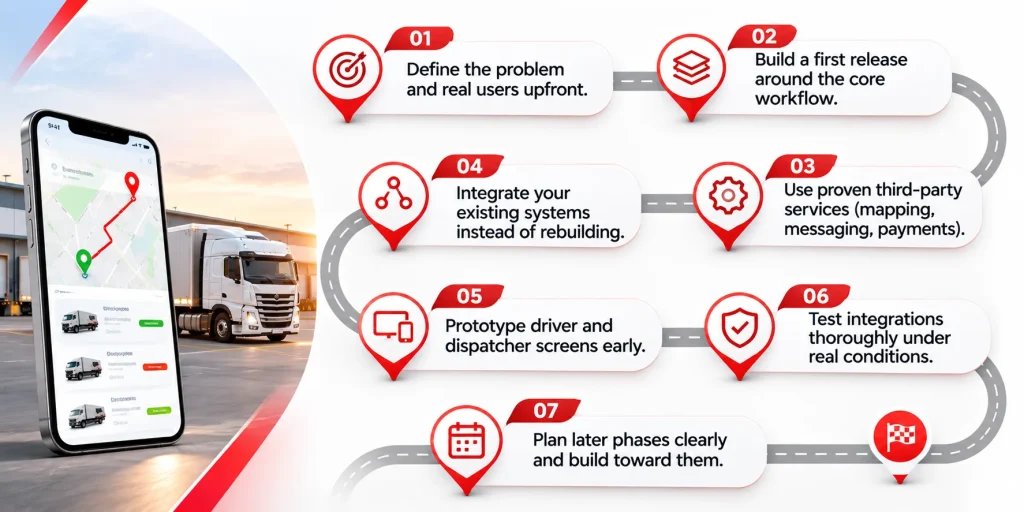
This is where the budget is genuinely being controlled, because a well-scoped first release is removing whole categories of work rather than shaving hours off each one.
What is not saving you anything is cutting discovery, testing, security or integration work. These are the parts that are invisible in a demo and decisive in production, and a quote that comes in far below the others has nearly always removed one of them. An app that is showing a driver the wrong load, or a tracking screen that is confidently wrong about where a shipment is, is costing you a customer, and that is a much bigger number than the line you saved.
So should you even be building at all? Let’s take a look.
Should Businesses Build a Custom Logistics App or Use Existing Software?
There are three honest routes here and the right one is depending on how unusual your operation really is.
Ready-made logistics software is getting you running in weeks, it is covering standard workflows well and the cost is predictable, which is making it sensible for a lot of smaller operations. The trade-off is flexibility, since you are fitting your process around somebody else’s product and you are dependent on their roadmap. Configuring or integrating what you already own is the middle route and it is being overlooked constantly, because plenty of businesses are already paying for a TMS or fleet platform with mobile capability they have simply never switched on. Custom development is making sense when your freight model, your customer commitments or your existing systems are genuinely not fitting anything on the market, and you are needing to own the workflow rather than rent it.
Custom is definitely not automatically better and it is rarely cheaper in year one, so any partner telling you otherwise before understanding your operation is selling rather than advising. The logistic app development cost of a custom build is higher upfront and you are also taking on the maintenance, the hosting and the roadmap, which is a real commitment rather than a line item. What you are buying in return is control, and that is worth paying for only when the thing you are controlling is actually giving you an edge. If your workflows are connecting into wider freight coordination and shipment visibility, our logistics software solutions page is showing what that engineering work is involving.
So how do you turn all of this into an actual number? Let’s break it down, from beginning until completion.
How Can Businesses Plan a Realistic Logistics App Development Budget?
The sequence that is working is practical rather than clever, and it is running roughly like this:
- Document the operational problem in plain language, including what it is costing you now.
- Identify your users and the handful of workflows that genuinely matter.
- Separate the must-haves from the things you are hoping for later.
- Confirm your platforms, your integrations and what data is moving where.
- Request an estimate against that documented scope, with the assumptions written down.
- Add testing, deployment, training and the recurring operating costs into the same budget.
- Hold a contingency sized to your actual uncertainty, which is bigger when the integrations are unknown.
- Agree how you will measure success before anybody is writing code.
Step one is the one people are rushing, and it is really the one deciding everything afterwards. Understanding the operational problem properly, before any feature list exists, is what is separating a useful estimate from a guess, and our piece on how transportation software solves logistics challenges is a good place to start if you are still framing what is actually broken.
What a development team is needing from you to give a useful estimate is fairly specific, meaning your user roles, your workflow list, your existing systems and their integration options, your data volumes, your platform requirements and your compliance obligations. Hand over that and you are getting an estimate worth discussing. Hand over a feature list and you are getting a number that is going to move.
Conclusion
Logistics app development cost is being decided by your scope, your feature complexity, your integrations, your platform requirements and the running costs that are starting the day you launch, and the published benchmarks are only ever giving you the shape of the market rather than your own number. A realistic budget is beginning with a clearly defined business problem, a prioritised set of requirements and an honest view of what the first year is costing after the build is finished.
And if you are working through whether to buy, configure or build for your own operation, we’ve got you covered, so talk to our team about how your logistics is running today and we will walk you through the transportation software solutions that are fitting the way your business is actually working.
Frequently Asked Questions
How much does logistics app development cost?
There is no verified logistics-specific benchmark. General app data from Clutch is putting the average project at $90,780 with most falling between $10,000 and $49,999, while GoodFirms' 2026 survey is putting a mid-level app at $40,000 to $120,000. A logistics app with live tracking and integrations is usually sitting at the higher end, and your real figure is coming from a scoped conversation.
What affects logistics mobile app development cost the most?
Integrations and user roles, nearly always. Connecting into an existing TMS, ELD provider or accounting system is carrying far more work than any individual screen, and each additional user type is effectively another product to design, build and test.
How long does it take to develop a logistics app?
It is depending on scope and no honest timeline exists before one. Clutch's data is showing an average app project running around eleven months across all app types, but a tightly scoped first release is landing much sooner and a full platform is taking considerably longer.
What features should a logistics app include in its first release?
Shipment or order records, driver assignment, basic live tracking, a driver app with proof of delivery, and simple status notifications. Customer portals, analytics dashboards and billing integration are fitting better in a second phase once the core is being used daily.
Is custom logistics app development more expensive than ready-made software?
Upfront, almost always yes, and you are taking on maintenance and hosting as well. It is making financial sense when your workflows are genuinely not supported by the market, or when per-seat pricing at your scale has stopped being reasonable.
 Profile of Lakhan Soni