
Healthcare has always been about people.
At the center of this transformation is AI in Healthcare Industry. The technology operates in the background to change how patients and healthcare providers communicate with each other throughout their daily routines. People expect quick answers now. They want to book appointments without friction. They don’t want to wait on hold or navigate confusing systems just to get basic information. The healthcare industry now needs new operational methods because people anticipate different results from their services.
This is exactly where AI chatbots in healthcare are proving their value.
Patients experience immediate system responses which eliminate both extended wait times and staff shortages. The chatbots operate continuously throughout the day because they manage both basic customer inquiries and complex business processes. The administrative work for providers decreases because they handle fewer administrative tasks. The system provides patients with speedy and accessible medical treatment.
At the same time, the growing demand for scalable digital solutions is pushing innovation in healthcare application development services. More organizations are investing in automation to improve the overall patient experience.
What Are AI Chatbots in Healthcare?
The purpose of healthcare chatbots is to create digital systems which can simulate patient dialogues. Their actual abilities extend beyond this basic definition of their functions.
Modern chatbots possess capabilities which enable them to comprehend contextual information while learning from user interactions and assisting users throughout their healthcare process. Their function extends beyond answering inquiries. Their function involves assisting users while providing various forms of support which enable patients to make educated choices.
Types of Healthcare Chatbots
Different chatbots constructs different operational methods. The operational abilities of systems rely on two main factors which include their architectural design and their utilized technological components.
Rule-Based Chatbots
The system represents the most basic operational structure. The system operates through established rules which guide its function and structured decision-making process.
The system functions optimally when users engage in predictable interactions that restrict their conversational range.
Answering frequently asked questions
Booking or rescheduling appointments
Providing basic instructions to patients
They are reliable and easy to control, which makes them useful in regulated environments. But their limitation is clear. If a user steps outside the expected flow, the system struggles to respond effectively.
AI-Powered Conversational Agents
This is where things become significantly more advanced.
AI-powered chatbots in healthcare use machine learning and language processing to interpret user intent. Instead of following a fixed script, they understand what the user is trying to say, even when the input is unclear or unstructured.
They can handle more complex and open-ended queries
They adapt responses based on context
They improve over time through interaction data
Most modern implementations of AI for chatbots in healthcare fall into this category because they provide a much more natural and flexible user experience.
Core Technologies Behind Healthcare Chatbots
The operational mechanisms of these systems become clearer through examination of their underlying technological components.
Natural Language Processing enables chatbots to understand human language, including intent and conversational context
Machine Learning allows systems to learn from past interactions and continuously improve their performance
Large Language Models power more advanced conversations, making responses feel more natural and less scripted
AI Technologies are transforming Healthcare through these technologies because intelligent systems enhance patient engagement and clinical workflow operations.
Healthcare chatbots function as embedded tools which interconnect through multiple digital platforms that patients use to contact their providers.
The system links with backend components which include electronic health records and scheduling systems. This integration serves as a fundamental element for real-world application while it remains essential for developing healthcare industry chatbot solutions.
The system creates a user experience which integrates with existing workflows when developers deploy it efficiently. The system operates as a fundamental component of the healthcare experience.
How AI Chatbots Work in Healthcare
From a user’s perspective, chatbot interactions feel simple. You ask something, and you get a response. But behind that simplicity is a structured process involving multiple layers of AI and system integration.
Understanding how this works gives a much clearer picture of why AI chatbots in healthcare are becoming such an important part of modern systems.
Input Processing
User input serves as the starting point for all system operations. Patients have three options to create their input which include typing a message and speaking through their device or using the application interface. The system first receives all user input which it then transforms into an analysis-ready format for processing.
The chatbot proceeds to execute data cleansing operations at this point. The system fixes minor spelling errors while it establishes language rules and transforms voice input into written text. The step needs basic execution because it operates at fundamental level yet its fundamental role keeps essential value. A healthcare environment begins with small errors which create problems for all future medical interactions.
Understanding Intent
The system requires user input preparation before it can determine user intent based on their actual meanings instead of their spoken words.
Natural Language Processing serves as the main component for this function. The chatbot begins its function by evaluating sentence structure to discover essential terms while using dialogue information to understand the situation.
The system interprets someone who reports having a headache together with a fever as expressing medical symptoms instead of making an ordinary statement. The distinction between the two points becomes important because it affects how AI-based healthcare diagnostic tools handle initial assessment results.
Decision-Making
The chatbot uses its understanding of user intentions to choose suitable responses. The system operates through established rules in its basic functions. The chatbot uses its established database to match user requests with existing situations and find the correct answer. The system applies machine learning methods to examine existing data while it predicts future events based on input information before making its final decision.
Systems require advanced development to handle increasing system needs. The final answer results from combining past interactions with patient information and medical standards. AI chatbots used in healthcare environments provide answers which create a personalized experience for users instead of delivering standard responses.
Integration with Backend Systems
A chatbot only reaches its full potential when it establishes connections with various systems.
Modern healthcare chatbots are integrated with core infrastructure such as electronic health records, hospital management systems, and centralized databases. This capability enables them to transition from providing fixed responses to executing actual operational tasks.
The chatbot connects to scheduling systems which enables it to complete appointment scheduling for patients. The healthcare chatbot development services require this integration level because it transforms chatbots into operational tools that deliver essential functions to users.
Output Generation
The system creates a reply after it has finished processing the user request and acquiring essential information.
The response can take two forms: it can provide a direct answer to a question or it can assist patients with their upcoming healthcare requirements. The system performs background operations at times which include creating appointments and sending alerts to healthcare professionals.
Continuous Learning and Improvement
One of the defining characteristics of AI systems is that they do not remain static. Over time, chatbots learn from interactions. They identify patterns, refine their understanding, and improve how they respond to different types of queries. This learning process is driven by data, feedback, and ongoing system updates.
As a result, AI chatbots in healthcare tend to become more accurate and more useful the longer they are in use. They adapt to real-world behavior, which is often unpredictable, and gradually become better at handling it.
Key Benefits of AI Chatbots in Healthcare
The real value of any technology in healthcare comes down to outcomes. It has to improve access, reduce pressure on systems, and make the overall experience better for both patients and providers. That is exactly where an AI chatbot in healthcare starts to prove its worth.
Improved Accessibility
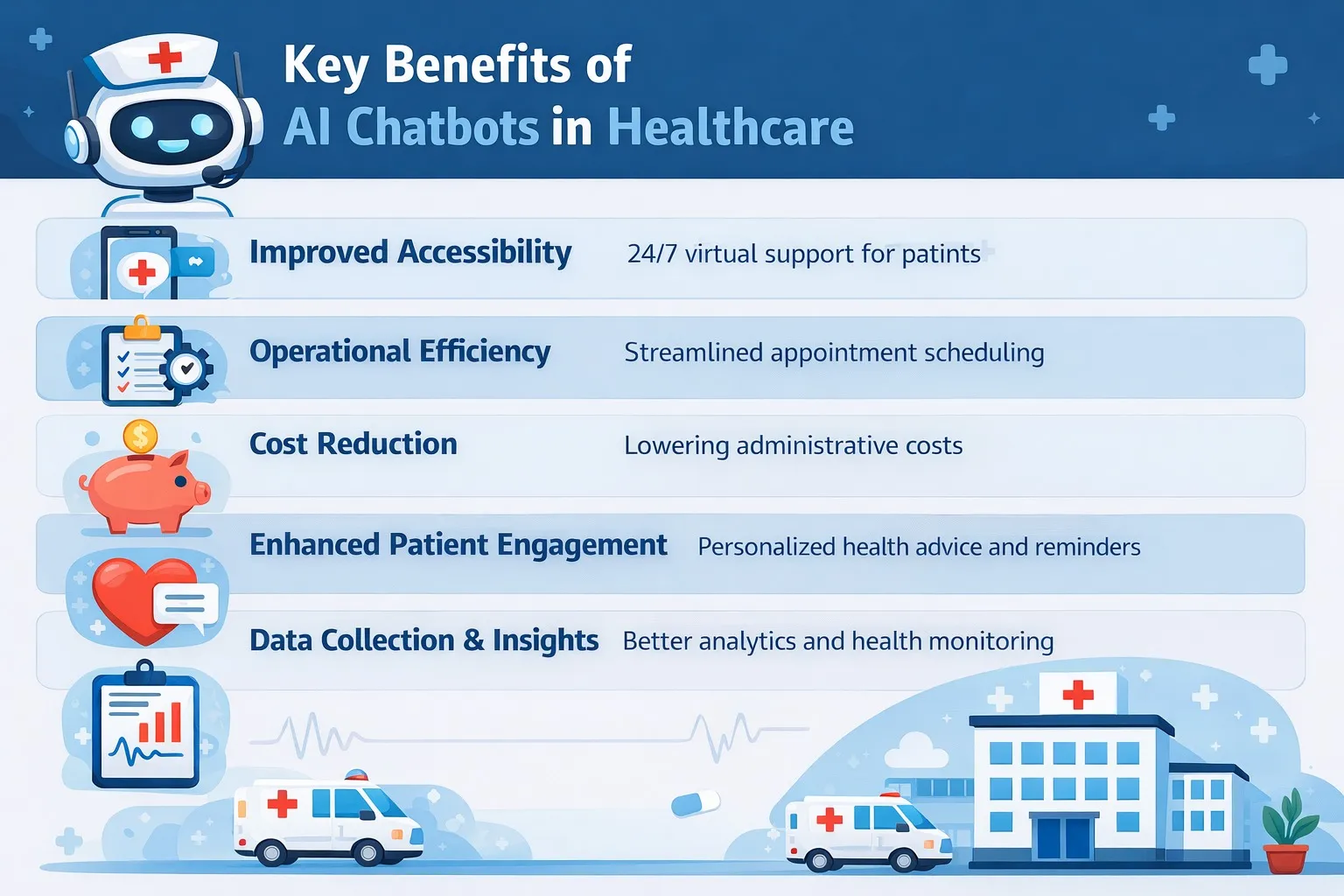
The most immediate advantage provides people with direct entry to services. The implementation of chatbots enables healthcare providers to decrease three existing barriers which still restrict their services through time-based requirements and geographical limits and staff shortages.
Patients can receive assistance at any time which includes both late-night hours and early-morning hours. This matters more than it seems. Many health concerns do not follow office hours, and waiting often leads to delayed care.
People who live in rural areas and underserved regions experience an even wider health care access gap. Not everyone has quick access to healthcare facilities or specialists. AI-powered chatbots in healthcare function as the initial contact point which guides patients through their symptoms and available medical solutions and next steps.
Operational Efficiency
Healthcare systems face an excessive volume of responsibilities related to administrative tasks. Staff members dedicate most of their time to handling scheduling and follow-up operations and documentation work and responding to basic patient inquiries.
AI chatbot development for healthcare provides more than technical enhancement because it serves as a workable solution. The automated chat system handles standard communications which enable healthcare staff to dedicate their efforts towards duties that need their medical knowledge.
For organizations working with an experienced AI-driven healthcare chatbot development services provider, the efficiency gains are often noticeable within a short period. Response times improve, staff workload decreases, and overall system performance becomes more streamlined.
Cost Reduction
Efficiency naturally leads to cost savings.
By reducing the need for manual intervention in repetitive tasks, healthcare providers can lower operational expenses. Fewer call center requirements, reduced paperwork, and optimized workflows all contribute to cost control.
Another important factor is the reduction in unnecessary hospital visits. When patients can get initial guidance through an AI chatbot in healthcare, they are less likely to visit emergency departments for non-critical issues. That alone can significantly reduce system strain and associated costs.
Enhanced Patient Engagement
Patient engagement does not end after a consultation. In many cases, what happens between visits has a direct impact on outcomes.
Chatbots help maintain that connection. They send reminders, provide follow-up guidance, and deliver relevant health information at the right time. Instead of feeling disconnected, patients remain actively involved in their care journey.
With the help of AI for chatbots in healthcare, these interactions can also be personalized. The system can adapt responses based on patient history, preferences, and behavior patterns, making the communication feel more relevant and less generic.
Data Collection and Insights
Every interaction with a chatbot generates data. When used correctly, this data becomes a valuable resource.
Healthcare providers can capture real-time patient inputs, identify trends, and improve decision-making processes. This is where AI Predictive Analytics starts to play a role. By analyzing patterns over time, systems can anticipate risks, detect early warning signs, and support better clinical outcomes.
For organizations investing in Enterprise AI Solutions, this combination of automation and insight creates a strong foundation for long-term innovation within the AI in Healthcare Industry.
Real-World Use Cases of AI Chatbots in Healthcare
The impact of AI chatbots in healthcare becomes clearer when you look at how they are actually being used. These are not theoretical applications. They are already part of everyday healthcare workflows.
Symptom Checking and Triage
One of the most common use cases is symptom assessment. Patients can describe their symptoms, and the chatbot provides an initial evaluation along with suggested next steps.
Platforms like Ada Health have demonstrated how effective this approach can be when combined with clinical data and intelligent algorithms.
This type of functionality is closely tied to AI in healthcare diagnostics, where early interpretation can guide timely intervention.
Appointment Scheduling and Virtual Assistance
Booking appointments is often more complicated than it should be. Chatbots simplify this process by handling scheduling, reminders, and rescheduling requests in real time.
Instead of navigating multiple systems or waiting on calls, patients can complete these tasks in seconds. For providers, this reduces no-shows and improves overall scheduling efficiency.
Mental Health Support
Mental health is an area where accessibility is still a major challenge. Chatbots are helping bridge that gap by offering immediate, judgment-free interaction.
Solutions like Woebot use conversational AI to deliver guided support, helping users manage stress, anxiety, and mood-related concerns.
While they do not replace professional care, they provide an additional layer of support that is available anytime.
Chronic Disease Management
Managing long-term conditions requires consistency. Patients need reminders, monitoring, and ongoing guidance.
Chatbots support this by tracking symptoms, encouraging adherence to treatment plans, and providing timely updates. For conditions like Diabetes, even small improvements in daily management can lead to significantly better outcomes over time.
Post-Treatment Monitoring
Recovery does not end when a patient leaves the hospital. In many cases, complications arise during the post-treatment phase.
Chatbots help monitor recovery by checking in with patients, collecting feedback, and flagging potential issues early. This reduces the risk of readmissions and ensures that patients stay on track during recovery.
Insurance and Claims Support
Insurance processes are often confusing and time-consuming. Chatbots simplify this by answering policy-related questions, guiding users through claims, and providing updates on status.
This reduces frustration for patients and lowers the support burden on administrative teams.
Challenges of AI Chatbots in Healthcare
Despite the benefits, implementing chatbots in healthcare is not without challenges. The environment is complex, and expectations are high.
Data Privacy and Security
Handling patient data requires strict safeguards. Any system dealing with sensitive information must ensure secure storage, controlled access, and full compliance with regulatory standards.
For any healthcare chatbot development company, security is not optional. It is a core requirement that influences every layer of the system.
Accuracy and Reliability
Healthcare decisions depend on accurate information. Even small errors can have serious consequences.
AI systems rely heavily on training data, and if that data is incomplete or biased, the output may not always be reliable. This is especially critical in areas involving AI in healthcare diagnostics, where precision matters most.
Lack of Human Empathy
Technology can simulate conversation, but it cannot fully replicate human emotion.
Patients dealing with sensitive or serious conditions often need empathy, reassurance, and human understanding. Chatbots can support these interactions, but they cannot replace them entirely.
Integration Complexity
Healthcare systems are often built on legacy infrastructure. Integrating modern chatbot solutions with older systems can be technically challenging and time-consuming.
This is where expertise in chatbot development for healthcare industry becomes essential, as seamless integration determines how effective the solution will be in real-world use.
Ethical and Legal Issues
There are still open questions around responsibility and accountability.
If a chatbot provides incorrect guidance, who is responsible? How do we ensure fairness and avoid bias in AI systems? These concerns continue to shape how AI Technologies in Healthcare are developed and regulated.
Implementing AI-Powered Chatbots in Healthcare
Deploying a chatbot successfully requires more than just technology. It requires a clear strategy and careful execution.
Define Objectives
Every implementation should start with a clear goal. Whether the focus is on patient support, automation, or diagnostics, defining the objective helps guide the entire development process.
Choose the Right Technology Stack
The effectiveness of the system depends heavily on the underlying technology.
This includes NLP engines, machine learning models, cloud infrastructure, and secure APIs. Many organizations partner with an experienced AI/ML development company to ensure the architecture is scalable and future-ready.
Ensure Compliance and Security
Compliance must be built into the system from the beginning. Data protection, encryption, and regulatory adherence are critical for any healthcare solution.
Organizations offering healthcare application development services typically prioritize these aspects during the design phase.
Integration with Existing Systems
A chatbot needs to connect with existing healthcare platforms to deliver real value.
Integration with electronic health records, scheduling systems, and hospital management software ensures that the chatbot can access and update real-time information.
Training and Optimization
No system is perfect at launch. Continuous training using real-world data helps improve accuracy and performance over time.
This is where AI for chatbots in healthcare becomes more effective with use, adapting to user behavior and evolving needs.
Testing and Deployment
Before full-scale rollout, testing is essential.
Pilot programs help identify gaps, refine workflows, and ensure the system performs reliably in real-world scenarios. A gradual deployment approach allows organizations to scale with confidence while maintaining quality and safety.
Future Trends in AI Chatbots for Healthcare
If you look at where things are headed, it’s clear that we’re still early in the journey. What we see today with an AI chatbot in healthcare is useful, sometimes impressive, but still evolving. The next phase is less about adding features and more about making these systems feel genuinely intelligent and helpful in real-world situations.
Generative AI and More Natural Conversations
One noticeable shift is how conversations are improving. Earlier chatbots felt scripted. You could almost predict the response. That’s changing quickly.
With newer models, responses feel more fluid and context-aware. The system can follow a conversation, understand follow-up questions, and explain things in a way that actually makes sense to patients.
For companies working on AI chatbot development for healthcare, this opens up a different level of usability. Patients don’t need to adjust how they speak. The system adjusts to them, and that small shift makes a big difference in adoption.
Voice-Based Healthcare Assistants
Not everyone wants to type, especially when they’re unwell or in a hurry. That’s why voice is becoming more relevant.
Voice-enabled assistants allow patients to simply speak and get answers. It sounds simple, but in practice, it removes a lot of friction. This is particularly helpful for older users or anyone who isn’t comfortable navigating apps.
Many teams offering AI-driven healthcare chatbot development services are already prioritizing voice as a core feature rather than something optional. It makes the experience feel more natural and accessible.
Hyper-Personalized Healthcare
Personalization is moving beyond just using a patient’s name or history. It’s becoming more predictive.
Future systems will look at patterns, behavior, and past interactions to anticipate needs. Instead of waiting for a patient to ask a question, the chatbot might check in at the right time or suggest something relevant before the issue escalates.
This is where AI Predictive Analytics comes into play. It helps turn raw data into meaningful insights, which can then be used to guide patients more effectively.
Integration with Wearables and Real-Time Data
There is also a growing connection between chatbots and wearable devices. People are already tracking their health through devices like the Apple Watch.
Now imagine that data being actively used. A chatbot could notice irregular patterns and start a conversation. It might ask a few questions, suggest monitoring something more closely, or recommend a consultation.
This kind of integration is becoming a focus area for organizations investing in Enterprise AI Solutions, especially those looking to move toward preventive care rather than reactive treatment.
Clinical Decision Support
Another shift that’s worth paying attention to is how chatbots are starting to support doctors, not just patients.
They can assist with summarizing patient information, highlighting possible concerns, or even suggesting next steps based on available data. Of course, the final decision always stays with the clinician, but having that extra layer of support can save time and improve efficiency.
An experienced AI/ML development company usually plays a key role here, ensuring that these systems are accurate, reliable, and aligned with clinical workflows.
Expansion of Telemedicine
Telemedicine has already changed how people access healthcare, and chatbots are quietly making it work better.
They act as the first interaction point, gathering basic information, guiding patients, and preparing them for virtual consultations. This makes the entire process smoother for both patients and providers.
For teams offering healthcare application development services, combining chatbots with telehealth platforms is becoming a natural step. It creates a more connected and efficient care experience.
Why Choose AppZoro for AI Chatbots in Healthcare
Choosing a development partner in healthcare is not just about technical skills. It’s about understanding the environment, the regulations, and the real challenges that providers face.
AppZoro approaches AI chatbot development for healthcare with that understanding. The focus is not just on building a chatbot, but on building something that actually works in a live healthcare setting.
With experience in AI-driven healthcare chatbot development services, the team works closely with clients to design solutions that fit their specific needs rather than forcing a one-size-fits-all approach.
Security and compliance are treated seriously from the start. Any reliable healthcare chatbot development company knows that handling patient data comes with responsibility, and that shows in how systems are designed and implemented.
There is also a strong focus on integration. Healthcare systems are rarely simple, and making sure the chatbot works seamlessly with existing platforms is often the difference between success and failure.
On top of that, the solutions are built to scale. As organizations grow or requirements change, the system adapts without needing to be rebuilt. That kind of flexibility matters for anyone investing in long-term Enterprise AI Solutions.
And perhaps most importantly, the support does not stop after deployment. Continuous improvement, optimization, and updates are part of the process, ensuring the solution stays relevant over time.
Conclusion
Healthcare is becoming more complex, but at the same time, it’s also becoming more accessible. Technology is playing a big role in making that happen.
The benefits of AI chatbots in healthcare are already visible. They make it easier for patients to get information, reduce pressure on healthcare teams, and create a more connected experience overall. At the same time, the challenges remind us that this is not something to implement casually. It needs the right approach and the right expertise.
What stands out is that these systems are not here to replace people. They are here to support them. They take care of the repetitive and time-consuming tasks so that healthcare professionals can focus on what really matters.
As the AI in Healthcare Industry continues to evolve, adopting solutions like chatbots is becoming less of an option and more of a necessity. Organizations that move early, especially with the help of strong healthcare application development services, will be better positioned to adapt and grow.
Connect with us today to learn more!
Leave a Comment