
Not too long ago, healthcare mostly followed a simple pattern. You felt sick, you visited a doctor, and treatment started after symptoms appeared. It worked, but it wasn’t always efficient. Today, that model is quietly changing.
We’re moving into a phase where healthcare doesn’t just react. It anticipates. In some cases, it even prevents problems before they fully develop. And a big reason behind that shift is artificial intelligence. Even patient communication is becoming more streamlined through smart systems.
What’s actually happening is more practical. AI is becoming a support layer. It helps clinicians process information faster, reduces manual workload, and brings useful insights into focus when time is limited.
That’s where the real strength of ai use cases in healthcare industry lies. Not in replacing expertise, but in enhancing it. According to recent industry estimates, the global AI healthcare market is expected to cross $180 billion by 2030, growing at a rapid pace each year.
If you’ve been trying to separate genuine progress from noise in this space, this should help.
What Are AI Use Cases in Healthcare?
Before going deeper, it’s worth slowing down for a moment. The term “AI in healthcare” gets used a lot, and sometimes it gets stretched to mean almost anything involving software.
So what are we actually talking about?
In practical terms, AI in healthcare refers to systems that can analyze data, learn from it, and make informed suggestions or decisions.
This includes a mix of technologies:
Machine learning models that detect patterns in patient data
Deep learning systems used in imaging and diagnostics
Natural language processing that understands clinical notes
Computer vision that reads scans and images
Generative AI that can create summaries, reports, or even simulate scenarios
Together, these form the backbone of many AI technology software use cases in healthcare that are currently being adopted.
Rule-Based Systems vs Intelligent AI
Here’s a distinction that often gets missed.
Traditional healthcare software usually follows fixed rules. For example, if certain symptoms are present, the system suggests a predefined outcome. It’s structured, but rigid.
AI systems behave differently. They learn from large datasets and improve over time. Instead of following strict instructions, they adapt based on patterns they discover.
That adaptability is what makes modern use cases of AI in healthcare far more powerful than earlier tools.
Clinical vs Non-Clinical Use Cases
AI doesn’t just live inside operating rooms or diagnostic labs. It plays a role across the entire healthcare system.
Clinical use cases include:
Detecting diseases from imaging data
Supporting diagnosis and treatment planning
Monitoring patient conditions in real time
Non-clinical use cases include:
Automating appointment scheduling
Managing billing and insurance workflows
Improving patient communication systems
Interestingly, many healthcare providers start with non-clinical AI. It’s easier to implement and often delivers quicker returns.
Key AI Use Cases in Healthcare for Diagnosis and Imaging
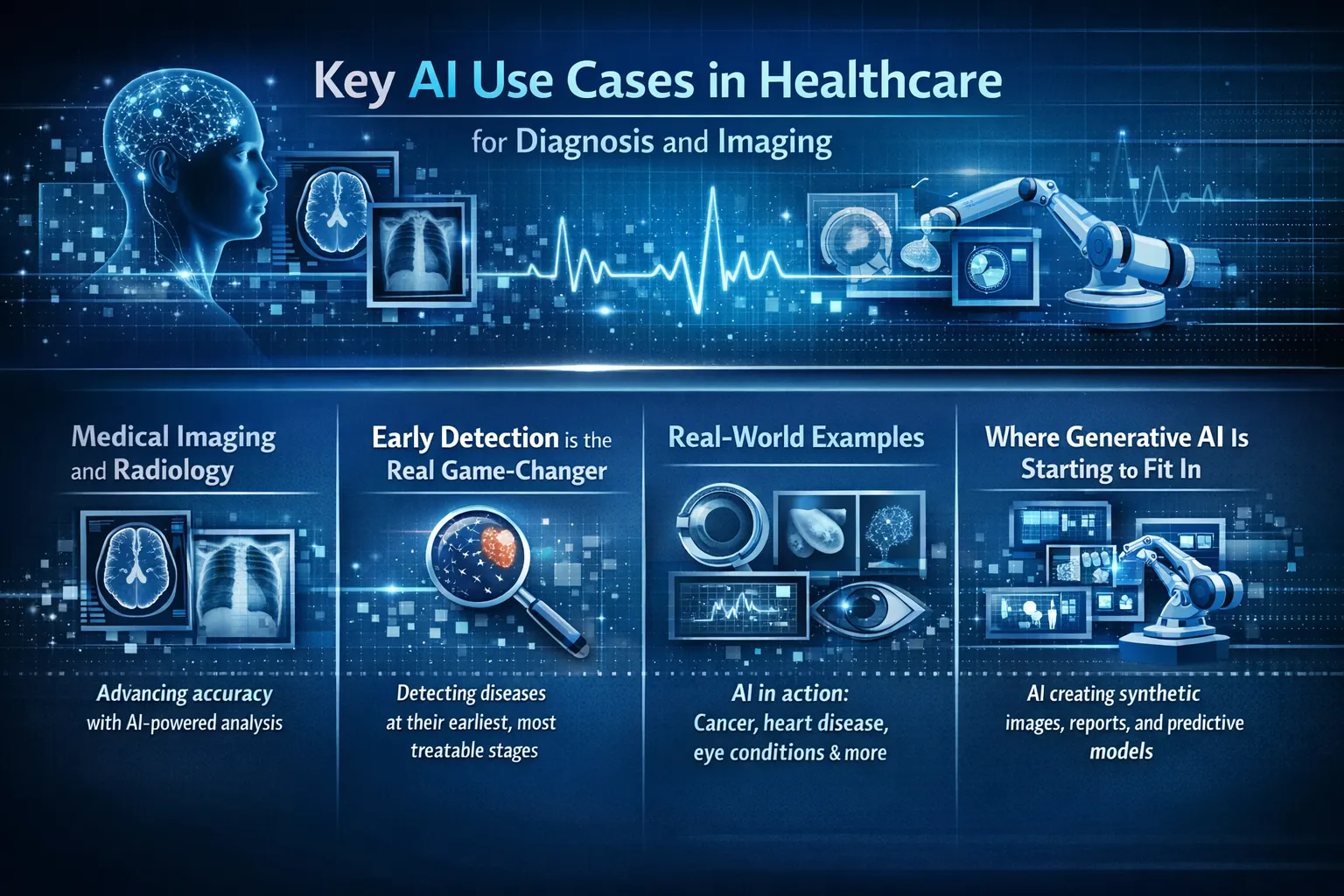
The diagnostic field together with medical imaging sector has become the most valuable application of AI technology according to its current progression whom researchers found to work in this area. The reason for this development stems from the fact that imaging data contains organized data which exists in large quantities and includes numerous visual elements which machine learning models can use for their analysis work.
Medical Imaging and Radiology
Today AI systems have reached the point where they can learn to read and understand medical images through training programs with the following image types:
X-rays
CT scans
MRI images
In many cases these systems work together with other systems. The radiologists use these systems as their extra medical detection tool which helps them to discover crucial medical details that require further examination.
The clinical benefits of AI ML applications in healthcare begin to appear in this section. The models can process thousands of images within a short time frame while they identify hidden patterns which become difficult to detect during busy work periods.
Early Detection Is the Real Game-Changer
The main benefit which this system provides is its capability to identify problems at their earliest stage.
AI technology already identifies initial indications of the following medical conditions:
Cancer detection through examination of mammograms and lung scans
Stroke risk assessment through analysis of brain imaging results
Pneumonia detection through examination of chest X-ray pictures
The correct moment of detection crucially impacts results. The detection of a medical condition at its earliest possible stage will lead to much better results.
Real-World Examples
The system demonstrates its most effective functionality through these practical use cases.
Tumor detection systems which reveal unusual growth patterns during imaging examinations
Emergency response systems which use automated tools to identify broken bones
AI technology which Pathology experts use to analyze digital slides for disease detection through microscopic analysis
The technologies have reached operational status because hospitals currently use multiple systems.
Where Generative AI Is Starting to Fit In
This is also where generative ai use cases in healthcare are beginning to emerge.
For example:
AI systems can now generate preliminary radiology reports based on scan results
They can summarize findings for faster review
In some setups, they assist in comparing current scans with historical data and explaining changes
These use cases for generative AI in healthcare are still evolving, but they’re already helping reduce reporting time.
So while the progress is real, careful implementation still matters.
AI Use Cases in Healthcare for Personalized Patient Care
Diagnosis is only one part of the story. Where things get even more interesting is how AI is reshaping ongoing patient care.
This is where healthcare starts to feel more personal, and less standardized.
Precision Medicine
Traditionally, treatment plans were based on general clinical guidelines. They worked, but they didn’t always account for individual differences.
Now, AI can analyze:
Genetic data
Lifestyle factors
Medical history
Environmental influences
This allows for more tailored treatment strategies.
These are some of the most impactful AI in healthcare use cases, especially when dealing with complex or chronic conditions.
Predictive Analytics
Another area gaining traction is prediction.
AI systems can estimate the likelihood of:
Developing chronic diseases like diabetes or heart conditions
Hospital readmissions after discharge
Potential complications based on patient history
This shift toward prediction is a major part of AI use cases in healthcare innovation. It helps providers act earlier instead of reacting later.
Virtual Health Assistants
You’ve probably seen this already in basic form, but it’s evolving quickly.
AI-powered assistants can now:
Handle initial patient queries
Guide symptom-based triage
Send medication reminders
Track adherence to treatment plans
These tools are part of growing gen AI in healthcare use cases, where systems are becoming more conversational and context-aware.
Remote Monitoring and Wearables
Wearable devices are adding another layer to patient care.
When combined with AI, they can:
Track vital signs in real time
Detect irregular patterns
Alert healthcare providers when something seems off
This is one of the more practical AI ML use cases in healthcare, especially for patients managing long-term conditions.
Where Agentic AI Is Starting to Appear
A newer development worth paying attention to is agentic AI use cases in healthcare.
Instead of just responding to inputs, these systems can take initiative.
For example:
Automatically scheduling follow-ups based on patient data
Coordinating between departments for ongoing care
Triggering alerts or actions without manual intervention
It’s still early, but it signals a shift toward more autonomous healthcare workflows.
Outcomes That Actually Matter
At the end of the day, all of this leads to a few meaningful changes.
Improved Patient Outcomes
Earlier interventions and personalized treatments lead to better results.
More Proactive Care
Instead of waiting for symptoms to worsen, providers can act sooner.
Better Patient Engagement
Patients stay more involved in their own care through continuous monitoring and communication.
Generative AI Use Cases in Healthcare for Clinical Documentation
Let’s be honest for a moment. One of the biggest frustrations in modern healthcare isn’t diagnosis or treatment. It’s documentation.
Doctors today spend a surprising amount of time dealing with electronic health records. In some cases, it’s hours every day just entering, updating, and organizing patient data. It’s necessary, but it pulls attention away from actual patient care.
This is exactly where some of the most practical ai use cases in healthcare industry are starting to make a difference.
The Documentation Problem Nobody Talks About Enough
Clinical documentation isn’t just about typing notes. It involves:
Capturing patient history accurately
Recording symptoms and observations
Updating treatment plans
Preparing discharge summaries
All of this needs to be structured, compliant, and detailed. It’s easy to see how it becomes overwhelming.
Where Generative AI Steps In
This is where gen ai use cases in healthcare are gaining serious traction. Instead of manually writing everything, clinicians can now rely on AI systems to assist with:
Automated medical note generation based on patient interactions
Summarizing patient visits into structured formats
Transcribing doctor-patient conversations in real time
Drafting discharge summaries with relevant clinical details
The Technology Behind It
At the core of these solutions are:
Natural Language Processing (NLP), which helps systems understand medical language
Large Language Models (LLMs), which generate human-like clinical text
Together, they power many AI technology software use cases in healthcare, especially those involving unstructured data like conversations and notes.
But It’s Not Without Concerns
There are still valid risks that need attention.
Data privacy: Patient information is sensitive, and compliance is critical
Hallucination issues: LLMs can sometimes generate incorrect or misleading content
Over-reliance: Clinicians still need to review and validate outputs
So while the upside is strong, careful implementation matters.
Use Cases of Generative AI in Healthcare for Drug Discovery
A Shift from Years to Possibilities
The main purpose of clinical documentation exists to reduce time requirements while drug discovery efforts need multiple years to complete their work. The process of drug discovery takes time which costs companies billions of dollars.
The drug development process has existed for many years as a slow and expensive method to create new medications with unpredictable results. The situation remains unchanged from the past but current developments show new progress because of better operations. AI technology in healthcare creates practical use cases which demonstrate its power to change current expectations.
Why Traditional Drug Discovery Feels So Slow
The drug market introduction process has always presented high levels of difficulty. The process requires between 10 to 15 years to complete all steps from the first idea to the final product. The financial investment reaches significant levels because companies spend billions yet their projects face uncertain chances of success.
A large number of drug candidates fail during trials. Some drugs do not produce the results which were anticipated. Some drugs create problems which make them dangerous to use. All these factors make drug discovery the most expensive research field which healthcare AI uses in its operations today.
How Generative AI Is Changing the Process
The introduction of generative AI technology creates new ways to observe things. The development of recent technology has made AI for healthcare purposes more applicable to pharmaceutical research applications.
Researchers can use AI to discover new possibilities at a faster pace through more intelligent methods which replace traditional trial and error methods.
AI models have the capability to create new molecular structures which meet specific needs through their generative abilities. The time dedicated to early-stage discovery work, which represents the slowest part of the process, gets reduced through this method.
Another area where AI is proving useful is protein structure prediction. Understanding how proteins behave is critical for designing effective drugs. AI can analyze and predict these structures much faster than traditional methods, which significantly speeds things up.
There’s also growing interest in drug repurposing. Rather than starting from scratch, AI can identify existing drugs that may work for new conditions. This approach saves both time and cost, while also reducing risk.
All of these are strong examples of how the AI use cases in healthcare innovation are extending far beyond hospitals and into research labs.
Real-World Applications That Are Taking Shape
While this space is still evolving, we’re already seeing meaningful applications.
AI is being used to identify potential drug candidates for rare diseases, where traditional research is often limited due to smaller patient populations. It’s also playing a role in accelerating vaccine development, especially in situations where speed becomes critical.
In many cases, AI is helping reduce the reliance on pure trial-and-error methods. That alone can make a noticeable difference in how quickly research progresses.
These developments reflect the growing importance of gen ai use cases in healthcare, particularly in areas that were previously slow to innovate.
The Impact on the Industry
The changes brought by AI are not just theoretical. They’re starting to influence real outcomes.
Research timelines are becoming shorter, especially in early discovery stages. Costs are being managed more efficiently because fewer resources are wasted on unsuccessful experiments. At the same time, better predictions are increasing the chances of viable candidates moving forward into clinical trials.
Taken together, these shifts are making the drug discovery process more focused and less uncertain. This is where AI technology software use cases in healthcare are creating measurable value.
AI and ML Use Cases in Healthcare Operations and Administration
When people think about AI in healthcare, they usually picture diagnosis or robotic surgery. But in reality, some of the most immediate impact is happening behind the scenes.
Operations and administration may not sound exciting, but they are where time, money, and efficiency are constantly under pressure. This is exactly where many AI in healthcare use cases are proving their value early.
Making Hospital Operations Less Chaotic
Hospitals deal with constant movement. Patients coming in, beds being assigned, staff rotations changing, and schedules shifting throughout the day. Managing all of this manually often leads to inefficiencies.
With the help of AI ML use cases in healthcare, hospitals are starting to bring more structure into this complexity.
AI systems can now optimize patient scheduling by analyzing availability, urgency, and resource constraints. Instead of long wait times or underutilized slots, schedules become more balanced.
Bed management is another area where AI is quietly making a difference. By predicting discharge timelines and admission patterns, hospitals can allocate beds more effectively. It sounds simple, but it can significantly reduce overcrowding.
Staff allocation is also improving. AI can suggest optimal staffing levels based on historical data, patient inflow, and even seasonal trends. This helps avoid both understaffing and unnecessary overtime.
These are practical examples of how AI Technologies in Healthcare are improving day-to-day operations.
Fixing the Revenue Cycle
Billing and coding have always been time-consuming and prone to errors. Even small mistakes can lead to delayed payments or compliance issues.
This is where automation comes in.
AI can assist in coding medical procedures more accurately by analyzing clinical data. It can also flag inconsistencies that might lead to claim rejections. Over time, this leads to smoother revenue cycles and fewer financial bottlenecks.
Fraud detection is another important area. AI models can identify unusual patterns in billing data that may indicate fraudulent activity. This is one of those AI technology software use cases in healthcare that directly impacts financial stability.
Smarter Supply Chain Management
Supply chain issues in healthcare can quickly become critical. Running out of essential supplies is not an option.
AI helps by predicting inventory needs based on usage patterns, seasonal demand, and historical data. Instead of reacting to shortages, hospitals can plan ahead.
Demand forecasting also becomes more accurate. This ensures that resources are available when needed, without excessive overstocking.
Improving Patient Experience Without Adding Pressure
Patient experience is no longer just about treatment. It includes everything from booking an appointment to follow-up communication.
This is where AI Chatbots in Healthcare are becoming more visible.
AI-powered systems can handle appointment bookings, answer common queries, and guide patients through basic processes. They reduce the load on front-desk staff while also improving response time.
Call centers are also evolving. Instead of long wait times, AI can route calls intelligently or even resolve simple issues instantly.
These improvements might seem small individually, but together they significantly enhance the overall patient experience.
Emerging Agentic AI Use Cases in Healthcare
So far, most AI systems in healthcare have been reactive. They analyze data and provide recommendations, but they still rely on humans to take action.
That’s starting to change.
A new category is emerging, often referred to as agentic AI. It’s still early, but it’s worth paying attention to.
What Is Agentic AI, Really?
Agentic AI refers to systems that can do more than just respond. They can plan, make decisions, and take actions based on goals.
In simple terms, instead of waiting for instructions, these systems can initiate tasks on their own.
This marks a shift in how we think about generative ai use cases in healthcare and their evolution into more autonomous systems.
Where It’s Starting to Show Up
Some early agentic AI use cases in healthcare are already taking shape.
AI care coordinators are one example. These systems can track patient journeys, schedule follow-ups, and ensure that care plans are being followed without constant manual intervention.
There’s also movement toward autonomous clinical workflows. Instead of separate systems handling different tasks, AI can coordinate across processes, connecting data, decisions, and actions.
In larger setups, multi-agent systems are being explored. Different AI agents handle different responsibilities, but they work together to manage hospital operations more holistically.
What This Looks Like in Practice
To make this more concrete, imagine a typical patient journey.
A patient gets discharged. Instead of waiting for someone to manually schedule a follow-up, the AI system automatically books it based on availability and urgency.
If additional tests are required, it coordinates with the relevant departments. If there’s a delay or risk, it flags it early.
Over time, it starts managing the entire journey, from admission to recovery, with minimal manual input.
These are advanced gen AI in healthcare use cases, where systems are not just generating outputs but actively managing processes.
What Changes Because of This
The biggest shift here is the reduction of manual intervention in routine workflows.
Tasks that used to require multiple people and constant coordination can now be handled more smoothly. This allows healthcare professionals to focus on more critical responsibilities.
However, this also brings up important questions.
How much decision-making should be delegated to AI?
How do we ensure accountability?
What happens when systems make mistakes?
These ethical concerns are part of the ongoing conversation around use cases for generative AI in healthcare as they evolve into more autonomous forms.
Future Trends in AI Use Cases in the Healthcare Industry
If we look ahead, it’s clear that we’re not just improving existing systems. We’re gradually redesigning how healthcare works. The next wave of ai use cases in healthcare industry will feel less like add-ons and more like core infrastructure.
Smarter, More Connected AI Systems
One of the biggest shifts we’re seeing is toward multimodal AI. Instead of analyzing just one type of data, we are now combining clinical notes, imaging, lab reports, and even genetic data into a single system.
This changes how decisions are made. Instead of fragmented insights, we get a more complete patient view. That’s where AI use cases in healthcare innovation start to move beyond incremental improvements.
Real-time diagnostics is another area gaining traction. Instead of waiting hours or days, we can process and interpret patient data instantly. In critical care scenarios, this can directly impact outcomes.
Robotics and Advanced Clinical Support
AI-powered robotic surgery is also evolving. While surgeons remain in control, AI enhances precision, reduces variability, and assists in complex procedures.
This is one of the more advanced AI technology software use cases in healthcare, where human expertise and machine intelligence work together in real time.
Privacy-Focused AI Is Becoming Essential
As we adopt more AI, data privacy is no longer optional. It’s central.
That’s why federated learning is gaining attention. Instead of moving patient data across systems, we train AI models locally while keeping data secure. This approach is becoming increasingly relevant across the AI in Healthcare Industry, especially with stricter compliance requirements.
Digital Twins and Predictive Healthcare
Another concept that’s slowly moving from theory to practice is digital twins.
In simple terms, we can create a virtual model of a patient and simulate different treatment outcomes. It’s still early, but it has strong potential for personalized care.
Regulation and Explainability
As adoption increases, regulation is catching up.
We now need AI systems that are not only accurate but also explainable. Doctors need to understand why a decision is made, not just what the decision is.
This is especially important for many use cases of AI in healthcare, where trust directly impacts adoption.
AI as a Co-Pilot, Not a Replacement
One pattern keeps repeating.
The most effective systems are not replacing humans. They are supporting them.
We are building AI that works alongside clinicians, not instead of them. This mindset is shaping how gen ai use cases in healthcare are being designed moving forward.
Why Choose AppZoro for AI Use Cases in Healthcare
When we move from ideas to execution, the real challenge begins. That’s where choosing the right partner matters.
At AppZoro, we focus on building practical, scalable solutions across real-world ai use cases in healthcare industry, not just prototypes.
What We Bring to the Table
We work at the intersection of healthcare and AI, combining domain understanding with technical execution.
Our experience includes:
Designing and deploying AI/ML solutions tailored to healthcare workflows
Building scalable platforms aligned with modern AI Technologies in Healthcare
Implementing both clinical and operational AI systems
This allows us to handle diverse AI in healthcare use cases, from patient engagement to advanced analytics.
Services Built for Real-World Adoption
We don’t just build features. We build complete systems.
Our core offerings include:
Custom AI model development aligned with specific healthcare needs
End-to-end product development through healthcare application development services
Integration of advanced gen ai use cases in healthcare into existing platforms
Data engineering and analytics for long-term scalability
As an experienced AI development company, we focus on solutions that actually get used, not just tested.
What Makes Our Approach Different
We prioritize compliance, scalability, and usability from day one.
Our solutions are designed to meet healthcare standards like HIPAA while remaining flexible enough to scale. More importantly, we build systems that fit into existing workflows instead of disrupting them.
That balance is critical when implementing AI technology software use cases in healthcare.
Real Case Studies: What This Looks Like in Practice
This is a strong example of how AI use cases in healthcare innovation can directly impact both patient experience and operational performance.
We’ve seen healthcare systems struggle heavily with scheduling inefficiencies. In one real-world implementation, a large hospital network introduced AI-driven automation across scheduling and resource allocation.
The results were significant.
Patient wait times reduced by 40%
Staff efficiency improved by 35%
Annual cost savings reached millions
Patient satisfaction increased to 95%
AI works best when applied to real problems. Scheduling, communication, documentation, and resource management are where we see the fastest returns.
That’s exactly how we approach projects. We don’t start with technology. We start with the problem. Then we design AI solutions that fit naturally into that workflow.
Conclusion
If we step back and look at the bigger picture, it’s clear that AI is no longer a side experiment in healthcare. It’s becoming part of the foundation.
We’re also seeing how AI ML use cases in healthcare and generative ai use cases in healthcare are moving beyond experimentation. They are becoming part of everyday workflows. Documentation, scheduling, patient engagement, and research are all being reshaped in subtle but meaningful ways.
At the same time, it’s important to stay grounded.
Not every solution is perfect. There are still challenges around data quality, privacy, and trust. But that’s expected in any evolving space. What matters is that the progress is real, and it’s already delivering results.
Looking ahead, the future feels more connected and more personalized.
We’re moving toward a healthcare system where care is proactive, decisions are data-driven, and patient journeys are smoother. This is where AI Trends in Healthcare are heading, and it’s happening faster than many expected.
If you’re exploring how AI can fit into your healthcare workflows, we’d be glad to help.
As an experienced AI/ML development company, we work closely with healthcare organizations to design and implement solutions that are practical, scalable, and aligned with real-world needs.
Leave a Comment