
Healthcare is evolving quickly, and if you look closely, artificial intelligence is driving much of that change. Not long ago, AI in this space felt experimental. Hospitals conducted model tests while startups presented their concepts and the industry showed only minimal acceptance. The current moment shows that previous doubts have started to diminish. AI technology now assists in clinical decision-making processes while it oversees operational activities and enhances patient treatment results.
The fast development of this transformation creates a bigger attraction to observe. The AI in Healthcare Industry is projected to grow at a massive scale over the coming years with estimates of reaching USD 500-700 billion by 2033. The presence of such expansion leads to more than temporary excitement for the market. The market demonstrates actual user adoption which creates tangible effects.
The year 2026 stands out as a major transformation moment. The emergence of AI did not bring a sudden change because it took time for all necessary elements to come together. The new regulations have started to establish their official guidelines. Healthcare providers are starting to see actual returns. AI systems no longer remain in their initial testing stage. They are being rolled out at scale.
This article takes a closer look at the most relevant ai trends in healthcare, how they are reshaping care delivery, and what they mean for businesses investing in healthcare application development services.
What Are AI Trends in Healthcare
To understand where things are going, it helps to first clarify what we mean by AI in healthcare.
AI is a combination of technologies working together in the background. Machine learning helps detect patterns in massive datasets. Natural language processing makes sense of clinical notes and patient records. Computer vision is used to analyze medical images, sometimes with remarkable accuracy. And now, generative AI is beginning to assist with documentation and even early-stage treatment planning.
Each of these technologies plays a role, but their real value comes from how they work together.
Key Drivers Behind AI Trends
Several forces are pushing these changes forward.
The first data source consists of data which healthcare systems create through their collection of electronic health records and their use of wearable devices. The challenge is not collecting data anymore. It is making sense of it.
Then there is computing power. AI models today operate at greater speed while consuming less resources and providing better user access. What once required heavy infrastructure can now be implemented more easily across different healthcare setups.
Organizations experience ongoing demands to lower expenses while delivering improved services that maintain current standards. This is where AI becomes more than just a technology upgrade. It becomes a practical solution.
The current situation leads to a major transformation in the operational methods used by healthcare systems. Earlier systems operated through establishing rules which restricted their capacity to execute tasks. The present situation demonstrates a transition toward systems which develop their capabilities through continuous learning processes.
These systems develop through data instead of requiring programmers to design their responses to each potential situation. The healthcare system establishes new decision-making procedures through this slight transformation.
How AI Is Transforming Healthcare Delivery
The real impact of AI becomes clear when you look at how care is actually being delivered today.
From Reactive to Predictive Care
The healthcare system now uses preventive measures instead of waiting until patients need treatment.
People used to wait until their health problems became serious before they decided to visit a doctor. AI Predictive Analytics enables healthcare organizations to discover potential threats at an earlier stage which allows them to take action before medical conditions develop into critical situations. The implementation results in actual outcome improvements which seem like a minor modification.
Faster and More Accurate Diagnostics
The field of diagnostics has experienced several advancements.
AI systems can process medical images and patient data much faster than traditional methods. The system can detect patterns which would take human experts more time to identify. Doctors use this system to support their medical judgment process because it gives them additional resources.
The system provides valuable assistance because it enables doctors to verify their diagnoses while detecting medical problems at an earlier stage.
Automation of Administrative Work
At the same time, a lot is happening behind the scenes.
Healthcare systems have always struggled to handle their administrative responsibilities. Scheduling, billing, and documentation tasks consume important work hours. The implementation of AI technology helps businesses achieve smoother operations through process automation.
The hidden alteration creates an essential effect on everyday operations of healthcare systems.
Enhanced Patient Interaction
Patient interaction is evolving too.
Patients no longer need to visit physical locations for their healthcare needs. AI-based platforms enable patients to access assistance while they track their health and receive information without needing to visit hospitals or clinics.
Healthcare application development services provide essential support for this process. Their work establishes platforms which enable users to interact with systems through safe and user-friendly interfaces.
Decreasing Clinician Work Exhaustion
The workforce experiences another vital transformation.
Healthcare workers have always faced the problem of professional burnout. AI technology decreases work demands through its ability to manage routine duties while delivering essential backup for decision-making.
This allows doctors and staff to focus more on patient care rather than administrative processes.
Key AI Trends in Healthcare (2026 Edition)
Predictive and Preventive Analytics
Healthcare is about anticipating it. With advanced models and data processing, AI Technologies in Healthcare are now able to detect early signs of diseases like cancer or heart conditions, sometimes even before symptoms appear.
Hospitals are also using AI to predict readmission risks. If a patient is likely to return within weeks, care teams can intervene early.
On a larger scale, population health management is becoming more data-driven. Instead of reacting to trends, healthcare providers can now plan ahead.
This is why predictive analytics continues to dominate ai in healthcare latest trends.
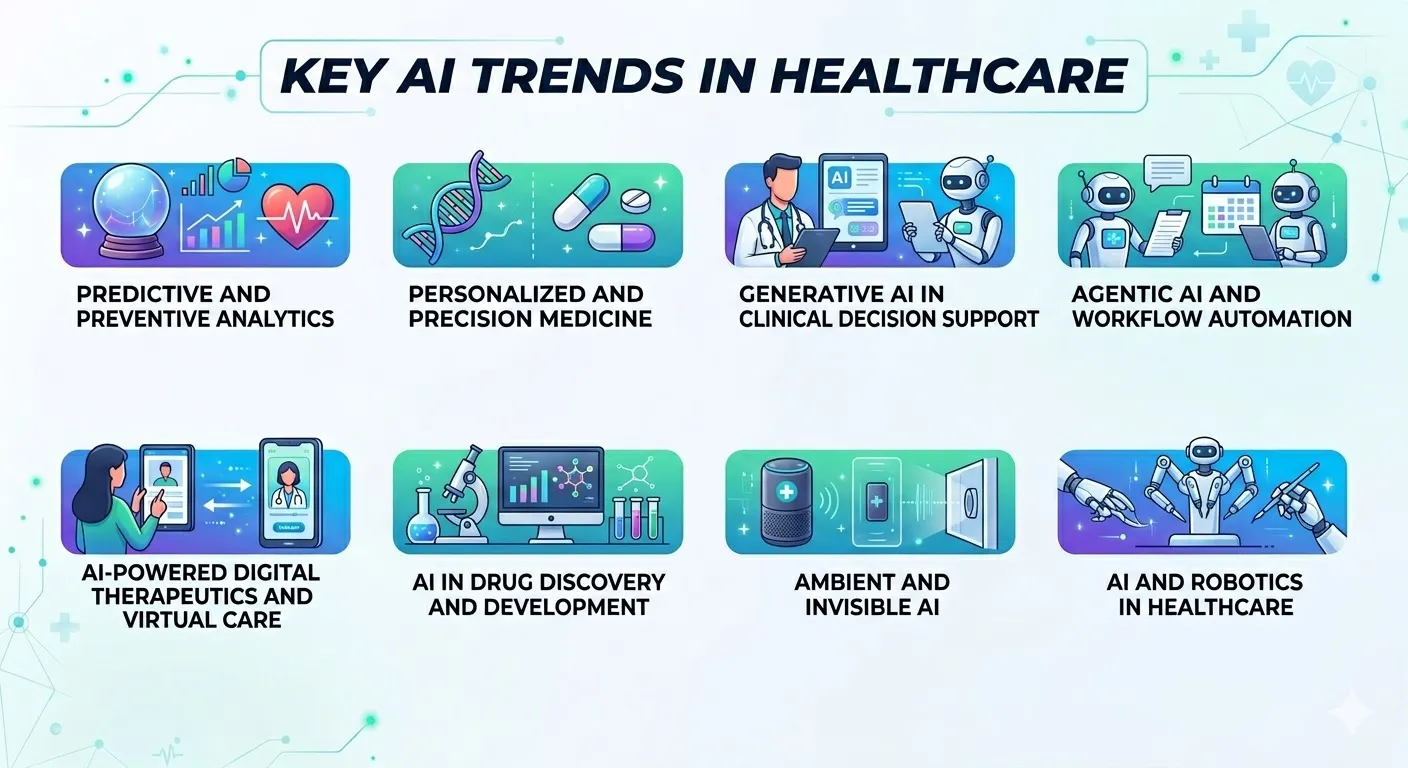
Personalized and Precision Medicine
Healthcare is becoming more personal, and AI is making that possible.
Instead of a one-size-fits-all approach, treatments are now being tailored using patient-specific data. This includes genetic information, lifestyle habits, and medical history.
AI helps doctors:
Adjust treatment plans based on individual response
Recommend more effective drug therapies
Manage chronic conditions with better accuracy
This shift toward personalization is one of the strongest future trends of ai in healthcare, and it is only going to deepen as more data becomes available.
Generative AI in Clinical Decision Support
Generative AI is starting to play a much bigger role than expected.
Doctors are now using AI copilots that assist with diagnosis, suggest treatment options, and even generate clinical notes. It does not replace expertise, but it adds a strong layer of support.
Another interesting development is multimodal AI. These systems combine:
Text data from patient records
Medical imaging
Lab results
This creates a more complete picture for decision-making, especially in complex cases.
Agentic AI and Workflow Automation
Automation is evolving into something more advanced.
Agentic AI refers to systems that can handle multi-step tasks with minimal human input. Instead of just giving recommendations, they actually execute workflows.
In healthcare, this shows up in areas like:
Insurance claims processing
Billing and prior authorizations
End-to-end hospital operations
For organizations investing in Enterprise AI Solutions, this is where efficiency gains become very real. It reduces delays, cuts operational costs, and improves overall workflow reliability.
Also Read: Why AI Agents Are the Future of Healthcare Innovation
AI-Powered Digital Therapeutics and Virtual Care
Patient care is no longer limited to hospitals or clinics.
AI-powered apps and platforms are enabling continuous care through:
Remote monitoring tools
AI-driven therapy applications
Integration with wearables and IoT devices
Patients can now receive feedback, track their progress, and even get guided interventions from home.
This trend is also fueling the growth of telehealth ecosystems, making healthcare more accessible and scalable.
AI in Drug Discovery and Development
Drug development has always been time-consuming and expensive. AI is changing that.
By analyzing vast datasets, AI can identify potential drug candidates much faster. It can also simulate how these drugs might behave, reducing the need for lengthy trial phases.
This leads to:
Faster research cycles
Lower development costs
More targeted therapies
It is one of the most promising areas within broader ai trends in healthcare, especially for pharma and biotech companies.
Ambient and Invisible AI
Some of the most powerful AI systems are the ones you do not even notice.
Ambient AI works quietly in the background. For example, it can listen to doctor-patient conversations and automatically generate clinical notes. No manual input needed.
There are also systems that monitor patient vitals continuously without requiring active interaction.
This idea of “zero-click” AI is gaining traction because it reduces friction and allows healthcare professionals to focus on care instead of screens.
AI and Robotics in Healthcare
AI is not just digital anymore. It is becoming physical.
Robotic-assisted surgeries are already improving precision and reducing recovery times. Smart ICUs are using AI to monitor patients in real time and respond faster to critical changes.
We are also seeing more automation in hospital environments, from logistics to patient handling.
These developments show how deeply AI is integrating into real-world healthcare settings.
Major Use Cases of AI in Healthcare
While trends give us direction, use cases show us where things are actually working on the ground.
AI in Healthcare Diagnostics and Imaging
One of the most established areas is AI in healthcare diagnostics, especially in radiology. AI systems are helping analyze X-rays, MRIs, and CT scans with increasing accuracy. In many cases, they act as a second set of eyes, helping doctors catch issues earlier and make more confident decisions.
Virtual Health Assistants and Chatbots
Virtual assistants are becoming a normal part of patient interaction. They handle basic queries, guide users through symptoms, and even help with appointment scheduling. It may seem simple, but it significantly reduces the burden on support staff and improves response time.
Remote Patient Monitoring
This is where AI really starts to extend care beyond hospitals.
Patients with chronic conditions can be monitored continuously through connected devices. AI analyzes this data in real time and alerts healthcare providers when something seems off. It allows for timely intervention without requiring constant hospital visits.
Clinical Decision Support Systems
Doctors today have access to more data than ever. The challenge is using it effectively.
AI-powered decision support systems help by analyzing large datasets quickly and presenting actionable insights. This supports better diagnosis, treatment planning, and overall clinical decision-making.
Hospital Operations and Resource Optimization
AI is also improving how hospitals function behind the scenes.
From managing bed availability to predicting patient flow, these systems help optimize resources. The result is smoother operations, reduced waiting times, and better overall efficiency.
Drug Discovery and Genomics Research
In research and development, AI is accelerating progress.
It can process complex biological data, identify patterns, and even suggest potential drug candidates. In genomics, AI helps researchers understand genetic variations and their impact on diseases, opening doors to more targeted treatments.
Challenges in Adopting AI in Healthcare Trends
While the progress is impressive, adopting AI is not as straightforward as it may seem. Many organizations in the AI in Healthcare Industry are still navigating practical challenges that slow down large-scale implementation.
Data Privacy and Security Concerns
Healthcare data is highly sensitive. Patient records, medical histories, and diagnostic data cannot be handled casually. Any AI system must comply with strict data protection standards.
The challenge is balancing innovation with privacy. Even though AI Predictive Analytics depends on large datasets, organizations need to ensure that data is secure and used responsibly.
Regulatory and Compliance Barriers
Regulations around AI in healthcare are still evolving. Different regions have different standards, and approval processes can be slow.
This creates uncertainty for healthcare providers and companies offering healthcare application development services. Before deploying AI solutions, they must ensure compliance, which often delays implementation.
Lack of Interoperability
Healthcare systems are often fragmented.
Hospitals, labs, and insurance providers use different platforms that do not always communicate well with each other. Integrating AI into such environments becomes complex, especially when data is stored in incompatible formats.
This lack of interoperability continues to be a major barrier across many ai in healthcare trends.
Bias and Reliability Issues
AI models are only as good as the data they are trained on.
If the data is biased or incomplete, the outcomes can be unreliable. In healthcare, this is a serious concern because decisions directly affect patient lives.
Ensuring fairness, accuracy, and consistency remains a critical challenge.
High Implementation Costs
Adopting AI is not just about software. It involves infrastructure, data management, training, and ongoing maintenance.
For many healthcare providers, especially smaller ones, the initial investment can be a significant hurdle. Even when the long-term benefits are clear, the upfront cost slows adoption.
Resistance to Change
Technology adoption always comes with a human factor.
Some healthcare professionals are cautious about relying on AI, especially in clinical decision-making. There is also a learning curve involved in using new systems effectively.
This resistance is gradually decreasing, but it still plays a role in how quickly AI is integrated into daily workflows.
Future Trends of AI in Healthcare
Looking ahead, the direction is quite clear. The next phase of innovation will not just expand AI capabilities but also deepen its integration across the entire ecosystem.
Here are some key ai in healthcare future trends to watch:
AI is expected to become core infrastructure in healthcare systems, not just an add-on tool
The global AI in Healthcare Industry is projected to grow at a CAGR of over 35 percent, potentially reaching more than 180 to 200 billion dollars by the early 2030s
Autonomous healthcare ecosystems will start to emerge, where AI handles multiple processes with minimal human intervention
Stronger integration across hospitals, pharmaceutical companies, and insurance providers will create more connected systems
Human and AI collaboration will become the standard model, rather than replacement
There will be a growing focus on explainable and ethical AI to build trust and ensure transparency
Continuous, real-time, personalized care will replace episodic treatment models
Another interesting shift is how organizations are approaching AI implementation. Instead of isolated tools, many are now investing in Enterprise AI Solutions that connect different functions into a unified system.
For businesses working with an AI/ML development company, the focus is also moving toward long-term scalability rather than short-term experimentation.
Overall, these developments suggest that AI will not just support healthcare systems. It will become a fundamental part of how they operate, evolve, and deliver care in the years ahead.
Why Choose AppZoro for AI in Healthcare
By now, it is clear that adopting AI is not just about following ai trends in healthcare. It requires the right strategy, the right technology stack, and more importantly, the right partner.
This is where AppZoro positions itself differently.
Deep Expertise in AI and Healthcare
AppZoro brings hands-on experience in building solutions tailored for the AI in Healthcare Industry. The focus is not just on implementing technology, but on solving real healthcare challenges using practical, scalable approaches.
From AI in healthcare diagnostics to workflow automation, the team works across multiple layers of healthcare systems.
Strong Foundation in Compliance and Security
Healthcare applications cannot afford gaps in compliance.
AppZoro has experience working with HIPAA-compliant systems, ensuring that data privacy and security are built into every solution from the ground up. This becomes especially important when dealing with sensitive patient data and advanced AI Technologies in Healthcare.
End-to-End Development Approach
What makes a real difference is the ability to handle the full lifecycle.
AppZoro offers complete healthcare application development services, covering:
Strategy and consulting
Design and architecture
Development and integration
Deployment and ongoing support
This ensures that businesses do not have to manage multiple vendors or fragmented workflows.
Custom AI Model Development
Every healthcare organization has different needs.
Instead of using generic solutions, AppZoro focuses on building custom AI models tailored to specific use cases. Whether it is predictive analytics, patient engagement platforms, or operational optimization, the solutions are designed to align with business goals and evolving ai in healthcare latest trends.
Case Study Snapshot
In one of their recent healthcare projects, AppZoro worked with a medical service provider looking to improve diagnostic efficiency and patient engagement.
The challenge was clear. The client was dealing with delays in diagnosis and fragmented patient communication systems.
AppZoro implemented:
An AI-powered diagnostic support system to enhance accuracy and speed
A patient-facing platform for real-time interaction and monitoring
Backend automation to streamline administrative workflows
The result was noticeable:
Faster diagnosis turnaround times
Improved patient engagement and satisfaction
Better operational efficiency across departments
This kind of outcome reflects how well-designed Enterprise AI Solutions can move beyond theory and deliver measurable impact.
Final Note
The rise of connected systems and intelligent platforms reflects a broader shift in how the AI in Healthcare Industry is evolving.
That said, innovation alone is not enough.
Healthcare organizations need to balance speed with responsibility. Trust, ethics, and human oversight still play a critical role, especially when decisions directly affect patient lives.
Looking ahead, one thing is clear. Organizations that approach AI strategically, not just as a tool but as a core capability, will be the ones leading this transformation.
If you are exploring how to implement AI or scale your existing systems, this is the right time to act. Working with an experienced partner can make all the difference.
AppZoro combines technical expertise, healthcare understanding, and a practical approach to building solutions that align with real business needs. Whether you are just starting out or looking to expand your capabilities, connecting with the right team can help you move forward with clarity and confidence.
Leave a Comment