
Healthcare Software Product Development: A Complete Guide for Teams Scoping a Build

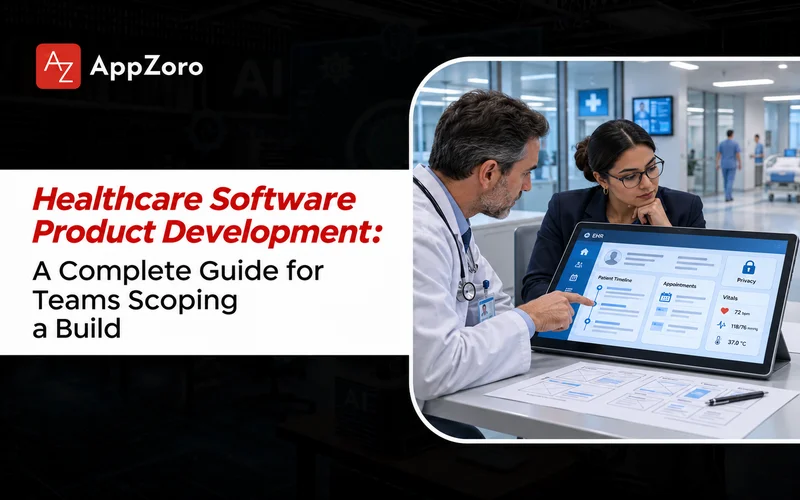
Seven months into the build, a founder, call him Raj, learned in an advisory meeting that the risk score his app was showing patients had made the product a medical device. Nothing in the code was broken. The pilot clinic liked it, and the number on the screen was telling a patient to change something about their medication, which is the sentence that changes a project. The roadmap his investors had seen was now eight months out of date.
We have watched that meeting more than once, and bad engineering is rarely the cause. The cause is a decision nobody made out loud in the first fortnight, when changing it would have cost nothing. Budgets are moving towards intelligent features at the same time, and the wider shift to AI in healthcare is adding fresh questions about data, evidence and oversight on top of everything else.
So where is the money in a serious healthcare build really going? Well, into the parts nobody puts on a slide: the classification decision, the integration surface, the audit trail, the clinical review and the maintenance that starts the day you launch. Let’s break it down.
What healthcare software product development actually covers
Design and engineering are a minority of the effort on a clinical product. The work that decides whether it survives contact with a hospital is sitting around them, in the scoping, the classification, the data modelling and the integration, and getting that right early is extremely crucial for the budget.
Grand View Research is valuing the global digital health market at USD 347.4 billion in 2025 and projecting USD 1,830.4 billion by 2033 in its June 2026 market release, which is a forecast rather than a measurement, so treat it as direction of travel.
The questions that set your budget
Before design starts we are trying to answer four things, resulting in:
- Who the first user is, and what they are doing in the ninety seconds before they open it.
- What the product claims, since diagnosis or treatment is pulling you towards device territory.
- Which systems hold your data, and whether you are reading, writing or both.
- What happens when the product is wrong, and who notices.
Every one of those has a cost attached, and the teams who skip them are the ones discovering in month seven that they have built a regulated product with an unregulated process. This is not only a compliance problem, this is also a commercial problem.
What you are building changes what has to be solved first
A patient app, a clinical workflow tool and a regulated diagnostic product share a stack and almost nothing else, because the hard part sits somewhere different in each.
Imaging products are the clearest example, since the work is dominated by storage, viewer performance and the claim attached to anything the software highlights, which is why building medical imaging software is a discipline rather than a feature.
Research facing products carry protocol logic, consent and audit trails that have to satisfy a sponsor, and our guide to clinical trial app development covers what that adds.
Commercial systems are lighter on clinical risk and heavier on data joins, the pattern in healthcare CRM development, where the patient record and the sales record stay separate.
If you are selling the same product to several providers, the tenancy model follows you for years, and our look at healthcare SaaS platforms goes into it.
So how is healthcare changing the engineering itself? Let’s take a look.
Why healthcare is different from ordinary software
Three things are true at once here that are rarely true together elsewhere. The data is legally protected, the user is interrupted, and a bad output can hurt somebody.
Your user is interrupted, tired and standing up
A nurse is using your product between two other tasks and almost always with somebody waiting. That is changing design in measurable ways: fewer screens, larger targets, nothing that needs two hands, no flow that loses state when the session times out. We push clients hard on this, because a workflow that tests beautifully in a quiet room is failing in a corridor.
The record is the product
In clinical software the data is often the legally meaningful record of care, so every write needs an author, a timestamp and a reason. If you are touching the patient record at all, it is worth understanding the difference between EMR and EHR systems before deciding what your product stores and what it reads from elsewhere.
So how does this translate into a sequence of work? Let’s walk the process stage by stage.
The medical software development process, stage by stage
The healthcare software development process follows the same arc as any other product, and the difference is what each stage produces as evidence. Durations are our own averages on US projects.
| Stage | What it produces | Typical duration |
| Discovery and classification | Problem statement, research, regulatory position | 2 to 5 weeks |
| Data and integration design | Data model, integration map, access rules | 2 to 4 weeks |
| Experience design | Flows, prototypes, accessibility decisions | 3 to 6 weeks |
| Build and integration | Working increments, sandbox connections | 10 to 30 weeks |
| Validation and testing | Test evidence, security testing, user acceptance | 3 to 8 weeks |
| Launch and adoption | Training, rollout plan, support runbook | 2 to 6 weeks per site |
| Maintenance | Patches, standards updates, new workflows | Ongoing |
The row people underestimate is the last one, because healthcare products are maintained against moving standards and regulations, not only user requests.
Discovery is where the budget is decided
The most valuable output of discovery is a narrow first release: one workflow, one site, one user group, instrumented properly. Our guide to building an MVP covers that reasoning.
Build is where integration either happens or gets deferred
Integration slides to the end of a plan, and that is where projects go wrong, since sandbox access takes weeks and the first real data always reveals something the specification missed. On the MedCraze platform our team was connecting external research databases and institutional sources alongside the core build, and running those connections early kept the phased rollout realistic.
So what is sitting on top of every stage? Well, the regulatory position.
Regulatory and compliance reality
Nothing here is legal advice, and the only safe version of this conversation is with a consultant who has read your intended use statement.
| Pathway | What triggers it | What it adds |
| HIPAA | Handling protected health information | Security controls, access logs, business associate agreements |
| FDA device regulation | Software that diagnoses, treats or directs decisions | Quality system, clinical evidence, a submission pathway |
| Non device decision support | A clinician can review the basis of the recommendation | Transparency documentation, careful wording |
| GDPR | Personal data of people in the EU or UK | Lawful basis, data subject rights, transfer mechanisms |
| State privacy laws | Consumer health data in certain US states | Consent flows, separate disclosures |
The row you land on is set by your intended use rather than by your technology.
HIPAA is the floor, and it is moving
HIPAA governs how protected health information is stored, transmitted and accessed, and the Security Rule is the part engineers live with daily. It is under revision: OCR issued a proposed rule in December 2024 proposing mandatory encryption, multifactor authentication, asset inventories and network maps, and the HHS notice states plainly that the current Security Rule remains in effect while the rulemaking continues.
Building to the proposed controls now is sensible, since most are already asked for in enterprise security reviews. Our walkthrough of developing a HIPAA compliant app covers the implementation detail.
Software as a medical device, and the line you are walking
The FDA regulates software functions rather than whole products, so one feature can pull an otherwise unregulated product into device territory. It published updated final guidance on clinical decision support software on 29 January 2026, listed on its digital health guidance page alongside guidance on device cybersecurity and AI enabled functions. We cannot tell you which side of the line your product sits on, and anybody who tells you confidently in a sales call is guessing.
GDPR and the international question
If any of your users are in the EU or the UK, GDPR applies regardless of where your servers sit, and lawful basis, data subject rights and transfer mechanisms are design decisions that are cheaper before launch. Our GDPR compliance guide is written for teams at the architecture stage.
And speaking of data leaving your system, let’s take a look at interoperability.
Interoperability and standards
The standards are well documented and still not making integration simple, because every health system implements them differently and the gaps only appear once you are holding real data.
HL7 version 2 messaging still carries an enormous amount of day to day hospital traffic, and you will meet it long before you meet anything modern. FHIR is the newer API based standard, and the version United States regulation is built around is R4. HL7’s own FHIR R4 specification notes that R4 is version 4.0.1 and that a later release, 5.0.0, supersedes it, which illustrates the gap between what a standards body publishes and what the market runs.
What EHR integration really involves
The phrase “we will integrate with the EHR” is hiding four separate pieces of work, resulting in:
- Getting sandbox credentials and an app registration, which is a queue with its own timeline.
- Mapping your data model to the profiles the system expects.
- Handling identity, so the right patient and clinician are matched reliably.
- Deciding whether you are reading only or writing back.
That last point is the expensive one. Read access is often achievable in weeks, write access pulls in clinical governance and vendor review at each site, and teams discover that after promising a date. A dedicated FHIR and EHR integration guide is the right home for the mechanics.
So what should you build all of this on? Let’s take a look at the stack.
The technology stack for health tech product development
Almost any mainstream stack can carry a healthcare product, and the constraints that matter are coming from compliance and hosting instead.
| Layer | Common choices | What it needs first |
| Mobile client | Swift, Kotlin, React Native, Flutter | Offline behaviour, session timeout rules |
| Web client | React, Next.js, Angular | Accessibility and role based views |
| Services | Node.js, Python, Java, .NET | Audit logging, a boundary around PHI |
| Data | PostgreSQL, warehouses, FHIR servers | A model agreed with clinical stakeholders |
| Hosting | AWS, Azure, Google Cloud | A signed business associate agreement |
| Integration | HL7 engines, FHIR APIs, vendor SDKs | Sandbox access, an identity strategy |
| Analytics and AI | Managed models, RAG pipelines | A position on what leaves your environment |
The column doing the real work is the third one, because every row has a prerequisite that is organisational rather than technical. You can pick a cloud provider in an afternoon and then wait three weeks for the agreement that lets you put patient data in it.
Healthcare products also need a release process somebody can describe to an auditor, on the same principles as our DevOps guide, with production access logged and reviewed.
Where the product sits alongside scheduling, billing or inventory systems, our custom software development team is usually involved at that level rather than only in the app.
Security and data architecture
Security here is a design constraint rather than a hardening exercise at the end. In the notice accompanying its proposed Security Rule update, OCR reported that large breach reports rose 102 percent between 2018 and 2023 and that more than 167 million individuals were affected by large breaches in 2023 alone.
The most useful architectural decision is drawing a hard boundary around protected health information and keeping as much of the system outside it as possible. Analytics, search indexes, logs and third party tooling are all places where identifiable data leaks by accident, and every leak is reportable. We review log statements, because a well meaning debug line is a common way a record ends up where it should not be.
Penetration testing belongs in the plan from the start, because enterprise buyers ask for a recent report before signing, and our mobile application security testing guide sets out the methods.
And that is not all, because security posture is directly affecting how quickly you can sell, which brings us to cost.
The cost of healthcare software development, and the timeline attached
The ranges below are our own, based on US work we have delivered rather than published research. A team quoting far below this table is almost always scoping something smaller than you think.
| Tier | What it covers | Our planning range | Typical time |
| Pilot or single workflow | One workflow, no write back, no device claim | $60,000 to $120,000 | 3 to 5 months |
| Production product | HIPAA aligned, one integration, several roles | $150,000 to $350,000 | 6 to 10 months |
| Multi site platform | Several integrations, analytics, administration | $350,000 to $700,000 | 9 to 15 months |
| Regulated device software | Quality system, clinical evidence, submission | $700,000 upwards | 12 to 24 months |
The fourth row catches founders, because regulated work adds a documentation burden running in parallel with engineering. Four things move an estimate more than anything else, resulting in:
- The number of integrations, and whether any of them write back into a clinical record.
- The regulatory position, since device classification changes the process itself.
- The number of user roles, because each one is a set of screens, permissions and test cases.
- The number of sites at launch, as every site brings its own IT review.
None of those is about design quality or feature count, where most clients expect the money to go.
Intelligent features add model and evaluation costs on top, and our breakdown of what implementing AI in healthcare costs goes into those variables.
Where AI is fitting into healthcare products now
Almost every healthcare roadmap we see this year has an AI line on it, and the ones that work share a pattern: the model is doing a narrow job with a human reviewing the output. Documentation support, message triage and coding support are where we see durable value, and the wider picture of automation in healthcare operations is where most realistic savings sit.
Grounding answers in your own documents is making them checkable, and our explanation of retrieval augmented generation in healthcare covers how that is assembled.
Healthcare is the place to be conservative about autonomous workflows, because an agent taking an action on a record is creating an auditable event somebody has to own. Our overview of AI agents in healthcare settings is a starting point for deciding what to automate and what to leave supervised.
An AI feature is also capable of moving your product into device territory, which is the first thing to settle if you are working anywhere near AI in healthcare diagnostics. We ask three questions: is the output a recommendation or a directive, can the clinician review the basis for it, and who is accountable if the model is wrong.
So why are some teams getting through all of this while others stall? Let’s break it down.
What separates teams that ship from teams that stall
The ones that stall are rarely stalling for technical reasons. They stall because a decision was deferred and stayed invisible until it was expensive. Four habits show up in the teams that launch on time, resulting in:
- They name a clinician with real authority and protect two hours of that time a fortnight.
- They write a one page intended use statement in month one and have it reviewed.
- They start sandbox access and vendor review in week three rather than month six.
- They measure workflow completion rather than downloads.
Choosing the right measures is a subject in itself, and our mobile app KPI guide covers the framework, which we adapt to include time on task and workarounds still in circulation.
Training, champions on each site and a visible support path are what make a phased rollout work better than a launch date, the approach we take on most healthcare app development engagements.
So where does that leave Raj and the seven month surprise?
Conclusion
Raj’s product did eventually ship, roughly nine months later than the plan his board had seen, because the risk score needed a different intended use statement, a different evidence package and a different conversation with every pilot site. All of that could have been scheduled in week one.
The uncertainty in a healthcare build is sitting in the parts you cannot see in a demo, and the way through is to make them explicit early, with somebody clinical in the room and somebody regulatory on the phone.
If you are scoping healthcare software product development at the moment and you want a second opinion on the shape of it rather than a pitch, our healthcare software development team is happy to walk through your intended use, your integration surface and a realistic timeline.
Frequently Asked Questions
How much does it cost to build healthcare software?
A single workflow pilot runs from $60,000 to $120,000, a production product with one integration from $150,000 to $350,000, and a multi site platform from $350,000 to $700,000. Regulated device software starts around $700,000, and these are our planning ranges rather than published benchmarks.
How long does healthcare product development take?
A narrow pilot takes three to five months, a production product six to ten, and a multi site platform nine to fifteen. Regulated work adds a year or more, and the biggest variable is how fast the health system grants sandbox access.
Does my product need to be HIPAA compliant?
If you are handling protected health information as a covered entity or as a business associate working for one, then yes, and that is decided by who your customer is rather than by what your software does. Products sold directly to consumers sometimes fall outside it, into consumer privacy law.
When does software become a regulated medical device?
Medical device software development rules apply when a software function is intended to diagnose, treat, prevent or mitigate disease, or when it directs a clinical decision the clinician cannot independently review. The FDA updated its clinical decision support guidance in January 2026, and the criteria there are the usual test.
Can we start with an MVP in healthcare?
You can, and most successful digital health product development starts narrow, with one workflow at one site. Compliance cannot be deferred to version two, so the approach is a small scope with full compliance rather than a wide scope with partial compliance.
What should we ask a vendor before signing?
Ask which integrations are in scope and whether any write to the record, what regulatory position they assume and who verified it, and what the annual maintenance figure is. Four vendors quoting the same healthcare software product design and development work will answer those four different ways.
 Profile of Abhishek Singh Parihar